Franken Marnix, van der Wal Erik, Zheng Dongxu, den Hamer Bianca, van der Vliet Patrick J, Lemmers Richard J L F, van den Heuvel Anita, Dorn Alexandra L, Duivenvoorden Cas G A, In 't Groen Stijn L M, Freund Christian, Eussen Bert, Tawil Rabi, van Engelen Baziel G M, Pijnappel W W M Pim, van der Maarel Silvère M, de Greef Jessica C
Department of Human Genetics, Leiden University Medical Center, 2333 ZA, Leiden, The Netherlands.
Department of Clinical Genetics, Erasmus University Medical Center, 3015 GD, Rotterdam, The Netherlands.
Brain. 2025 May 13;148(5):1723-1739. doi: 10.1093/brain/awae379.
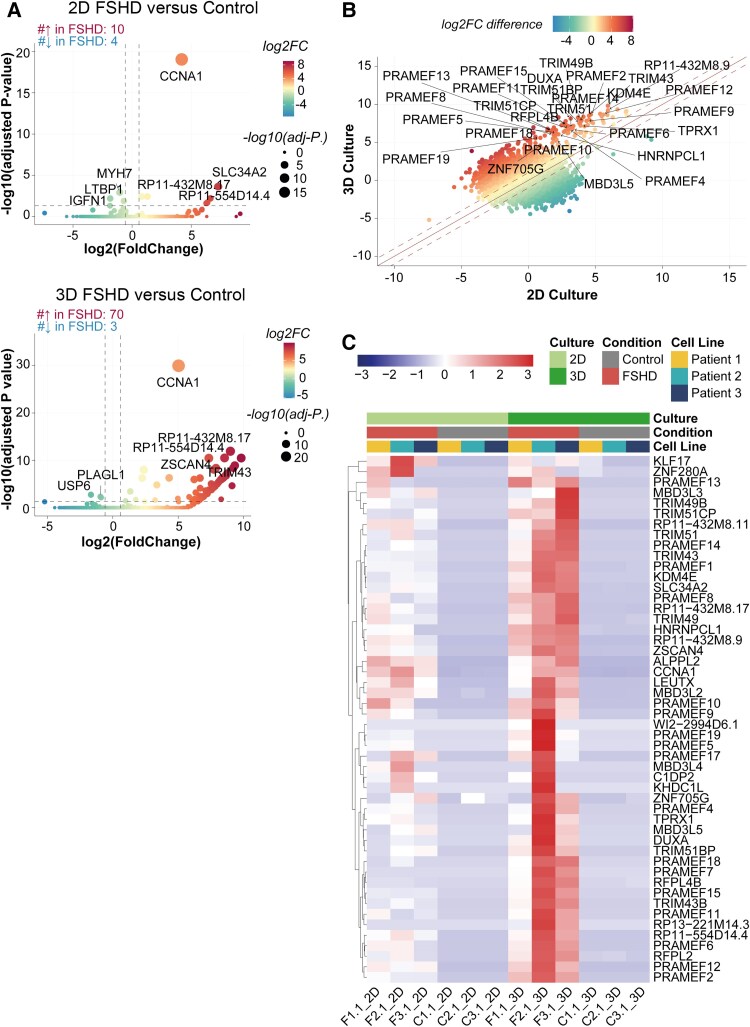
Facioscapulohumeral muscular dystrophy (FSHD) is caused by sporadic misexpression of the transcription factor double homeobox 4 (DUX4) in skeletal muscles. So far, monolayer cultures and animal models have been used to study the disease mechanism of FSHD and for development of FSHD therapy, but these models do not fully recapitulate the disease and there is a lack of knowledge on how DUX4 misexpression leads to skeletal muscle dysfunction. To overcome these barriers, we have developed a 3D tissue engineered skeletal muscle (3D-TESM) model by generating genetically matched myogenic progenitors from human induced pluripotent stem cells of three mosaic FSHD patients. 3D-TESMs derived from genetically affected myogenic progenitors recapitulated pathological features including DUX4 and DUX4 target gene expression, smaller myofibre diameters and reduced absolute forces upon electrical stimulation. RNA-sequencing data illustrated increased expression of DUX4 target genes in 3D-TESMs compared with 2D myotubes, and cellular differentiation was improved by 3D culture conditions. Treatment of 3D-TESMs with three different small molecules identified in drug development screens in 2D muscle cultures showed no improvements, and sometimes even declines, in contractile force and sarcomere organization. These results suggest that these compounds either have a detrimental effect on the formation of 3D-TESMs, an effect that might have been overlooked or was challenging to detect in 2D cultures and in vivo models, and/or that further development of the 3D-TESM model is needed. In conclusion, we have developed a 3D skeletal muscle model for FSHD that can be used for preclinical research focusing on DUX4 expression and downstream pathways of FSHD in relationship to contractile properties. In the future, we expect that this model can also be used for preclinical drug screening.
面肩肱型肌营养不良症(FSHD)是由转录因子双同源盒4(DUX4)在骨骼肌中散发性错误表达引起的。到目前为止,单层培养和动物模型已被用于研究FSHD的疾病机制以及开发FSHD治疗方法,但这些模型并不能完全重现该疾病,并且对于DUX4错误表达如何导致骨骼肌功能障碍缺乏了解。为了克服这些障碍,我们通过从三名嵌合型FSHD患者的人诱导多能干细胞中生成基因匹配的成肌祖细胞,开发了一种3D组织工程化骨骼肌(3D-TESM)模型。源自基因受影响的成肌祖细胞的3D-TESM重现了病理特征,包括DUX4和DUX4靶基因表达、较小的肌纤维直径以及电刺激时绝对力的降低。RNA测序数据表明,与2D肌管相比,3D-TESM中DUX4靶基因的表达增加,并且3D培养条件改善了细胞分化。用在2D肌肉培养的药物开发筛选中鉴定出的三种不同小分子处理3D-TESM,结果显示收缩力和肌节组织没有改善,甚至有时下降。这些结果表明,这些化合物要么对3D-TESM的形成有有害影响,这种影响在2D培养和体内模型中可能被忽视或难以检测到,和/或需要进一步开发3D-TESM模型。总之,我们开发了一种用于FSHD的3D骨骼肌模型,可用于专注于DUX4表达以及FSHD与收缩特性相关的下游途径的临床前研究。未来,我们预计该模型还可用于临床前药物筛选。