Xue Cindy, Yuan Jing, Lo Gladys G, Poon Darren M C, Chu Winnie Cw
Research Department, Hong Kong Sanatorium and Hospital, Hong Kong, China.
Department of Imaging and Interventional Radiology, The Chinese University of Hong Kong, Hong Kong, China.
Vis Comput Ind Biomed Art. 2024 Nov 19;7(1):28. doi: 10.1186/s42492-024-00180-9.
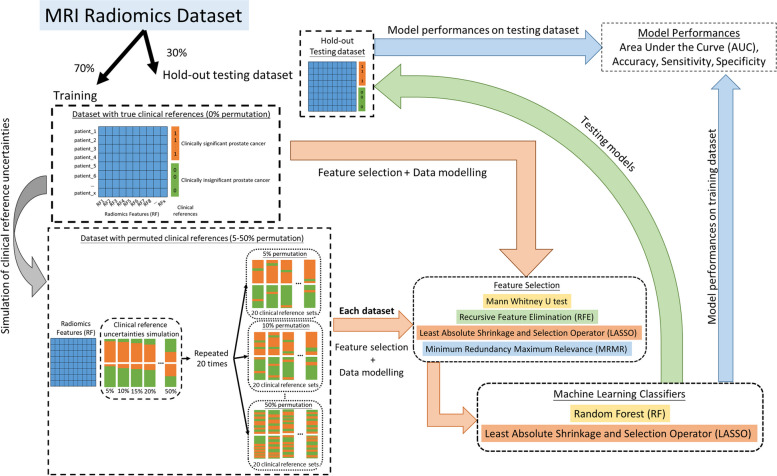
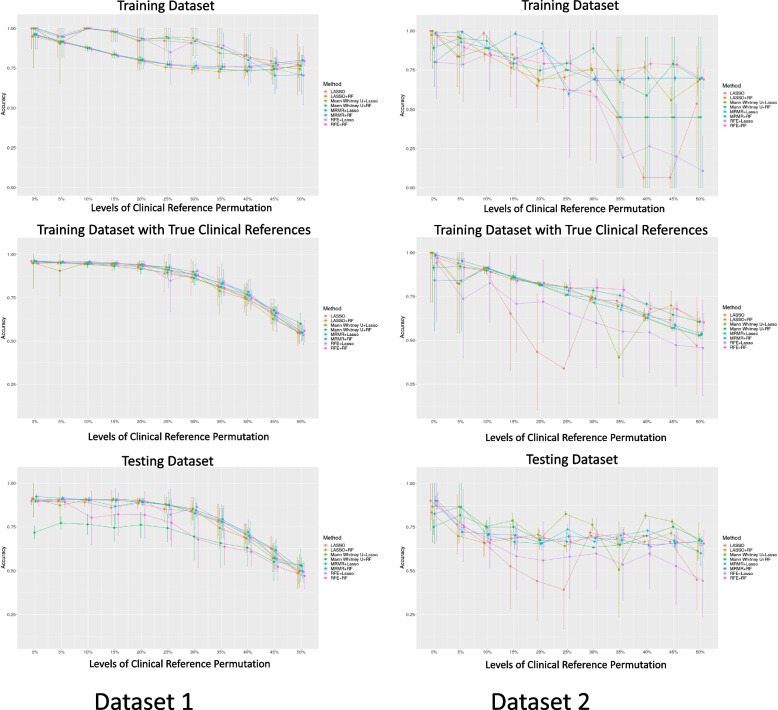
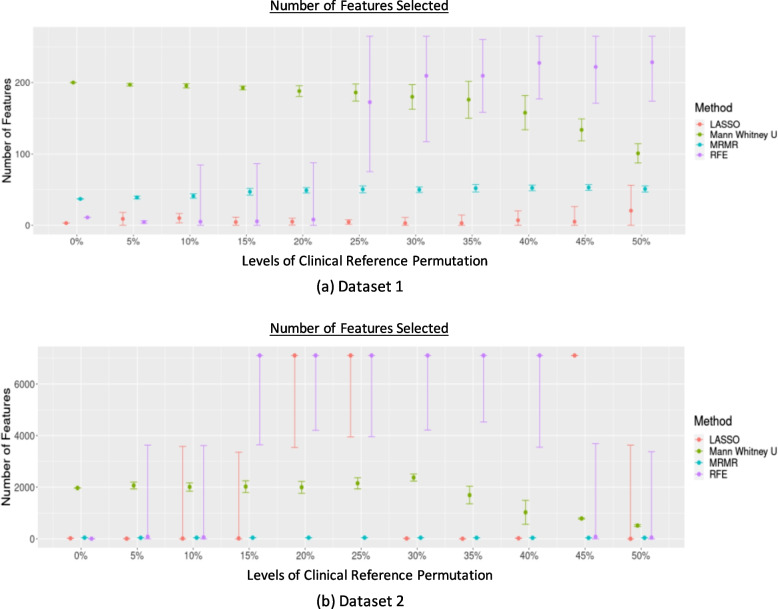
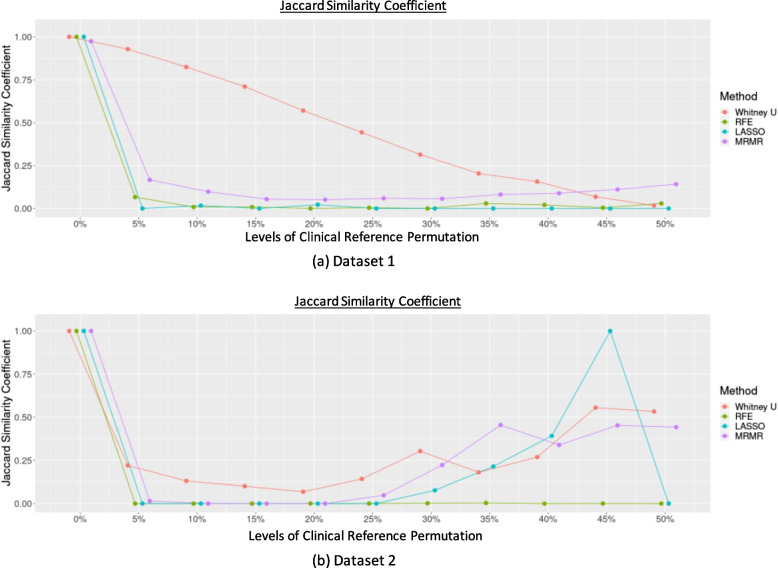
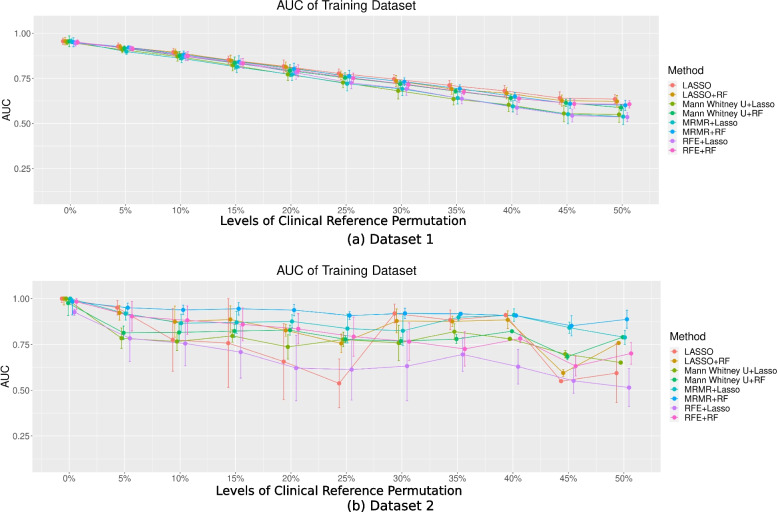
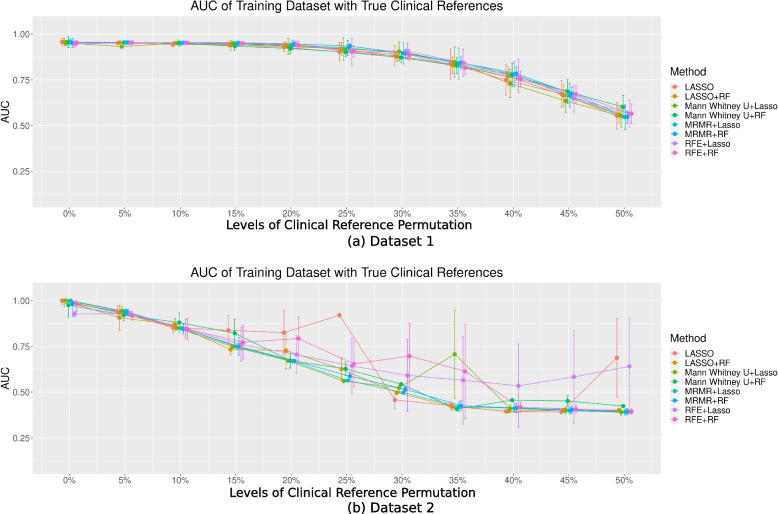
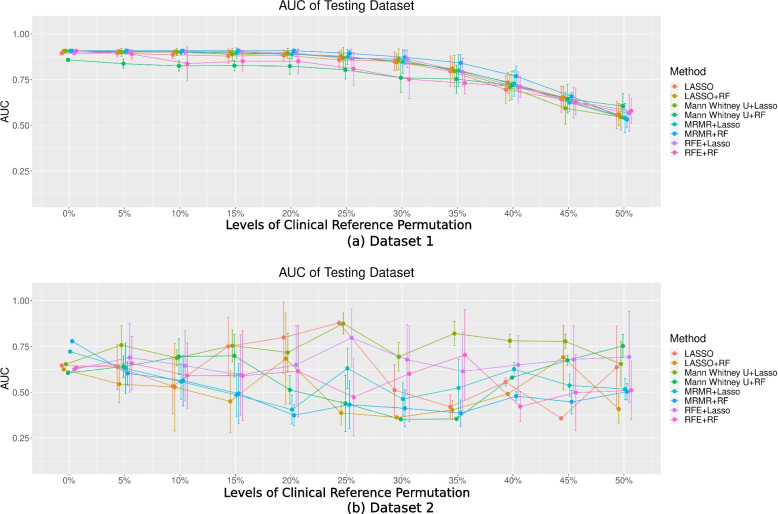
To conduct a computational investigation to explore the influence of clinical reference uncertainty on magnetic resonance imaging (MRI) radiomics feature selection, modelling, and performance. This study used two sets of publicly available prostate cancer MRI = radiomics data (Dataset 1: n = 260; Dataset 2: n = 100) with Gleason score clinical references. Each dataset was divided into training and holdout testing datasets at a ratio of 7:3 and analysed independently. The clinical references of the training set were permuted at different levels (increments of 5%) and repeated 20 times. Four feature selection algorithms and two classifiers were used to construct the models. Cross-validation was employed for training, while a separate hold-out testing set was used for evaluation. The Jaccard similarity coefficient was used to evaluate feature selection, while the area under the curve (AUC) and accuracy were used to assess model performance. An analysis of variance test with Bonferroni correction was conducted to compare the metrics of each model. The consistency of the feature selection performance decreased substantially with the clinical reference permutation. AUCs of the trained models with permutation particularly after 20% were significantly lower (Dataset 1 (with ≥ 20% permutation): 0.67, and Dataset 2 (≥ 20% permutation): 0.74), compared to the AUC of models without permutation (Dataset 1: 0.94, Dataset 2: 0.97). The performances of the models were also associated with larger uncertainties and an increasing number of permuted clinical references. Clinical reference uncertainty can substantially influence MRI radiomic feature selection and modelling. The high accuracy of clinical references should be helpful in building reliable and robust radiomic models. Careful interpretation of the model performance is necessary, particularly for high-dimensional data.
开展一项计算研究,以探讨临床参考不确定性对磁共振成像(MRI)放射组学特征选择、建模及性能的影响。本研究使用了两组公开可用的前列腺癌MRI放射组学数据(数据集1:n = 260;数据集2:n = 100),带有 Gleason评分临床参考。每个数据集以7:3的比例分为训练集和保留测试集,并独立进行分析。训练集的临床参考在不同水平(5%的增量)进行排列,并重复20次。使用四种特征选择算法和两种分类器构建模型。采用交叉验证进行训练,同时使用单独的保留测试集进行评估。使用Jaccard相似系数评估特征选择,而使用曲线下面积(AUC)和准确率评估模型性能。进行了带有Bonferroni校正的方差分析测试,以比较每个模型的指标。随着临床参考排列,特征选择性能的一致性大幅下降。与未排列模型的AUC(数据集1:0.94,数据集2:0.97)相比,排列后的训练模型的AUCs,特别是在20%之后显著更低(数据集1(排列≥20%):0.67,数据集2(≥20%排列):0.74)。模型的性能还与更大的不确定性和排列后的临床参考数量增加相关。临床参考不确定性可显著影响MRI放射组学特征选择和建模。临床参考的高精度应有助于构建可靠且稳健的放射组学模型。尤其对于高维数据,有必要仔细解读模型性能。