Tsai Hui-Jen, Yeh Kun-Huei, Lin Chung-Wu, Wu Ming-Shiang, Liou Jyh-Ming, Hsu Ping-Ning, Zeng Yi-Shin, Wei Ming-Feng, Shun Chia-Tung, Wang Hsiu-Po, Chen Li-Tzong, Cheng Ann-Lii, Kuo Sung-Hsin
National Institute of Cancer Research, National Health Research Institutes, Tainan, Taiwan.
Department of Internal Medicine, Kaohsiung Medical University Hospital, Kaohsiung Medical University, Kaohsiung, Taiwan.
Cancer Cell Int. 2024 Nov 18;24(1):383. doi: 10.1186/s12935-024-03552-6.
This study aimed to explore whether cytotoxin-associated gene A (CagA) can inhibit cell cycle progression by activating nuclear factor of activated T cells (NFAT) in lymphoma B cells and contribute to Helicobacter pylori eradication (HPE) responsiveness (complete remission [CR] after HPE) in gastric mucosa-associated lymphoid tissue (MALT) lymphoma.
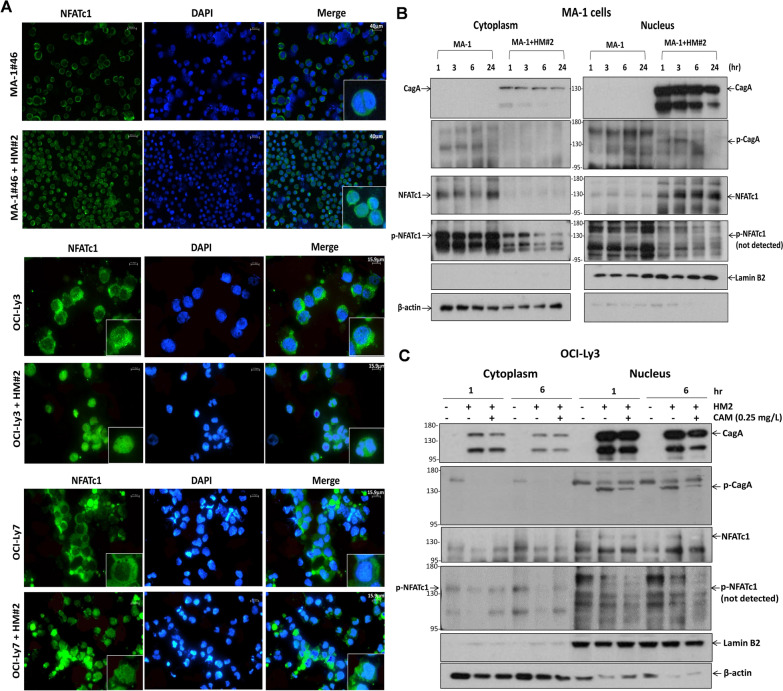
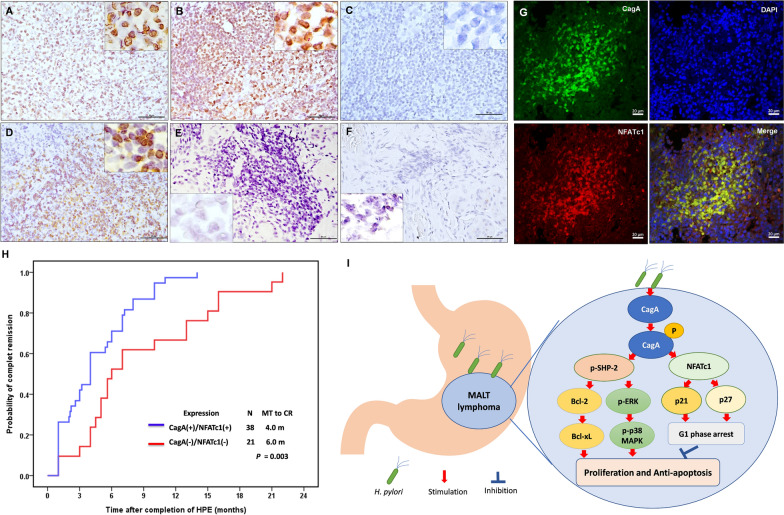
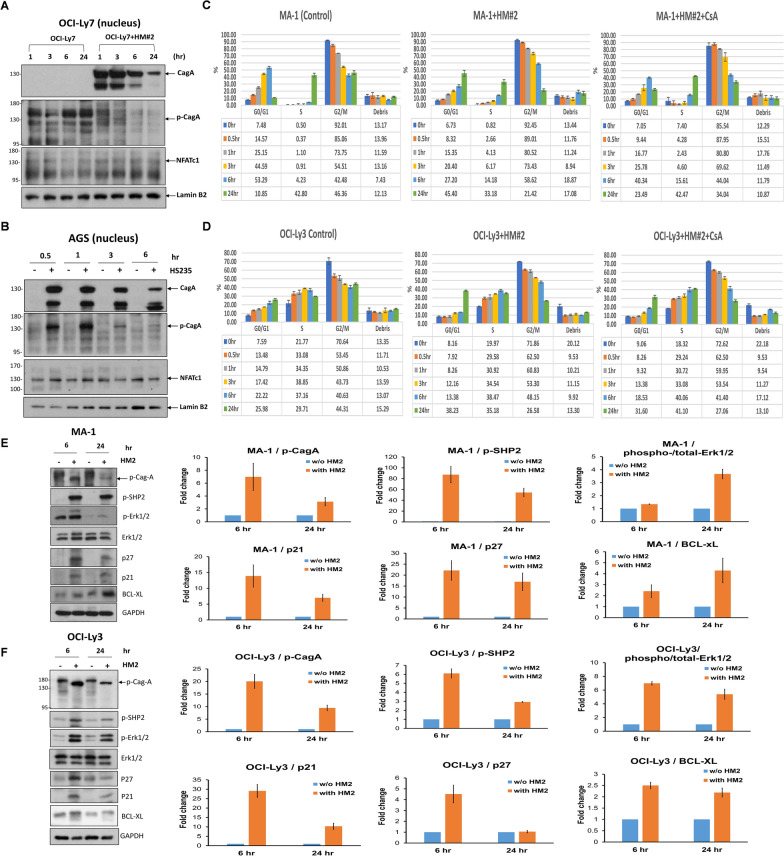
We co-cultured three B-lymphoma cell lines (MA-1, OCI-Ly3, and OCI-Ly7) with HP strains (derived from HPE-responsive gastric MALT lymphoma) and evaluated the expression patterns of CagA, phosphorylated (p)-CagA (CagA), and CagA-signaling molecules, cell-cycle inhibitors, p-NFATc1 (Ser), and NFATc1 using western blotting. Furthermore, we evaluated the association between nuclear NFATc1 expression in the tumor cells of 91 patients who received first-line HPE (59 patients with HPE responsiveness and 32 without HPE responsiveness) and HPE responsiveness and CagA expression in tumor cells.
In HP strains co-cultured with B cell lymphoma cell lines, CagA was translocated to the nucleus through tyrosine phosphorylation (CagA) and simultaneously dephosphorylated NFATc1, subsequently causing nuclear NFATc1 translocation and stimulating the expression of p-SHP-2/p-ERK/Bcl-xL. Activated NFATc1 causes G1 cell cycle retardation in both MA-1 and OCI-Ly3 cells by triggering p21 and p27 production. Nuclear NFATc1 localization was significantly associated with the presence of CagA in gastric MALT lymphomas (80% [41/51] vs. 33% [13/40]; p < 0.001) and with HPE responsiveness (73% [43/59] vs. 25% [8/32]; p < 0.001). Patients exhibiting both the presence of CagA and nuclear NFATc1 localization responded more rapidly to HPE than those without (median interval to CR, 4.00 vs. 6.00 months, p = 0.003).
Our findings indicated that CagA and NFATc1 cooperatively participate in the lymphomagenesis of HPE-responsive gastric MALT lymphoma.
本研究旨在探讨细胞毒素相关基因A(CagA)是否可通过激活淋巴瘤B细胞中活化T细胞核因子(NFAT)来抑制细胞周期进程,并有助于胃黏膜相关淋巴组织(MALT)淋巴瘤对幽门螺杆菌根除(HPE)的反应性(HPE后完全缓解[CR])。
我们将三种B淋巴瘤细胞系(MA-1、OCI-Ly3和OCI-Ly7)与幽门螺杆菌菌株(源自对HPE有反应的胃MALT淋巴瘤)共培养,并使用蛋白质免疫印迹法评估CagA、磷酸化(p)-CagA(CagA)、CagA信号分子、细胞周期抑制剂、p-NFATc1(Ser)和NFATc1的表达模式。此外,我们评估了91例接受一线HPE治疗的患者(59例对HPE有反应,32例无反应)肿瘤细胞中核NFATc1表达与HPE反应性以及肿瘤细胞中CagA表达之间的关联。
在与B细胞淋巴瘤细胞系共培养的幽门螺杆菌菌株中,CagA通过酪氨酸磷酸化(CagA)易位至细胞核,同时使NFATc1去磷酸化,随后导致核NFATc1易位并刺激p-SHP-2/p-ERK/Bcl-xL的表达。活化的NFATc1通过触发p21和p27的产生,导致MA-1和OCI-Ly3细胞中G1期细胞周期阻滞。胃MALT淋巴瘤中核NFATc1定位与CagA的存在显著相关(80%[41/51]对33%[13/40];p<0.001),与HPE反应性也显著相关(73%[43/59]对25%[8/32];p<0.001)。同时存在CagA和核NFATc1定位的患者对HPE的反应比无此情况的患者更快(至CR的中位间隔时间,4.00对6.00个月,p=0.003)。
我们的研究结果表明,CagA和NFATc1协同参与对HPE有反应的胃MALT淋巴瘤的淋巴瘤发生过程。