School of Psychology and Social Sciences, Department of Psychology, International Medical University, 126, Jalan Jalil Perkasa 19, Bukit Jalil, Kuala Lumpur, 57000, Malaysia.
Centre for Research in Psychology and Human Well-Being, Faculty of Social Sciences and Humanities, Universiti Kebangsaan Malaysia, Bangi, 43600 UKM, Malaysia.
BMC Psychol. 2024 Nov 18;12(1):673. doi: 10.1186/s40359-024-02129-2.
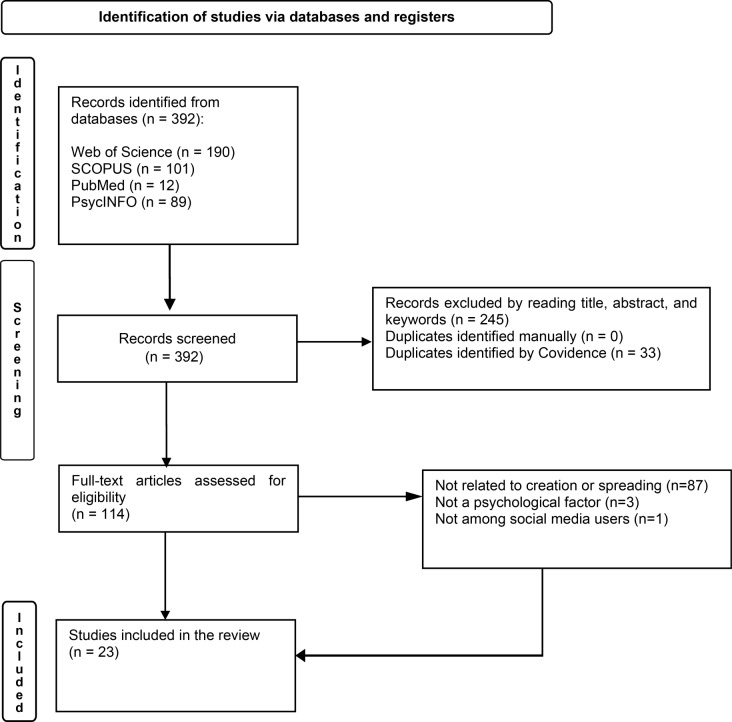
The proliferation of fake news on social media platforms has become a significant concern, influencing public opinion, political decisions, and societal trust. While much research has focused on the technological and algorithmic factors behind the spread of misinformation, less attention has been given to the psychological drivers that contribute to the creation and dissemination of fake news. Cognitive biases, emotional appeals, and social identity motivations are believed to play a crucial role in shaping user behaviour on social media, yet there is limited systematic understanding of how these psychological factors intersect with online information sharing. Existing studies tend to focus on individual aspects of fake news consumption, such as susceptibility to misinformation or partisan biases, leaving a gap in understanding the broader psychological mechanisms behind both the creation and dissemination of fake news. This systematic review aims to fill this gap by synthesizing current research on the psychological factors that influence social media users' involvement in dissemination and creation of fake news. Twenty-three studies were identified from 2014 to 2024 following the PRISMA guidelines. We have identified five themes through critical review and synthesis of the literature which are personal factors, ignorance, social factors, biological process, and cognitive process. These themes help to explain the psychological factors contributing to the creation and dissemination of fake news among social media users. Based on the findings, it is evident that diverse psychological factors influence the dissemination and creation of fake news, which must be studied to design better strategies to minimize this issue.
社交媒体平台上假新闻的泛滥已成为一个重大问题,影响了公众舆论、政治决策和社会信任。尽管许多研究都集中在错误信息传播背后的技术和算法因素上,但对于导致假新闻产生和传播的心理驱动因素的关注较少。认知偏见、情感诉求和社会认同动机被认为在塑造社交媒体用户行为方面起着至关重要的作用,但对于这些心理因素如何与在线信息共享相互作用,我们的理解还很有限。现有研究往往侧重于假新闻消费的个别方面,例如对错误信息的易感性或党派偏见,从而在理解假新闻的产生和传播背后的更广泛心理机制方面存在差距。本系统评价旨在通过综合当前关于影响社交媒体用户参与假新闻传播和创作的心理因素的研究来填补这一空白。根据 PRISMA 指南,从 2014 年到 2024 年共确定了 23 项研究。我们通过对文献的批判性回顾和综合,确定了五个主题,即个人因素、无知、社会因素、生物过程和认知过程。这些主题有助于解释导致社交媒体用户产生和传播假新闻的心理因素。根据研究结果,很明显,各种心理因素都会影响假新闻的传播和创作,必须对此进行研究,以设计更好的策略来最小化这个问题。