
长期暴露于空气污染与各种心律失常的发病风险:一项前瞻性队列研究。
Long-term exposure to air pollution and incidence risk of various arrhythmias: A prospective cohort study.
作者信息
Zhou Lu, Zhang Qingli, Luo Huihuan, Yu Kexin, Meng Xia, Chen Renjie, Kan Haidong
机构信息
Shanghai Institute of Infectious Disease and Biosecurity, Key Lab of Public Health Safety of the Ministry of Education, NHC Key Lab of Health Technology Assessment, School of Public Health, Fudan University, Shanghai 200032, China.
Children's Hospital of Fudan University, National Center for Children's Health, Shanghai 201102, China.
出版信息
Eco Environ Health. 2024 Jun 11;3(4):445-451. doi: 10.1016/j.eehl.2024.05.006. eCollection 2024 Dec.
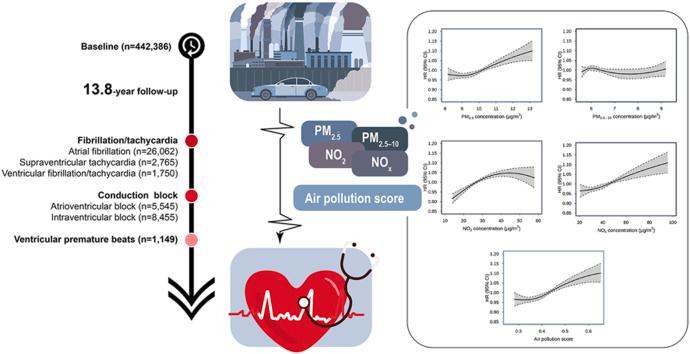
To investigate the association of long-term exposure to air pollution with incident arrhythmia from various causes, this prospective cohort study included 442,386 participants from the UK Biobank cohort. Residential annual average exposures at baseline were evaluated, including fine particles (PM), coarse particles (PM), nitrogen dioxide (NO), and nitrogen oxides (NO). We further constructed a composite air pollution score (APS) to evaluate the concomitant exposure to these four pollutants. The associations of air pollutants with various arrhythmia subtypes were assessed utilizing the Cox proportional hazards model, and the hazard ratios (HRs) for incident arrhythmias were estimated. A total of 41,021 patients with incident arrhythmia were recorded. The HRs of overall arrhythmia associated with a 10 μg/m increment in PM, PM, NO, and NO were 1.26, 0.95, 1.03, and 1.02, respectively. The HR was 1.08 in the highest quintile of the APS compared to the lowest one. For cause-specific arrhythmias, the HRs per unit increment in APS were 1.45, 1.67, 1.51, 1.80, 2.63, and 4.66 for atrial fibrillation, atrioventricular block, ventricular fibrillation/tachycardia, intraventricular block, supraventricular tachycardia, and ventricular premature beats, respectively. Females, older individuals, overweight or obese individuals, and those with low education attainment, low income, or cardiometabolic morbidities had higher HRs associated with pollutants. Long-term exposure to air pollution is linked to increased incidence risks of atrial and ventricular arrhythmias. More focus should be shifted to the impact of air pollution on other arrhythmias besides atrial fibrillation.
为了研究长期暴露于空气污染与各种原因导致的心律失常之间的关联,这项前瞻性队列研究纳入了英国生物银行队列中的442,386名参与者。评估了基线时的住宅年平均暴露情况,包括细颗粒物(PM)、粗颗粒物(PM)、二氧化氮(NO₂)和氮氧化物(NOₓ)。我们进一步构建了一个综合空气污染评分(APS)来评估对这四种污染物的同时暴露情况。利用Cox比例风险模型评估空气污染物与各种心律失常亚型之间的关联,并估计心律失常事件的风险比(HRs)。共记录了41,021例心律失常事件患者。PM₂、PM₁₀、NO₂和NOₓ每增加10 μg/m³,总体心律失常的HRs分别为1.26、0.95、1.03和1.02。与最低五分位数相比,APS最高五分位数的HR为1.08。对于特定病因的心律失常,APS每增加一个单位,心房颤动、房室传导阻滞、心室颤动/心动过速、室内传导阻滞、室上性心动过速和室性早搏的HRs分别为1.45、1.67、1.51、1.80、2.63和4.66。女性、老年人、超重或肥胖个体以及教育程度低、收入低或患有心脏代谢疾病的个体与污染物相关的HRs更高。长期暴露于空气污染与心房和心室心律失常的发病风险增加有关。除心房颤动外,应更多关注空气污染对其他心律失常的影响。



 Zotero 插件