Tri-Institutional Center for Translational Research in Neuroimaging and Data Science (TReNDS), Georgia State University, Georgia Institute of Technology, and Emory University, Atlanta, Georgia, USA.
School of Electrical and Computer Engineering, Georgia Institute of Technology, Atlanta, Georgia, USA.
Hum Brain Mapp. 2024 Dec 1;45(17):e70037. doi: 10.1002/hbm.70037.
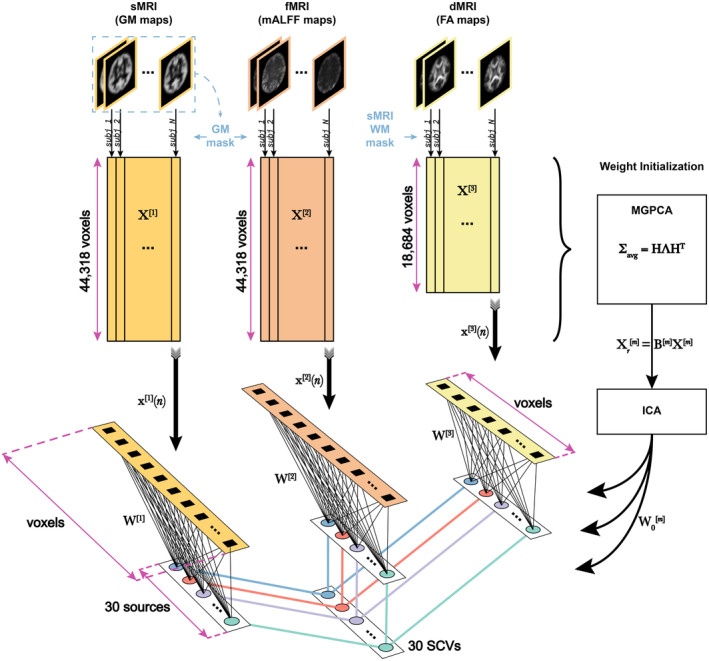
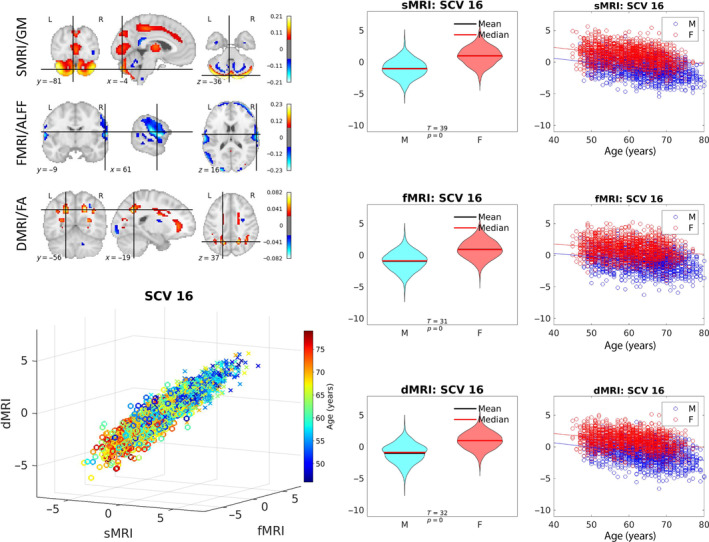
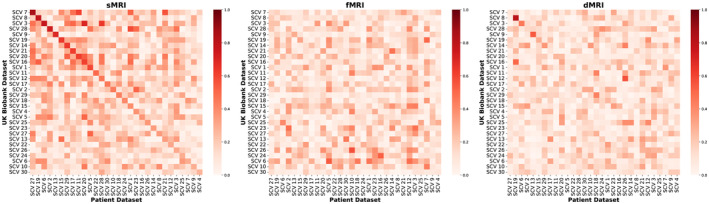
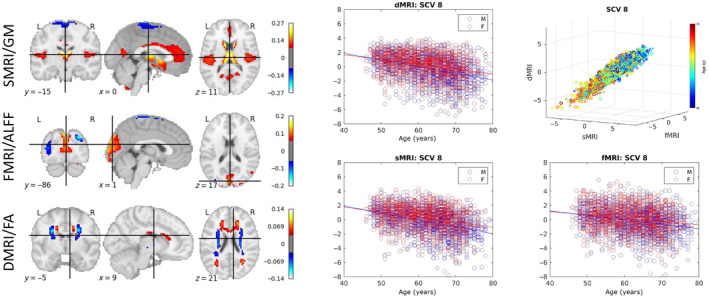
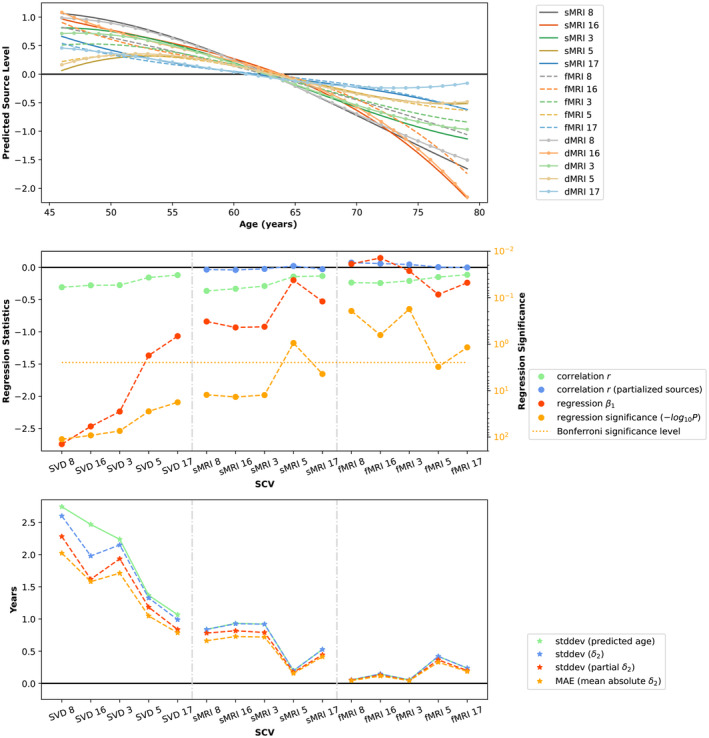
With the increasing availability of large-scale multimodal neuroimaging datasets, it is necessary to develop data fusion methods which can extract cross-modal features. A general framework, multidataset independent subspace analysis (MISA), has been developed to encompass multiple blind source separation approaches and identify linked cross-modal sources in multiple datasets. In this work, we utilized the multimodal independent vector analysis (MMIVA) model in MISA to directly identify meaningful linked features across three neuroimaging modalities-structural magnetic resonance imaging (MRI), resting state functional MRI and diffusion MRI-in two large independent datasets, one comprising of control subjects and the other including patients with schizophrenia. Results show several linked subject profiles (sources) that capture age-associated decline, schizophrenia-related biomarkers, sex effects, and cognitive performance. For sources associated with age, both shared and modality-specific brain-age deltas were evaluated for association with non-imaging variables. In addition, each set of linked sources reveals a corresponding set of cross-modal spatial patterns that can be studied jointly. We demonstrate that the MMIVA fusion model can identify linked sources across multiple modalities, and that at least one set of linked, age-related sources replicates across two independent and separately analyzed datasets. The same set also presented age-adjusted group differences, with schizophrenia patients indicating lower multimodal source levels. Linked sets associated with sex and cognition are also reported for the UK Biobank dataset.
随着大规模多模态神经影像学数据集的日益普及,有必要开发能够提取跨模态特征的数据融合方法。已经开发了一种通用框架,即多数据集独立子空间分析(MISA),它可以包含多种盲源分离方法,并在多个数据集识别相关的跨模态源。在这项工作中,我们利用 MISA 中的多模态独立向量分析(MMIVA)模型直接识别三个神经影像学模态(结构磁共振成像(MRI)、静息态功能 MRI 和弥散 MRI)在两个大型独立数据集之间的有意义的相关特征,一个数据集包括对照组,另一个数据集包括精神分裂症患者。结果显示了几个相关的个体特征(源),这些特征可以捕捉到与年龄相关的下降、与精神分裂症相关的生物标志物、性别效应和认知表现。对于与年龄相关的源,评估了共享和模态特定的脑龄差值与非成像变量的相关性。此外,每组相关的源都揭示了一组相应的跨模态空间模式,可以联合研究。我们证明了 MMIVA 融合模型可以识别多个模态之间的相关源,并且至少有一组与年龄相关的相关源可以在两个独立的、分别分析的数据集之间复制。同一组还显示出年龄调整后的组间差异,精神分裂症患者的多模态源水平较低。还报告了与 UK Biobank 数据集相关的性别和认知相关的相关集。