Department of Biomedical Engineering, Cleveland Clinic Foundation, Cleveland, OH, USA.
Department of Neurosurgery, Cleveland Clinic, Cleveland, OH, USA.
Sci Rep. 2024 Nov 19;14(1):28673. doi: 10.1038/s41598-024-80249-w.
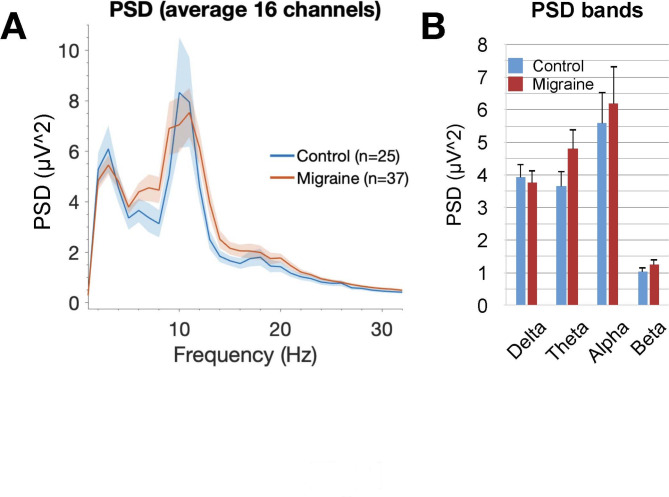
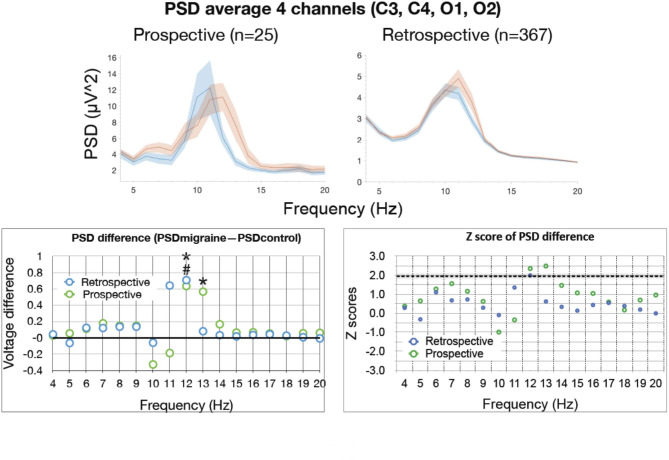
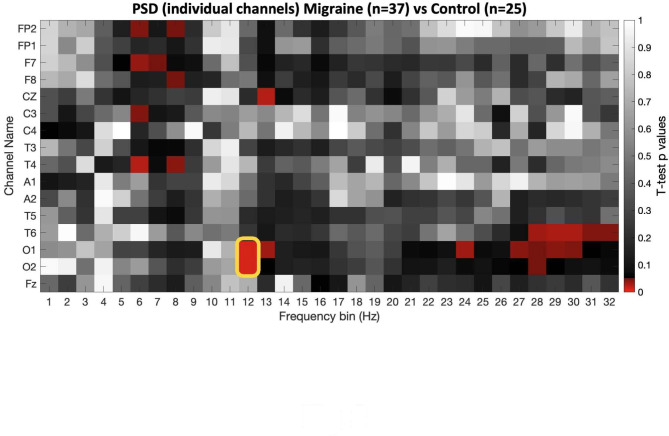
Migraine is one of the most common neurological disorders in the US. Currently, the diagnosis and management of migraine are based primarily on subjective self-reported measures, which compromises the reliability of clinical diagnosis and the ability to robustly discern candidacy for available therapies and track treatment response. In this study, we used a computational pipeline for the automated, rapid, high-throughput, and objective analysis of encephalography (EEG) data at Cleveland Clinic to identify signatures that correlate with migraine. We performed two independent analyses, a prospective analysis (n = 62 subjects) and a retrospective age-matched analysis on a larger cohort (n = 734) obtained from the sleep registry at Cleveland Clinic. In the prospective analysis, no significant difference between migraine and control groups was detected in the mean power spectral density (PSD) of an all-electrodes montage in the frequency range of 1-32 Hz, whereas a significant PSD increase in single occipital electrodes was found at 12 Hz in migraine patients. We then trained machine learning models on the binary classification of migraine versus control using EEG power features, resulting in high accuracies (82-83%) with occipital electrodes' power at 12 Hz ranking highest in the contribution to the model's performance. Further retrospective analysis also showed a consistent increase in power from occipital electrodes at 12 and 13 Hz in migraine patients. These results demonstrate distinct and localized changes in brain activity measured by EEG that can potentially serve as biomarkers in the diagnosis and personalized therapy for individuals with migraine.
偏头痛是美国最常见的神经紊乱疾病之一。目前,偏头痛的诊断和管理主要基于主观的自我报告测量,这降低了临床诊断的可靠性,也难以准确识别可用疗法的候选者和跟踪治疗反应。在这项研究中,我们使用克利夫兰诊所的脑电图(EEG)数据的自动、快速、高通量和客观分析计算管道,来识别与偏头痛相关的特征。我们进行了两项独立分析,一项是前瞻性分析(n=62 名受试者),另一项是在克利夫兰诊所睡眠登记处获得的更大队列(n=734)的回顾性年龄匹配分析。在前瞻性分析中,在 1-32 Hz 的频率范围内,所有电极导联的平均功率谱密度(PSD)在偏头痛组和对照组之间没有显著差异,而在偏头痛患者的 12 Hz 处发现单个枕叶电极的 PSD 显著增加。然后,我们使用 EEG 功率特征对偏头痛与对照组的二进制分类进行了机器学习模型训练,结果表明,基于枕叶电极在 12 Hz 处的功率的分类准确率高达 82-83%,该功率对模型性能的贡献最高。进一步的回顾性分析也显示,偏头痛患者的枕叶电极在 12 和 13 Hz 处的功率持续增加。这些结果表明,EEG 测量的大脑活动存在明显的、局部的变化,这些变化可能成为偏头痛患者诊断和个性化治疗的生物标志物。