Division of Cardiology, Chung-Ang University Gwangmyeong Medical Center, Chung-Ang University College of Medicine, Gwangmyeong, South Korea.
Division of Cardiology, Healthcare System Gangnam Center, Seoul National University Hospital, Seoul, South Korea.
Cardiovasc Diabetol. 2024 Nov 19;23(1):418. doi: 10.1186/s12933-024-02508-4.
Both insulin resistance and hyperglycemia are important risk factors for atherosclerosis. While the characteristics of atherosclerosis are obviously different according to established diabetes, little has been known regarding the risk of coronary artery calcification (CAC) progression related to the biomarkers of atherogenic index of plasma (AIP), triglyceride glucose (TyG) index, and hemoglobin A1C (HbA1C) in conditions with and without diabetes.
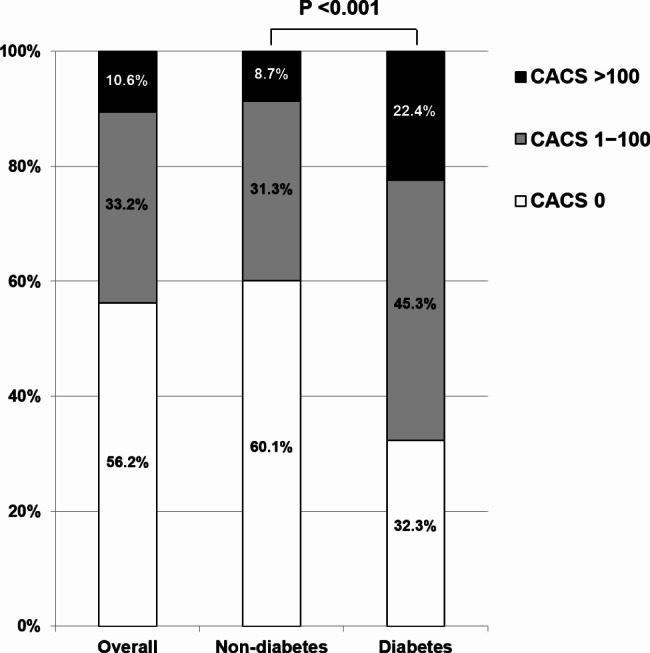
We analyzed 12,326 asymptomatic Korean adults (mean age 51.7 ± 8.5 years; 84.2% males; 15.8% with diabetes) over a median follow-up period of 3.0 years. AIP was defined as the base-10 logarithm of the ratio of triglyceride concentration (mmol/L) to high-density lipoprotein cholesterol (mmol/L). The TyG index was calculated as ln (fasting triglycerides [mg/dL] × fasting glucose [mg/ dL]/2). CAC progression was defined using the SQRT method, as a difference of ≥ 2.5 between the square roots (√) of baseline and follow-up coronary artery calcium scores (CACS) (Δ√transformed CACS). Logistic regression models adjusted for interscan periods were used to estimate the odds ratio (OR).
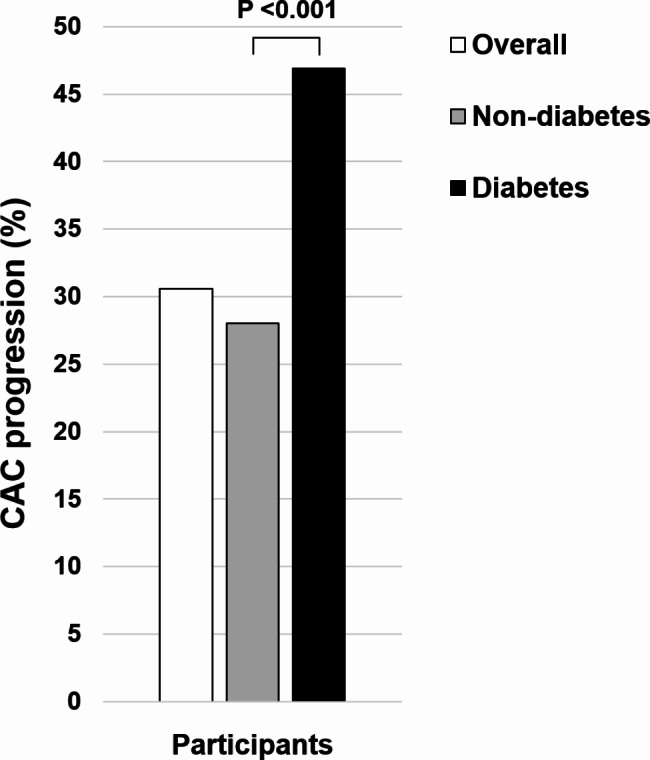
The levels of AIP, TyG index, and HbA1C were significantly higher in diabetics than in non-diabetics. CAC progression was more frequently observed in diabetics (46.9%) than in non-diabetics (28.0%). After adjusting for age, sex, hypertension, hyperlipidemia, obesity, current smoking status, serum creatinine levels, baseline CACS, and interscan period, AIP (per-0.1 unit increase) was associated with CAC progression in only non-diabetics (OR: 1.04, 95% confidence interval [CI]: 1.02 - 1.06; P < 0.001). In contrast, HbA1C level (per-1% increase) was significantly associated with CAC progression in only diabetics (OR: 1.19, 95% CI: 1.08 - 1.32; P = 0.001). The TyG index (per-1 unit increase) was associated with CAC progression in both non-diabetics (OR: 1.32, 95% CI: 1.19 - 1.46; P < 0.001) and diabetics (OR: 1.33, 95% CI: 1.10 - 1.60; P = 0.003).
The associations between AIP, TyG index, and HbA1C levels with CAC progression vary according to established diabetes. Of these biomarkers, TyG index is independently associated with CAC progression irrespective of established diabetes.
胰岛素抵抗和高血糖都是动脉粥样硬化的重要危险因素。虽然根据已确诊的糖尿病,动脉粥样硬化的特征明显不同,但对于与血浆致动脉粥样硬化指数(AIP)、三酰甘油葡萄糖(TyG)指数和糖化血红蛋白(HbA1C)生物标志物相关的冠状动脉钙化(CAC)进展风险知之甚少,这些生物标志物在有和没有糖尿病的情况下。
我们分析了 12326 名无症状韩国成年人(平均年龄 51.7±8.5 岁;84.2%为男性;15.8%患有糖尿病),中位随访时间为 3.0 年。AIP 定义为三酰甘油浓度(mmol/L)与高密度脂蛋白胆固醇(mmol/L)比值的 base-10 对数。TyG 指数的计算方法为空腹三酰甘油 [mg/dL]×空腹血糖 [mg/dL]/2] 的对数。CAC 进展采用 SQRT 法定义,基线和随访冠状动脉钙评分(CACS)的平方根(√)之间的差异≥2.5(Δ√转换的 CACS)。使用调整扫描间隔的逻辑回归模型来估计比值比(OR)。
AIP、TyG 指数和 HbA1C 在糖尿病患者中明显高于非糖尿病患者。糖尿病患者(46.9%)比非糖尿病患者(28.0%)更常发生 CAC 进展。在校正年龄、性别、高血压、高血脂、肥胖、当前吸烟状态、血清肌酐水平、基线 CACS 和扫描间隔后,AIP(每增加 0.1 单位)仅与非糖尿病患者的 CAC 进展相关(OR:1.04,95%置信区间 [CI]:1.02-1.06;P<0.001)。相比之下,HbA1C 水平(每增加 1%)仅与糖尿病患者的 CAC 进展显著相关(OR:1.19,95%CI:1.08-1.32;P=0.001)。TyG 指数(每增加 1 单位)与非糖尿病患者(OR:1.32,95%CI:1.19-1.46;P<0.001)和糖尿病患者(OR:1.33,95%CI:1.10-1.60;P=0.003)的 CAC 进展均相关。
AIP、TyG 指数和 HbA1C 水平与 CAC 进展的相关性因已确诊的糖尿病而不同。在这些生物标志物中,TyG 指数与 CAC 进展独立相关,与已确诊的糖尿病无关。