Cardiology, Chung-Ang University Gwangmyeong Hospital, Chung-Ang University College of Medicine, Gwangmyeong, Republic of Korea.
Cardiology, Seoul National University Hospital, Seoul, Republic of Korea.
BMJ Open. 2024 Nov 21;14(11):e086075. doi: 10.1136/bmjopen-2024-086075.
This study evaluated the association between serum albumin levels and coronary artery calcification (CAC) progression in asymptomatic adults without hypoalbuminaemia at baseline.
Observational cohort study.
Data from the Korea Initiatives on Coronary Artery Calcification (KOICA) which is a retrospective, single ethnicity, multicentre and observational registry were analysed.
A total of 12 344 Korean adults with baseline albumin level of ≥3.5 g/dL (51.7±8.5 years; 84.3% male) were included. The median interscan period was 3.0 (2.0-4.8) years. All participants were stratified into three groups based on serum albumin tertile.
Association of serum albumin with the risk of CAC progression was analysed using multivariate logistic regression models with adjustment of interscan period. CAC progression was defined as a square root (√) transformed difference between the baseline and follow-up coronary artery calcium score (CACS) (Δ√transformed CACS) of ≥2.5. Annualised Δ√transformed CACS was defined as Δ√transformed CACS divided by interscan period.
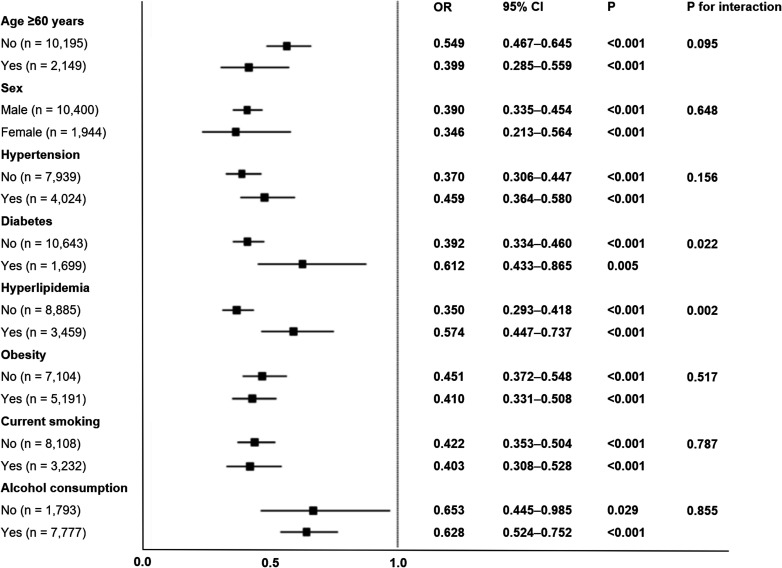
With increasing serum albumin tertiles, the annualised Δ√transformed CACS (I (lowest): 0.16 (0-1.24) vs II: 0 (0-1.09) vs III (highest): 0 (0-1.01)) and the incidence of CAC progression (I: 36.6% vs II: 31.3% vs III: 25.0%) were decreased despite higher prevalence of hypertension, diabetes and hyperlipidaemia (all p<0.05). Serum albumin levels were inversely related to the annualised Δ√transformed CACS and the risk of CAC progression among overall participants. After adjusting for age, sex, hypertension, diabetes, hyperlipidaemia, obesity, current smoking, alcohol consumption, serum creatinine levels, baseline CACS and interscan period, this inverse association between serum albumin levels (per-1 g/dL increase) and the risk of CAC progression was consistently observed, especially in baseline CACS of 1-10 (OR: 0.392, 95% CI: 0.234 to 0.658) and 11-100 (OR: 0.580, 95% CI: 0.381 to 0.883) (all p<0.05).
Serum albumin levels were inversely associated with the risk of CAC progression. This phenomenon was predominantly observed in CACS of 1-100 at baseline.
本研究评估了基线时无低白蛋白血症的无症状成年人中血清白蛋白水平与冠状动脉钙化(CAC)进展之间的关系。
观察性队列研究。
分析了来自韩国动脉钙化倡议(KOICA)的数据,这是一项回顾性、单一种族、多中心和观察性登记研究。
共纳入 12344 名基线白蛋白水平≥3.5g/dL(51.7±8.5 岁;84.3%为男性)的韩国成年人。中位扫描间隔为 3.0(2.0-4.8)年。所有参与者均根据血清白蛋白三分位值分为三组。
使用多元逻辑回归模型,在校正扫描间隔后,分析血清白蛋白与 CAC 进展风险之间的关系。CAC 进展定义为基线和随访冠状动脉钙评分(CACS)之间的平方根(√)差值(Δ√transformed CACS)≥2.5。每年的Δ√transformed CACS 定义为Δ√transformed CACS 除以扫描间隔。
随着血清白蛋白三分位值的升高,每年的Δ√transformed CACS(I[最低]:0.16(0-1.24)vs II:0(0-1.09)vs III[最高]:0(0-1.01))和 CAC 进展的发生率(I:36.6% vs II:31.3% vs III:25.0%)尽管高血压、糖尿病和高脂血症的患病率较高(均 p<0.05)但有所下降。血清白蛋白水平与总体参与者的每年Δ√transformed CACS 和 CAC 进展风险呈负相关。在校正年龄、性别、高血压、糖尿病、高脂血症、肥胖、当前吸烟、饮酒、血清肌酐水平、基线 CACS 和扫描间隔后,这种血清白蛋白水平(每增加 1g/dL)与 CAC 进展风险之间的负相关关系仍然存在,特别是在基线 CACS 为 1-10(OR:0.392,95%CI:0.234 至 0.658)和 11-100(OR:0.580,95%CI:0.381 至 0.883)时(均 p<0.05)。
血清白蛋白水平与 CAC 进展风险呈负相关。这种现象主要发生在基线 CACS 为 1-100 时。