Volta Laura, Myburgh Renier, Hofstetter Mara, Koch Christian, Kiefer Jonathan D, Gobbi Celeste, Manfredi Francesco, Zimmermann Kathrin, Kaufmann Philipp, Fazio Serena, Pellegrino Christian, Russkamp Norman F, Villars Danielle, Matasci Mattia, Maurer Monique, Mueller Jan, Schneiter Florin, Büschl Paul, Harrer Niclas, Mock Jacqueline, Balabanov Stefan, Nombela-Arrieta César, Schroeder Timm, Neri Dario, Manz Markus G
Department of Medical Oncology and Hematology University and University Hospital Zürich Zürich Switzerland.
Comprehensive Cancer Center Zürich University and University Hospitals Zürich Zürich Switzerland.
Hemasphere. 2024 Nov 19;8(11):e70055. doi: 10.1002/hem3.70055. eCollection 2024 Nov.
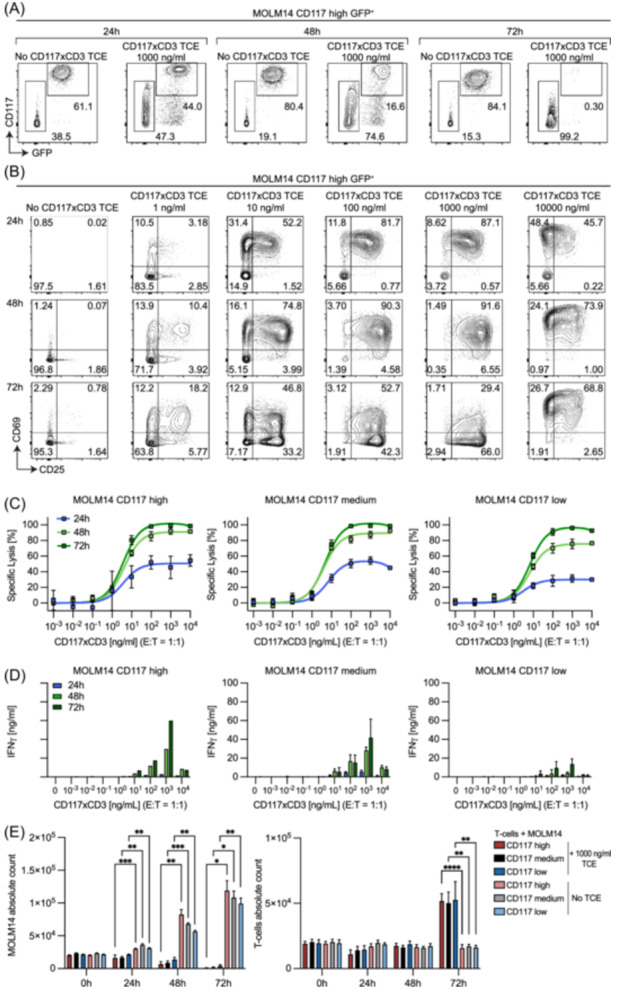
Acute myeloid leukemia (AML) derives from hematopoietic stem and progenitor cells (HSPCs). To date, no AML-exclusive, non-HSPC-expressed cell-surface target molecules for AML selective immunotherapy have been identified. Therefore, to still apply surface-directed immunotherapy in this disease setting, time-limited combined immune-targeting of AML cells and healthy HSPCs, followed by hematopoietic stem cell transplantation (HSCT), might be a viable therapeutic approach. To explore this, we generated a recombinant single-chain variable fragment-based bispecific T-cell engaging and activating antibody directed against CD3 on T-cells and CD117, the surface receptor for stem cell factor, expressed by both AML cells and healthy HSPCs. Bispecific CD117xCD3 targeting induced lysis of CD117-positive healthy human HSPCs, AML cell lines and patient-derived AML blasts in the presence of T-cells at subnanomolar concentrations in vitro. Furthermore, in immunocompromised mice, engrafted with human CD117-expressing leukemia cells and human T-cells, the bispecific molecule efficiently prevented leukemia growth in vivo. Additionally, in immunodeficient mice transplanted with healthy human HSPCs, the molecule decreased the number of CD117-positive cells in vivo. Therefore, bispecific CD117xCD3 targeting might be developed clinically in order to reduce CD117-expressing leukemia cells and HSPCs prior to HSCT.
急性髓系白血病(AML)起源于造血干细胞和祖细胞(HSPCs)。迄今为止,尚未发现用于AML选择性免疫治疗的、AML特异性且非HSPC表达的细胞表面靶分子。因此,为了在这种疾病背景下仍能应用表面导向免疫疗法,对AML细胞和健康HSPCs进行限时联合免疫靶向,随后进行造血干细胞移植(HSCT),可能是一种可行的治疗方法。为了探索这一点,我们构建了一种基于重组单链可变片段的双特异性T细胞结合和激活抗体,该抗体针对T细胞上的CD3以及AML细胞和健康HSPCs均表达的干细胞因子表面受体CD117。在体外,双特异性CD117xCD3靶向在亚纳摩尔浓度的T细胞存在下可诱导CD117阳性健康人HSPCs、AML细胞系和患者来源的AML原始细胞裂解。此外,在植入表达人CD117的白血病细胞和人T细胞的免疫受损小鼠中,双特异性分子在体内有效抑制了白血病生长。另外,在移植了健康人HSPCs的免疫缺陷小鼠中,该分子在体内减少了CD117阳性细胞的数量。因此,双特异性CD117xCD3靶向可能会在临床上得到开发,以便在HSCT之前减少表达CD117的白血病细胞和HSPCs。