Childress Paul J, Nielsen Jeffery J, Bemenderfer Thomas B, Dadwal Ushashi C, Chakraborty Nabarun, Harris Jonathan S, Bethel Monique, Alvarez Marta B, Tucker Aamir, Wessel Alexander R, Millikan Patrick D, Wilhite Jonathan H, Engle Andrew, Brinker Alexander, Rytlewski Jeffrey D, Scofield David C, Griffin Kaitlyn S, Shelley W Christopher, Manikowski Kelli J, Jackson Krista L, Miller Stacy-Ann, Cheng Ying-Hua, Ghosh Joydeep, Mulcrone Patrick L, Srour Edward F, Yoder Mervin C, Natoli Roman M, Shively Karl D, Gautam Aarti, Hammamieh Rasha, Low Stewart A, Low Philip S, McKinley Todd O, Anglen Jeffrey O, Lowery Jonathan W, Chu Tien-Min G, Kacena Melissa A
Department of Orthopaedic Surgery, Indiana University School of Medicine, Indianapolis, IN, 46202, United States.
Richard L. Roudebush VA Medical Center, Indianapolis, IN, 46202, United States.
J Bone Miner Res. 2024 Dec 31;40(1):125-139. doi: 10.1093/jbmr/zjae191.
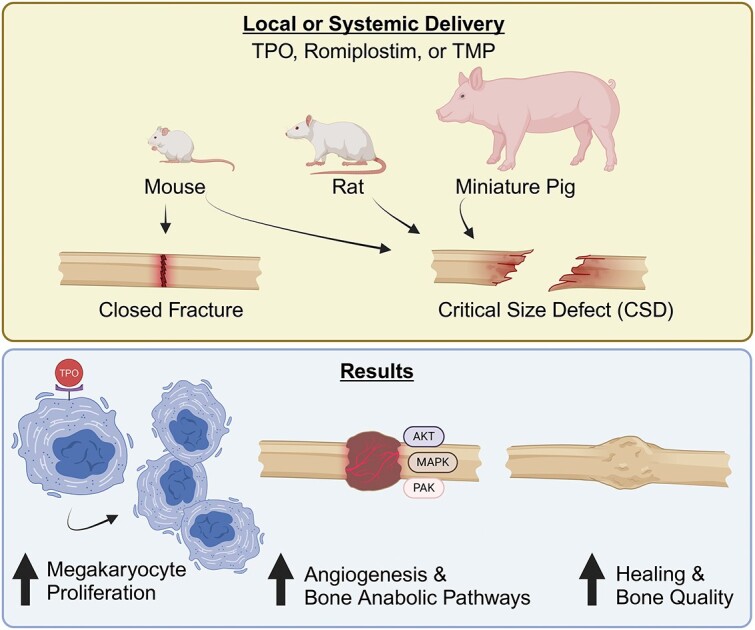
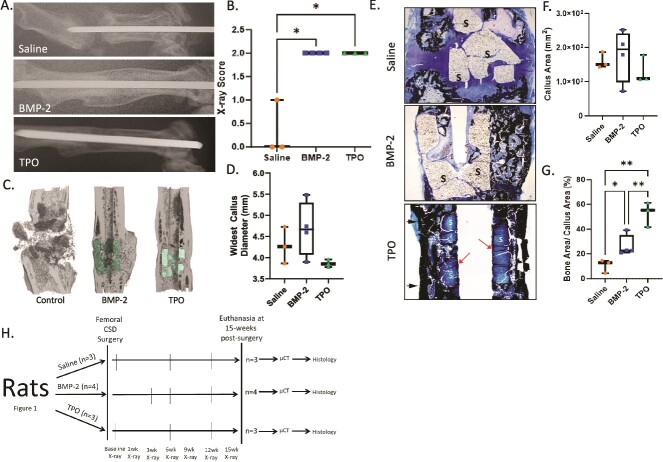
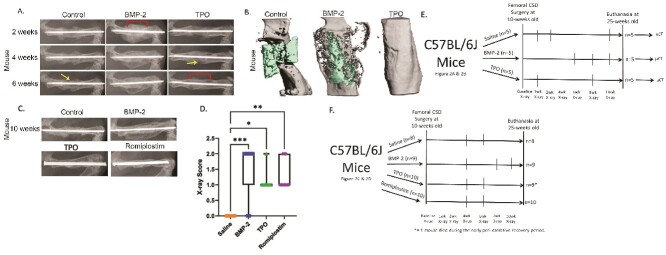
Achieving bone union remains a significant clinical dilemma. The use of osteoinductive agents, specifically bone morphogenetic proteins (BMPs), has gained wide attention. However, multiple side effects, including increased incidence of cancer, have renewed interest in investigating alternatives that provide safer, yet effective bone regeneration. Here we demonstrate the robust bone healing capabilities of the main megakaryocyte (MK) growth factor, thrombopoietin (TPO), and second-generation TPO agents using multiple animal models, including mice, rats, and pigs. This bone healing activity is shown in two fracture models (critical-sized defect [CSD] and closed fracture) and with local or systemic administration. Our transcriptomic analyses, cellular studies, and protein arrays demonstrate that TPO enhances multiple cellular processes important to fracture healing, particularly angiogenesis, which is required for bone union. Finally, the therapeutic potential of thrombopoietic agents is high since they are used in the clinic for other indications (eg, thrombocytopenia) with established safety profiles and act upon a narrowly defined population of cells.
实现骨愈合仍然是一个重大的临床难题。骨诱导剂的使用,特别是骨形态发生蛋白(BMPs),已引起广泛关注。然而,包括癌症发病率增加在内的多种副作用,重新激发了人们对研究提供更安全但有效的骨再生替代方案的兴趣。在此,我们使用包括小鼠、大鼠和猪在内的多种动物模型,证明了主要巨核细胞(MK)生长因子血小板生成素(TPO)和第二代TPO制剂具有强大的骨愈合能力。这种骨愈合活性在两种骨折模型(临界尺寸缺损[CSD]和闭合性骨折)以及局部或全身给药中均有体现。我们的转录组分析、细胞研究和蛋白质阵列表明,TPO可增强对骨折愈合重要的多个细胞过程,特别是骨愈合所需的血管生成。最后,血小板生成剂的治疗潜力很大,因为它们已在临床上用于其他适应症(如血小板减少症),具有既定的安全性,并且作用于特定的细胞群体。