
基于细胞-微球的活性微杂交体用于调节骨生成以促进生物矿化。
Cell-microsphere based living microhybrids for osteogenesis regulating to boosting biomineralization.
作者信息
Hu Zhaofan, Zhang Yunyang, Zhang Jingjing, Zheng Ran, Yang Yang, Kong Fei, Li Haoran, Yang Xinyan, Yang Shuhui, Kong Xiangdong, Zhao Ruibo
机构信息
Institute of Smart Biomedical Materials, School of Materials Science & Engineering, Zhejiang Sci-Tech University, Hangzhou 310000, PR China.
Zhejiang-Mauritius Joint Research Center for Biomaterials and Tissue Engineering, Zhejiang Sci-Tech University, Hangzhou 310018, PR China.
出版信息
Regen Biomater. 2024 Oct 29;11:rbae125. doi: 10.1093/rb/rbae125. eCollection 2024.
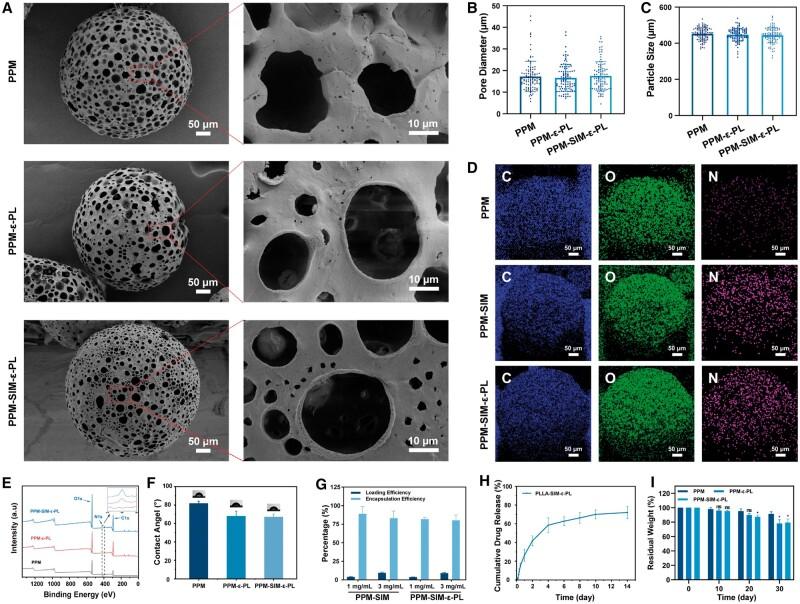
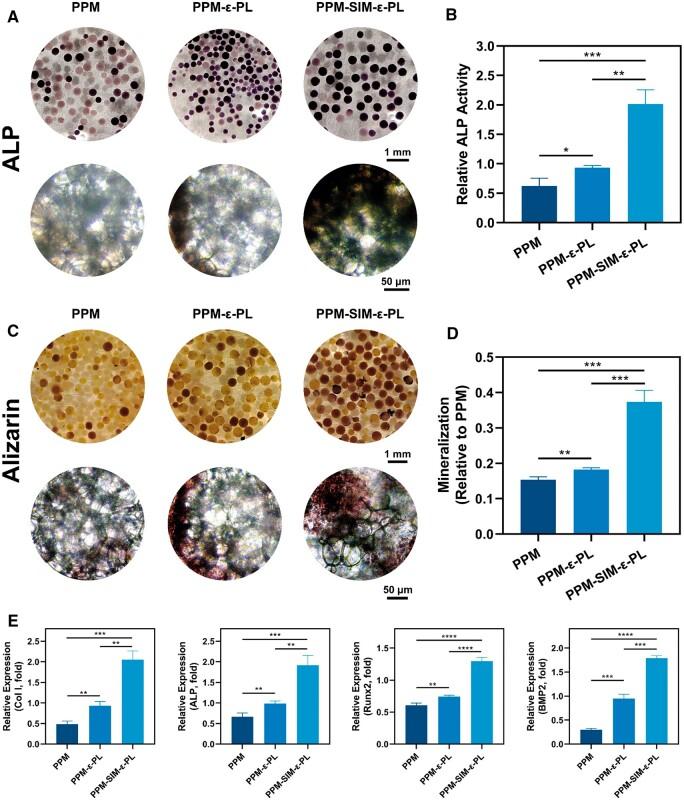
Biomineralization-based cell-material living composites showed great potential for living materials construction and cell regulation. However, cells in scaffolds with unconnected pores usually induce confined nutrient transfer and cell-cell communications, affecting the transformation of osteoblasts into osteocytes and the mineralization process. Herein, the osteoblast-materials living hybrids were constructed with porous PLLA microspheres using a rational design, in which cell-based living materials presented an improved osteoblast differentiation and mineralization model using rationally designed cell-microsphere composites. The results indicated that the microfluidic-based technique provided an efficient and highly controllable approach for producing on-demand PLLA microspheres with tiny pores (<5 μm), medium pores (5-15 μm) and large pores (>15 μm), as well as further drug delivery. Furthermore, the simvastatin (SIM)-loaded porous PLLA microsphere with ε-polylysine (ε-PL) modification was used for osteoblast (MC3T3-E1) implantation, achieving the cell-material living microhybrids, and the results demonstrated the ε-PL surface modification and SIM could improve osteoblast behavior regulation, including cell adhesion, proliferation, as well as the antibacterial effects. Both and results significantly demonstrated further cell proliferation, differentiation and cascade mineralization regulation. Then, the quantitative polymerase chain reaction or histological staining of typical markers, including collagen type I, alkaline phosphatase, runt-related transcription factor 2 and bone morphogenetic protein 2, as well as the calcium mineral deposition staining , reconfirmed the transformation of osteoblasts into osteocytes. These achievements revealed a promising boost in osteogenesis toward mineralization at the microtissue level by cell-microsphere integration, suggesting an alternative strategy for materials-based tissue construction and cell regulation, further demonstrating excellent application prospects in the field of biomineralization-based tissue regeneration.
基于生物矿化的细胞-材料活性复合材料在活性材料构建和细胞调控方面显示出巨大潜力。然而,具有不连通孔隙的支架中的细胞通常会导致有限的营养物质传递和细胞间通讯,影响成骨细胞向骨细胞的转变以及矿化过程。在此,通过合理设计,用多孔聚乳酸(PLLA)微球构建了成骨细胞-材料活性杂化体,其中基于细胞的活性材料使用合理设计的细胞-微球复合材料呈现出改进的成骨细胞分化和矿化模型。结果表明,基于微流控的技术为按需生产具有微孔(<5μm)、中孔(5-15μm)和大孔(>15μm)的PLLA微球以及进一步的药物递送提供了一种高效且高度可控的方法。此外,用ε-聚赖氨酸(ε-PL)修饰的载有辛伐他汀(SIM)的多孔PLLA微球用于成骨细胞(MC3T3-E1)植入,实现了细胞-材料活性微杂化体,结果表明ε-PL表面修饰和SIM可改善成骨细胞行为调控,包括细胞黏附、增殖以及抗菌效果。这两个结果都显著证明了进一步的细胞增殖、分化和级联矿化调控。然后,对包括I型胶原蛋白、碱性磷酸酶、 runt相关转录因子2和骨形态发生蛋白2在内的典型标志物进行定量聚合酶链反应或组织学染色,以及钙矿物质沉积染色,再次证实了成骨细胞向骨细胞的转变。这些成果揭示了通过细胞-微球整合在微组织水平上对矿化成骨的有前景的促进作用,为基于材料的组织构建和细胞调控提出了一种替代策略,进一步证明了在基于生物矿化的组织再生领域的优异应用前景。





 Zotero 插件