Department of Public Health and Caring Sciences, Geriatrics, Uppsala University, Uppsala, Sweden
Department of Medical Sciences, Physiotherapy, Uppsala University, Uppsala, Sweden.
BMJ Open. 2024 Nov 20;14(11):e087907. doi: 10.1136/bmjopen-2024-087907.
Adults with congenital heart disease (ACHD) are a heterogeneous group with a large variation in the severity of lesions and symptoms. This population has rapidly grown in recent years due to improved surgical and medical treatments. Sedentary time and physical activity (PA) and health among individuals classified with single lesions, for example, shunt defects such as atrial and ventricular septal defects, and patent foramen ovale (PFO) with stroke are less studied. The present study describes the study protocol and examines associations between sedentary time, PA, circulating biomarkers in the blood (heart and muscles) and heart failure. Results have the potential to supply the healthcare system with information if further action to promote cardiovascular health in ACHD is needed.
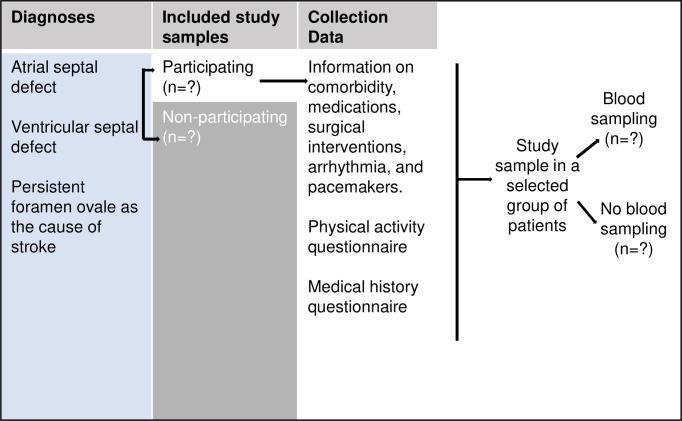
A cross-sectional design will be used with data from the local heart register, Swedish Registry for Congenital Heart Disease in Uppsala, Sweden. Individuals ≥18 years of age with simple congenital heart disease, according to the definition atrial septal defect, ventricle septal defect or PFO as the cause of stroke, will be included.
Self-reported questionnaire: demographic characteristics, education, the prevalence of diabetes, smoking, ethnicity, self-reported level of sitting time and leisure-time PA/exercise, everyday activities, commuting and degree of symptoms associated with exertion. Blood analyses: blood lipids (total cholesterol, high-density lipoprotein and low-density lipoprotein cholesterol, apolipoprotein A1 and B), creatinine, cystatin-C (eGFR), creatine kinase, myoglobin, high-sensitivity troponin, brain natriuretic peptide, C-reactive protein and glycated haemoglobin. Quantitative methods will be used for statistical analyses.
The Swedish Ethical Review Authority has approved the study (registration numbers 2022-06525-01 and 2023-02082-02). Results will be disseminated in peer-reviewed journals, research meetings, conferences and possibly patient organisations.
成人先天性心脏病(ACHD)患者是一个异质性群体,病变和症状的严重程度差异很大。由于手术和医疗治疗的改善,近年来该人群迅速增长。患有单一病变(例如,心房和室间隔缺损、卵圆孔未闭和中风等分流缺陷)的个体的久坐时间和体力活动(PA)和健康状况研究较少。本研究描述了研究方案,并检查了久坐时间、PA 与血液(心脏和肌肉)中的循环生物标志物以及心力衰竭之间的关联。如果需要进一步采取行动促进 ACHD 的心血管健康,研究结果有可能为医疗保健系统提供信息。
本研究将采用横断面设计,数据来自瑞典乌普萨拉的当地心脏登记处、瑞典先天性心脏病登记处。将纳入年龄≥18 岁、有单纯先天性心脏病(根据定义为房间隔缺损、室间隔缺损或卵圆孔未闭导致中风)的患者。
自填式问卷:人口统计学特征、教育程度、糖尿病患病率、吸烟状况、种族、久坐时间和休闲时间 PA/运动、日常活动、通勤和与劳累相关的症状程度自评。血液分析:血脂(总胆固醇、高密度脂蛋白胆固醇和低密度脂蛋白胆固醇、载脂蛋白 A1 和 B)、肌酐、胱抑素-C(eGFR)、肌酸激酶、肌红蛋白、高敏肌钙蛋白、脑钠肽、C 反应蛋白和糖化血红蛋白。将采用定量方法进行统计分析。
瑞典伦理审查局已批准该研究(注册号 2022-06525-01 和 2023-02082-02)。研究结果将在同行评议的期刊、研究会议、会议和可能的患者组织中发表。