Liu Fengxia, Zheng Xifeng, Chen Junchang, Huang Deju, Li Jingxu, Chen Yu, Wang Yang, Cao Hui, Xu Zicheng, Chen Yufeng, Mao Xinyue
Fine Mechanics and Physics, Chinese Academy of Science, Changchun, 130013, Jilin, China.
University of Chinese Academy of Sciences, Beijing, 100049, China.
Sci Rep. 2024 Nov 21;14(1):28851. doi: 10.1038/s41598-024-80111-z.
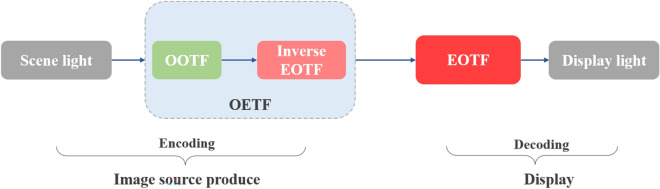
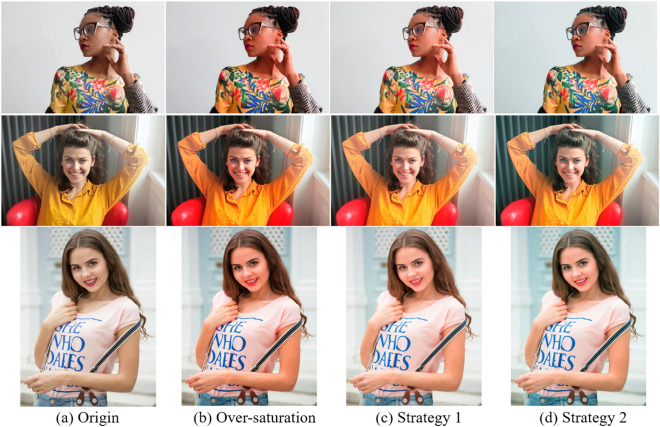
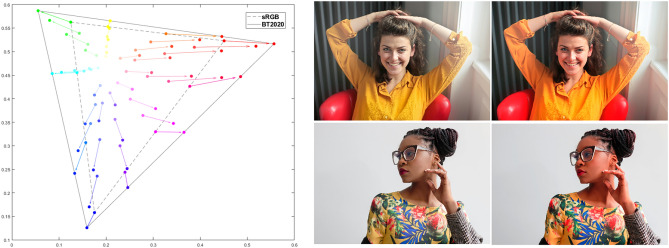
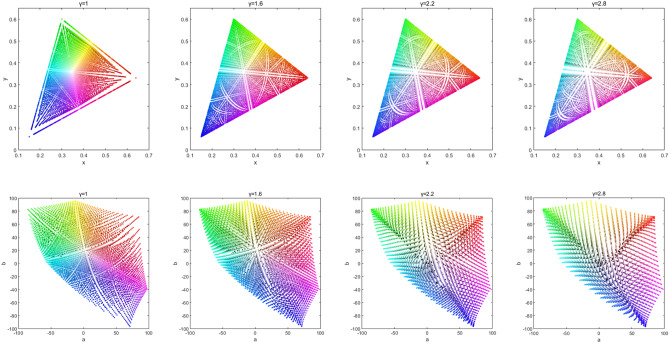
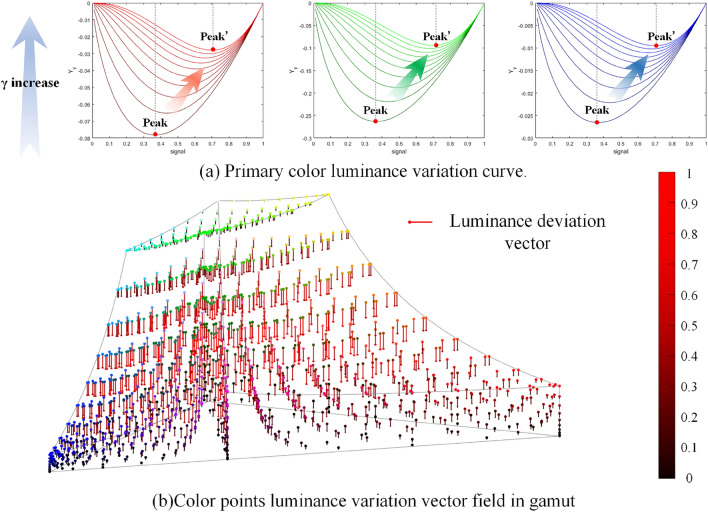
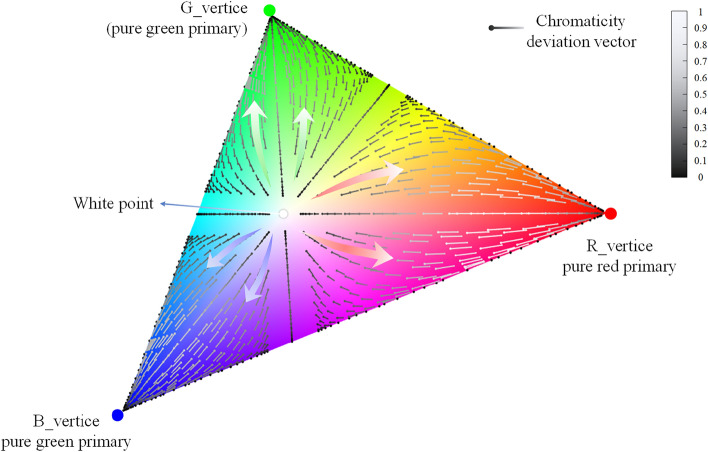
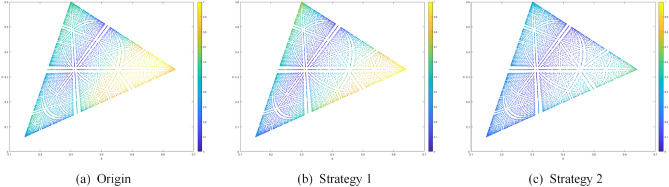
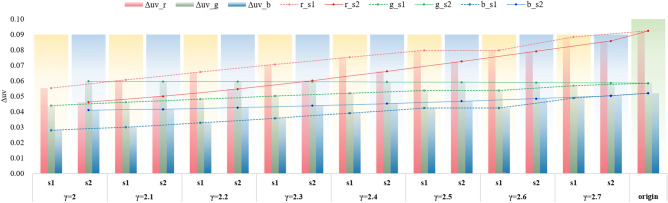
The gamut and EOTF (Electro-Optical Transfer Function) of a display together determine its color performance. Gamut determines the range of displayable colors, and the EOTF determines the color accuracy and depth. Image reproduction often comprises two parts: the image source and the display terminal. To ensure the universality of different terminals, the image source is generally produced in a standardized gamut standard, while the terminal pursues a wider gamut and more spectacular color performance. As a widely welcomed form of display, WCGDs (Wide Color Gamut Displays) boast stunning color performance. However, certain colors in WCGDs displays are oversaturated, which is unacceptable to the human eye. This paper analyzes the oversaturation problem of WCGDs. Firstly, a display model based on EOTF and gamut parameters is established. Then the color point vector field varies with EOTF is derived and the drift of luminance and chromaticity are analyzed separately. Finally, two strategies are present to optimize the color oversaturation problem of WCGDs based on the analysis conclusions and verify its effectiveness. This paper presents a detailed analysis and possible strategy for color oversaturation in WCGDs, providing a theoretical basis for the accurate color reproduction and efficient color management of WCGDs.
显示器的色域和电光传输函数(EOTF)共同决定其色彩表现。色域决定了可显示颜色的范围,而EOTF决定了色彩精度和深度。图像再现通常包括两个部分:图像源和显示终端。为确保不同终端的通用性,图像源一般按照标准化的色域标准制作,而终端则追求更宽的色域和更出色的色彩表现。作为一种广受欢迎的显示形式,广色域显示器(WCGD)拥有令人惊叹的色彩表现。然而,WCGD显示器中的某些颜色过度饱和,这是人眼无法接受的。本文分析了WCGD的过度饱和问题。首先,建立了基于EOTF和色域参数的显示模型。然后推导了随EOTF变化的色点矢量场,并分别分析了亮度和色度的漂移。最后,基于分析结论提出了两种优化WCGD色彩过度饱和问题的策略,并验证了其有效性。本文对WCGD中的色彩过度饱和问题进行了详细分析并提出了可能的策略,为WCGD的精确色彩再现和高效色彩管理提供了理论依据。