Cobos Àlex, Sibila Marina, Huerta Eva, Pérez Mónica, Marcos Marcial, Menjón Rut, Jiménez Marta, Gálvez Laura, Segalés Joaquim
IRTA, Animal Health, Centre de Recerca en Sanitat Animal (CReSA), Campus de la Universitat Autònoma de Barcelona (UAB), Bellaterra, Catalonia, 08193, Spain.
Unitat mixta d'investigació IRTA- UAB en Sanitat Animal, Centre de Recerca en Sanitat Animal (CReSA), Campus de la Universitat Autònoma de Barcelona (UAB), Bellaterra, Catalonia, 08193, Spain.
Porcine Health Manag. 2024 Nov 21;10(1):52. doi: 10.1186/s40813-024-00407-4.
Porcine circovirus 3 (PCV3) is a recently discovered swine pathogen associated with reproductive disease. To date, clinical problems linked to PCV3 have been described in intensive rearing pig farms. The present case describes an Iberian semi-outdoors sow farm affected by PCV3 reproductive disease.
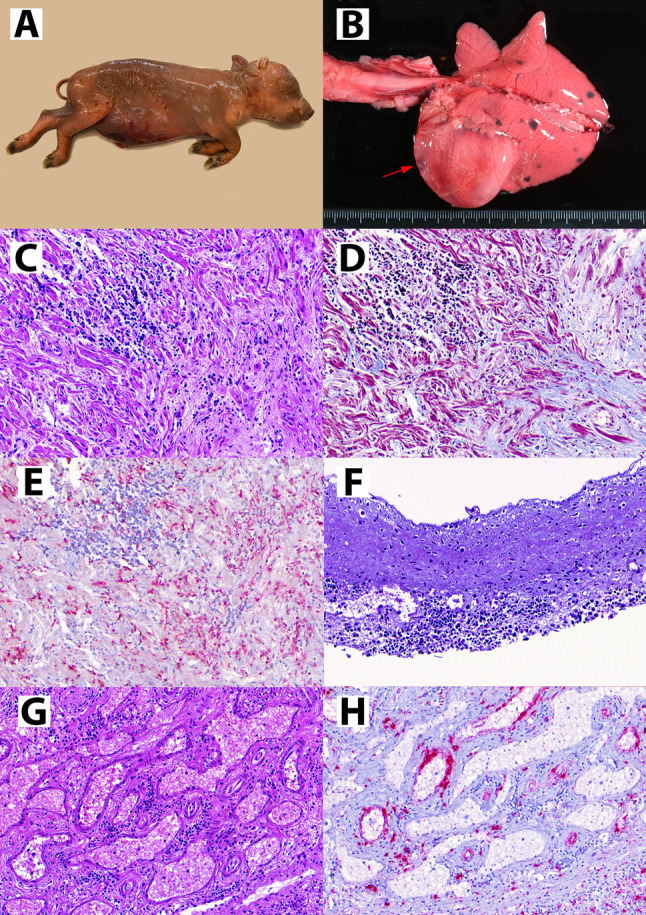
The affected farm was composed of 420 self-replaced Iberian sows, working in 3-week batches (60 sows per batch). The farm was free from porcine reproductive and respiratory syndrome virus (PRRSV) and had been previously affected by porcine circovirus 2 (PCV2) reproductive disease, which was successfully managed through sow vaccination. In spring 2022, reproductive disease was noticed with a high increase in the number of mummified foetuses and stillborn piglets from gilts as the most remarkable finding; multiparous sows were not affected. A first analysis with pooled stillborn tissues ruled out most swine reproductive pathogens and revealed detection of PCV3. To further elucidate PCV3 implication in the reproductive disease, a complete post-mortem examination of stillborn and mummified foetuses from two affected litters was conducted. Pooled tissue samples yielded high PCV3 loads by quantitative PCR. Grossly, one (out of 5) stillborn had an enlarged, flaccid heart. Histopathological evaluation revealed PCV3 lesions consisting of lymphohistiocytic and systemic periarteritis (3/5). The grossly affected heart had lymphohistiocytic myocarditis with fibrosis and lymphohistiocytic endocarditis. By in situ hybridization, high amounts of PCV3 genome were observed within histological lesions. Moreover, immunohistochemistry against PRRSV and PCV2 resulted negative in the same tissues.
This is the first report of PCV3 reproductive disease in a semi-extensive production Iberian pig farm, affecting exclusively gilts. Moreover, this is the first description of grossly apparent myocarditis associated to PCV3 infection. Therefore, PCV3 should be considered within the differential diagnostic list of swine reproductive problems in non-intensive pig rearing production.
猪圆环病毒3型(PCV3)是一种最近发现的与繁殖疾病相关的猪病原体。迄今为止,集约化养猪场中已描述了与PCV3相关的临床问题。本病例描述了一个受PCV3繁殖疾病影响的伊比利亚半户外母猪场。
受影响的猪场由420头自行繁殖的伊比利亚母猪组成,按3周批次运作(每批60头母猪)。该猪场没有猪繁殖与呼吸综合征病毒(PRRSV),且之前曾受猪圆环病毒2型(PCV2)繁殖疾病影响,通过母猪疫苗接种成功控制了该病。2022年春季,发现繁殖疾病,最显著的发现是后备母猪木乃伊化胎儿和死产仔猪数量大幅增加;经产母猪未受影响。对死产组织进行的首次分析排除了大多数猪繁殖病原体,并检测到PCV3。为进一步阐明PCV3在繁殖疾病中的作用,对两窝受影响仔猪的死产和木乃伊化胎儿进行了完整的尸检。定量PCR检测显示合并组织样本中PCV3载量很高。大体检查发现,5头死产仔猪中有1头心脏肿大、松弛。组织病理学评估显示PCV3病变包括淋巴细胞性和全身性动脉周围炎(5例中的3例)。心脏大体受影响的病例有淋巴细胞性心肌炎伴纤维化和淋巴细胞性心内膜炎。通过原位杂交,在组织学病变中观察到大量PCV3基因组。此外,同一组织中针对PRRSV和PCV2的免疫组化结果为阴性。
这是半集约化生产的伊比利亚猪场中PCV3繁殖疾病的首次报告,仅影响后备母猪。此外,这是与PCV3感染相关的明显心肌炎的首次描述。因此,在非集约化养猪生产中猪繁殖问题的鉴别诊断清单中应考虑PCV3。