National Clinical Research Center for Hematologic Diseases, Jiangsu Institute of Hematology, The First Affiliated Hospital of Soochow University, Suzhou, China.
Institute of Blood and Marrow Transplantation, Collaborative Innovation Center of Hematology, Soochow University, Suzhou, China.
Blood Adv. 2021 Mar 9;5(5):1250-1258. doi: 10.1182/bloodadvances.2020002790.
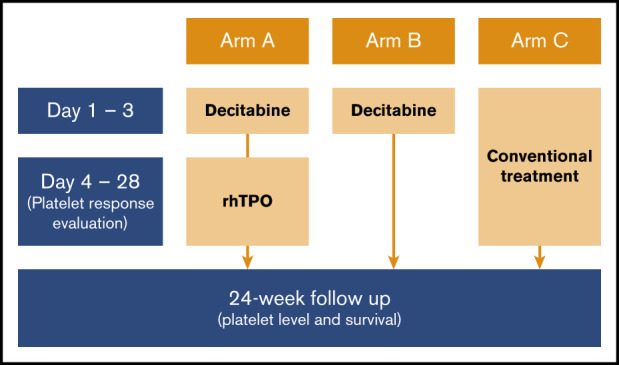
Refractory prolonged isolated thrombocytopenia (RPIT) is an intractable complication after allogeneic hematopoietic cell transplantation (HCT), which often leads to poor prognosis. A clinical study was designed to validate the efficacy and safety of low-dose decitabine for RPIT after HCT and explore the related underlying mechanisms. Eligible patients were randomly allocated to receive 1 of 3 interventions: arm A, low-dose decitabine (15 mg/m2 daily IV for 3 consecutive days [days 1-3]) plus recombinant human thrombopoietin (300 U/kg daily); arm B, decitabine alone; or arm C, conventional treatment. The primary end point was the response rate of platelet recovery at day 28 after treatment. Secondary end points included megakaryocyte count 28 days after treatment and survival during additional follow-up of 24 weeks. Among the 91 evaluable patients, response rates were 66.7%, 73.3%, and 19.4% for the 3 arms, respectively (P < .001). One-year survival rates in arms A (64.4% ± 9.1%) and B (73.4% ± 8.8%) were similar (P = .662), and both were superior to that in arm C (41.0% ± 9.8%; P = .025). Megakaryocytes, endothelial cells (ECs), and cytokines relating to megakaryocyte migration and EC damage were improved in patients responding to decitabine. This study showed low-dose decitabine improved platelet recovery as well as overall survival in RPIT patients after transplantation. This trial was registered at www.clinicaltrials.gov as #NCT02487563.
难治性迁延性孤立性血小板减少症(RPIT)是异基因造血细胞移植(HCT)后的一种难治性并发症,常导致预后不良。一项临床研究旨在验证低剂量地西他滨治疗 HCT 后 RPIT 的疗效和安全性,并探讨相关的潜在机制。合格的患者被随机分配接受以下 3 种干预措施之一:A 组,低剂量地西他滨(每天 15mg/m2,静脉注射,连续 3 天[第 1-3 天])+重组人血小板生成素(300U/kg,每天);B 组,地西他滨单独使用;或 C 组,常规治疗。主要终点是治疗后第 28 天血小板恢复的反应率。次要终点包括治疗后 28 天巨核细胞计数和额外 24 周随访期间的生存情况。在 91 例可评估患者中,3 组的反应率分别为 66.7%、73.3%和 19.4%(P<0.001)。A 组(64.4%±9.1%)和 B 组(73.4%±8.8%)的 1 年生存率相似(P=0.662),均优于 C 组(41.0%±9.8%;P=0.025)。对地西他滨有反应的患者中巨核细胞、内皮细胞(EC)和与巨核细胞迁移和 EC 损伤相关的细胞因子均得到改善。这项研究表明,低剂量地西他滨可改善移植后 RPIT 患者的血小板恢复和总体生存率。该试验在 www.clinicaltrials.gov 上注册为 #NCT02487563。