Frey Zachary D, Price David A, Connors Kaleigh A, Rush Rachael E, Brown Griffin, Sterling Cade E, Fatma Farheen, Schwarz Madeline M, Ganaie Safder, Cui Xiaoxia, Wills Zachary P, Leung Daisy W, Amarasinghe Gaya K, Hartman Amy L
Center for Vaccine Research, University of Pittsburgh School of Medicine, Pittsburgh, PA, United States.
Department of Medicine, Washington University School of Medicine, St. Louis, MO, United States.
bioRxiv. 2024 Nov 6:2024.11.06.622176. doi: 10.1101/2024.11.06.622176.
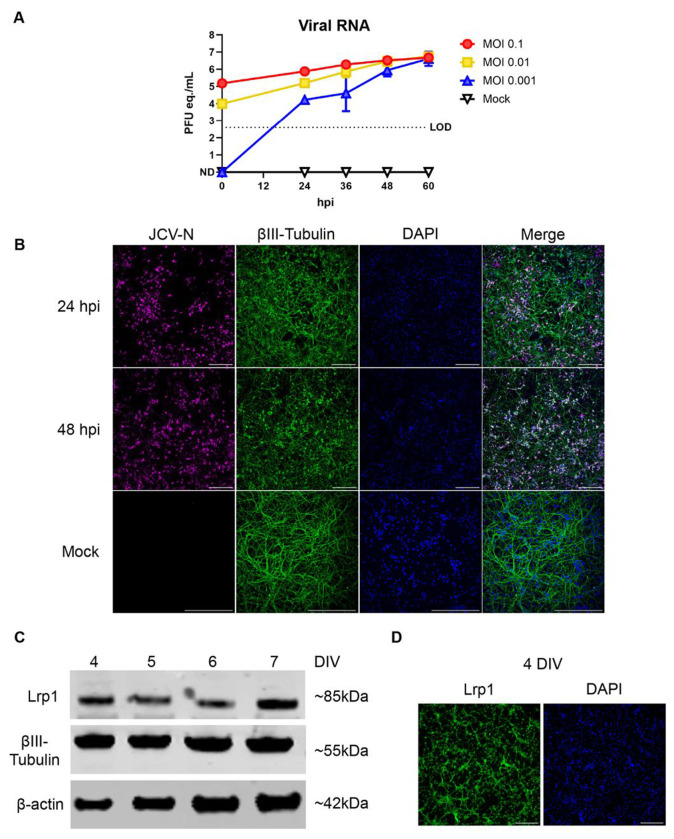
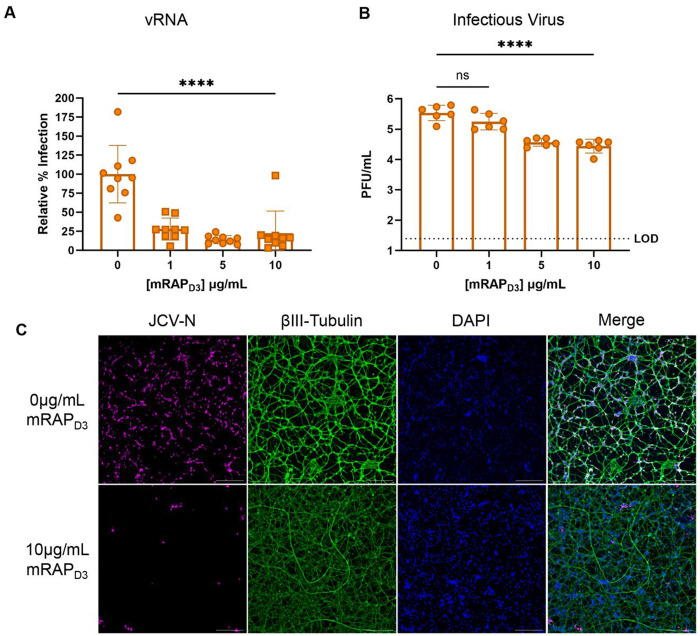
Jamestown Canyon virus (JCV) is a bunyavirus and arbovirus responsible for neuroinvasive disease in the United States. Little is known about JCV pathogenesis, and no host factors required for cellular infection have been identified. Recently, we identified low-density lipoprotein receptor related protein 1 (Lrp1) as a host entry factor for two other bunyaviruses Rift Valley fever virus (RVFV) and Oropouche virus (OROV). Here, we assessed the role of Lrp1 in mediating JCV cellular infection of neurons. Both neuronal and non-neuronal immortalized cell lines deficient for Lrp1 displayed reduction in infection with JCV, and early stages of infection such as binding and internalization were impacted by lack of Lrp1. In primary rat neurons, Lrp1 was highly expressed, and the neurons were highly permissive for JCV infection. Treatment of primary neurons with recombinant receptor-associated protein (RAP), a high affinity ligand for Lrp1, resulted in reduced infectivity with JCV. In addition, pretreatment of cells with RVFV Gn inhibited JCV infection, suggesting that the two viruses may share overlapping binding sites. These results provide compelling evidence that Lrp1 is an important cellular factor for efficient infection by JCV, and thus multiple bunyaviruses with varying clinical manifestations and tissue tropism are facilitated by the host cell Lrp1. Reliance of multiple bunyaviruses on Lrp1 makes it a promising target for pan-bunyaviral antivirals and therapeutics.
詹姆斯敦峡谷病毒(JCV)是一种布尼亚病毒和虫媒病毒,在美国可引发神经侵袭性疾病。人们对JCV的发病机制知之甚少,且尚未确定细胞感染所需的宿主因子。最近,我们确定低密度脂蛋白受体相关蛋白1(Lrp1)是另外两种布尼亚病毒——裂谷热病毒(RVFV)和奥罗普切病毒(OROV)的宿主进入因子。在此,我们评估了Lrp1在介导JCV对神经元的细胞感染中的作用。缺乏Lrp1的神经元和非神经元永生化细胞系对JCV的感染均减少,且Lrp1的缺乏影响了感染的早期阶段,如结合和内化。在原代大鼠神经元中,Lrp1高度表达,且这些神经元对JCV感染高度敏感。用重组受体相关蛋白(RAP,一种Lrp1的高亲和力配体)处理原代神经元,导致其对JCV的感染性降低。此外,用RVFV Gn预处理细胞可抑制JCV感染,这表明这两种病毒可能共享重叠的结合位点。这些结果提供了令人信服的证据,表明Lrp1是JCV有效感染的重要细胞因子,因此宿主细胞Lrp1促进了多种具有不同临床表现和组织嗜性的布尼亚病毒的感染。多种布尼亚病毒对Lrp1的依赖使其成为泛布尼亚病毒抗病毒药物和治疗方法的一个有前景的靶点。