Teixeira Vanessa, Singh Kashish, Gama José B, Celestino Ricardo, Carvalho Ana Xavier, Pereira Paulo, Abreu Carla M C, Dantas Tiago J, Carter Andrew P, Gassmann Reto
i3S - Instituto de Investigação e Inovação em Saúde, Universidade do Porto, 4200-135 Porto, Portugal.
IBMC - Instituto de Biologia Molecular e Celular, 4200-135 Porto, Portugal.
bioRxiv. 2024 Nov 6:2024.11.06.622207. doi: 10.1101/2024.11.06.622207.
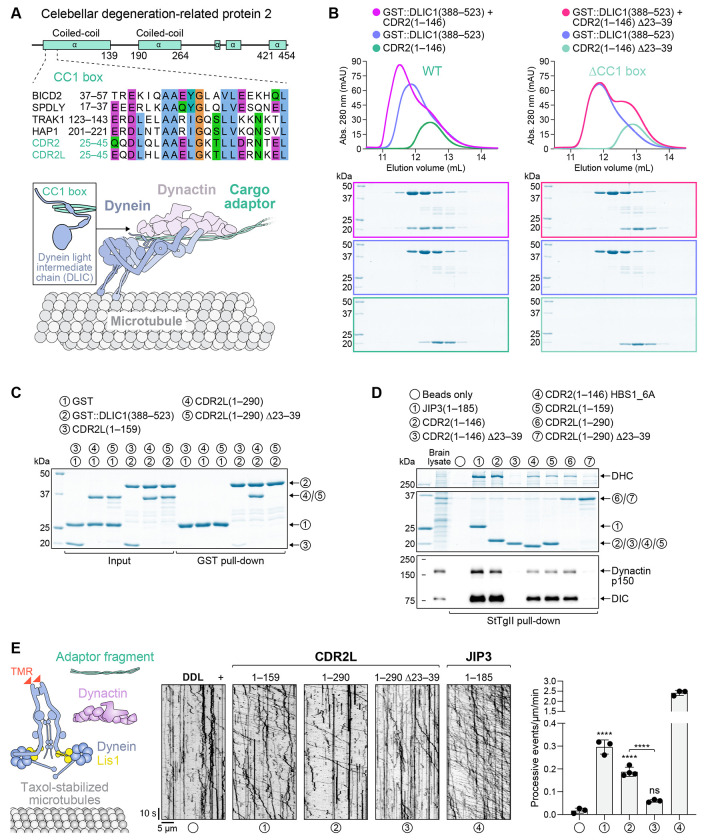
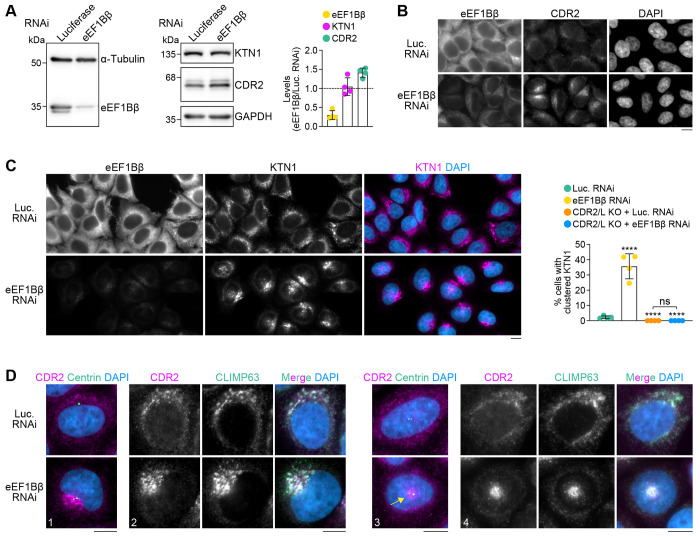
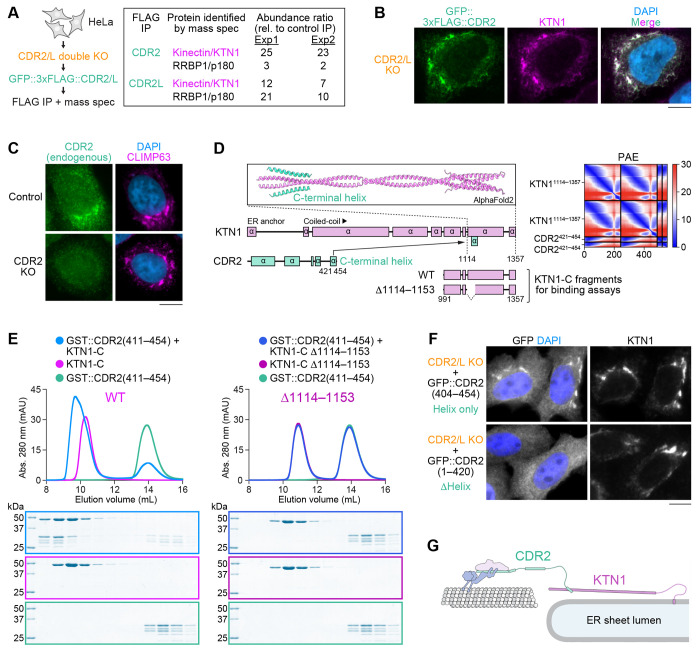
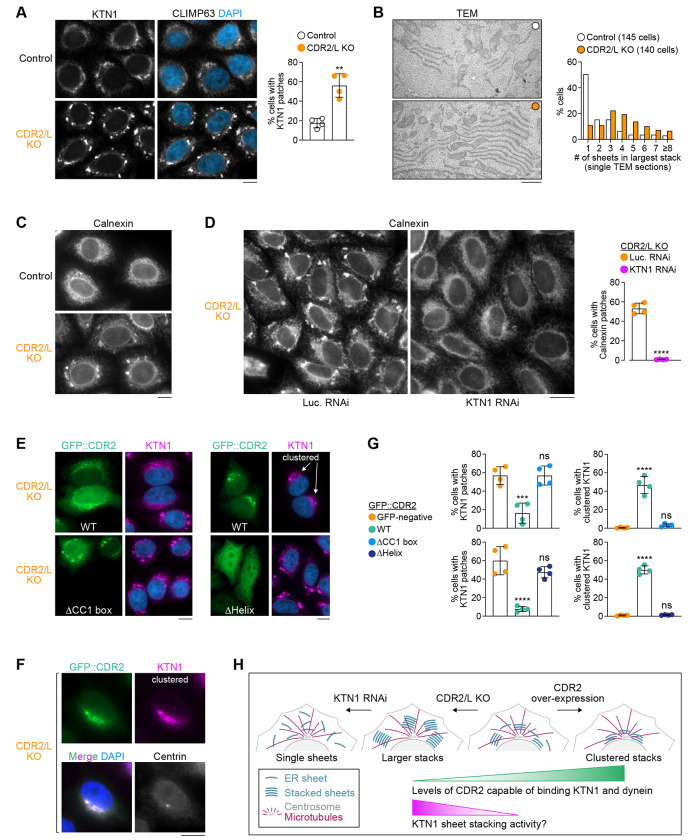
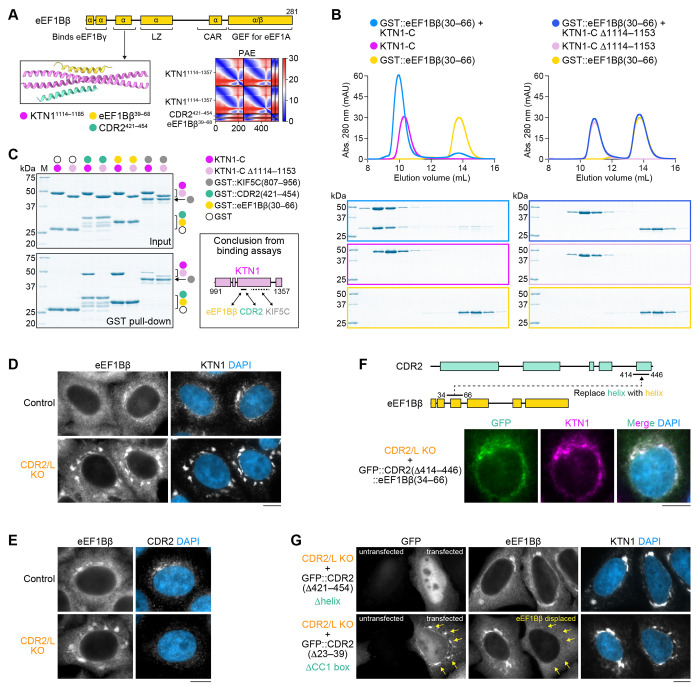
The endoplasmic reticulum (ER) relies on the microtubule cytoskeleton for distribution and remodelling of its extended membrane network, but how microtubule-based motors contribute to ER organization remains unclear. Using biochemical and cell-based assays, we identify cerebellar degeneration-related protein 2 (CDR2) and its paralog CDR2-like (CDR2L), onconeural antigens with poorly understood functions, as ER adaptors for cytoplasmic dynein-1 (dynein). We demonstrate that CDR2 is recruited by the integral ER membrane protein kinectin (KTN1) and that double knockout of CDR2 and CDR2L enhances KTN1-dependent ER sheet stacking, reversal of which by exogenous CDR2 requires its dynein-binding CC1 box motif. Exogenous CDR2 expression additionally promotes CC1 box-dependent clustering of ER sheets near centrosomes. CDR2 competes with the eEF1Bβ subunit of translation elongation factor 1 for binding to KTN1, and eEF1Bβ knockdown increases endogenous CDR2 levels on ER sheets, inducing their centrosome-proximal clustering. Our study describes a novel molecular pathway that implicates dynein in ER sheet organization and may be involved in the pathogenesis of paraneoplastic cerebellar degeneration.
内质网(ER)依赖微管细胞骨架来分布和重塑其延伸的膜网络,但基于微管的马达蛋白如何促进内质网的组织仍不清楚。通过生化和细胞实验,我们确定小脑变性相关蛋白2(CDR2)及其旁系同源物CDR2样蛋白(CDR2L),这两种功能尚不明确的肿瘤神经抗原,作为胞质动力蛋白-1(动力蛋白)的内质网衔接蛋白。我们证明CDR2由内质网整合膜蛋白驱动素连接蛋白(KTN1)招募,并且CDR2和CDR2L的双敲除增强了KTN1依赖性的内质网片层堆叠,外源性CDR2使其逆转需要其与动力蛋白结合的CC1盒基序。外源性CDR2的表达还促进了内质网片层在中心体附近的CC1盒依赖性聚集。CDR2与翻译延伸因子1的eEF1Bβ亚基竞争与KTN1结合,并且eEF1Bβ的敲低增加了内质网片层上内源性CDR2的水平,诱导其向中心体近端聚集。我们的研究描述了一条新的分子途径,该途径表明动力蛋白参与内质网片层组织,并可能与副肿瘤性小脑变性的发病机制有关。