Slaney Chloe, Mac Giollabhui Naoise, van der Most Peter J, Palacios Ensor R, Snieder Harold, Nivard Michel, Hemani Gibran, Hartman Catharina A, Khandaker Golam M
Medical Research Council Integrative Epidemiology Unit, Bristol Medical School, University of Bristol, UK.
Centre for Academic Mental Health, Population Health Sciences, Bristol Medical School, University of Bristol, UK.
medRxiv. 2024 Nov 2:2024.11.01.24316562. doi: 10.1101/2024.11.01.24316562.
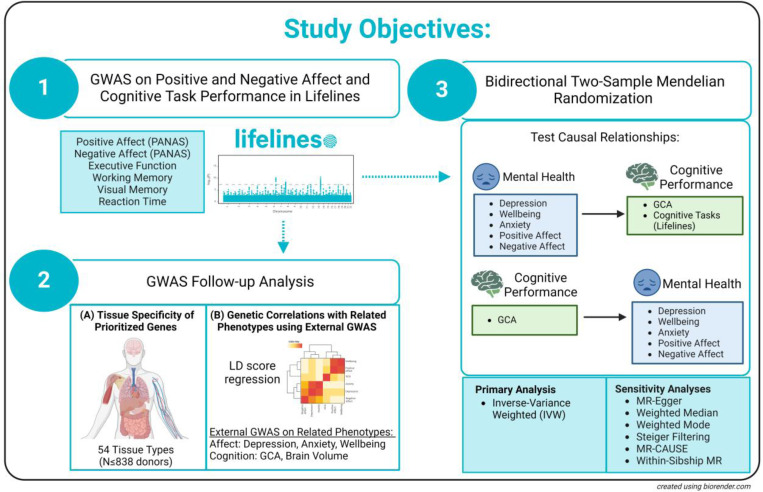
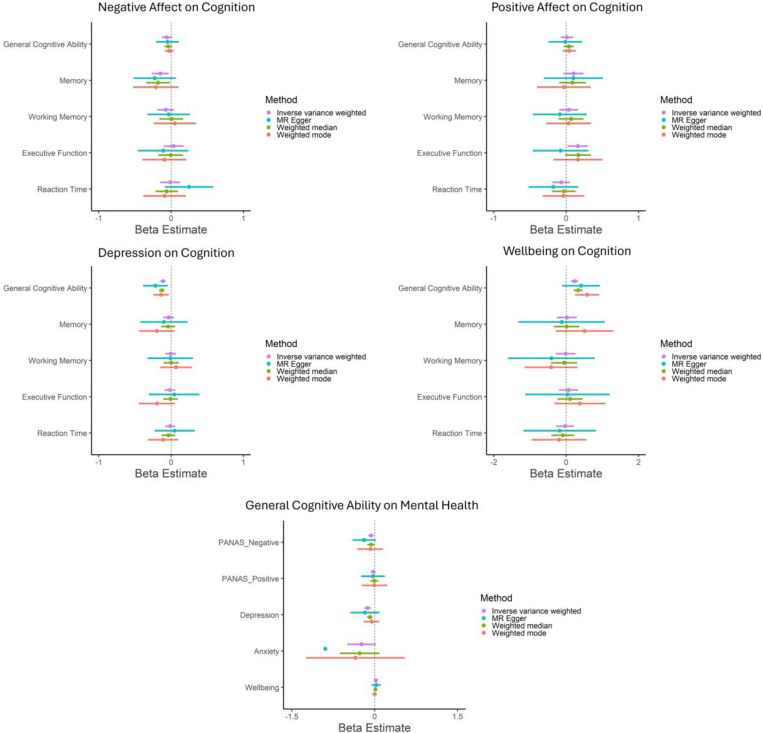
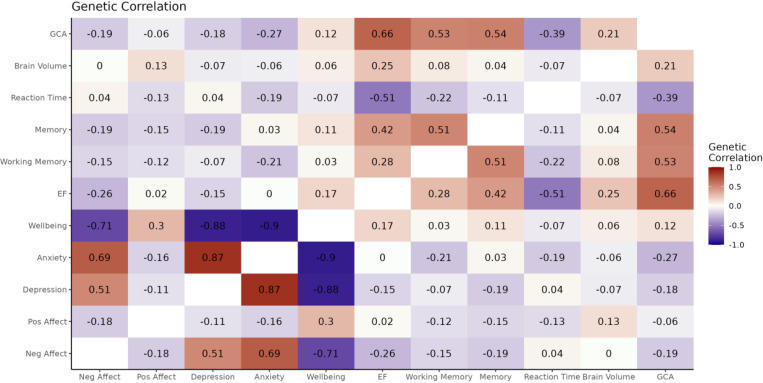
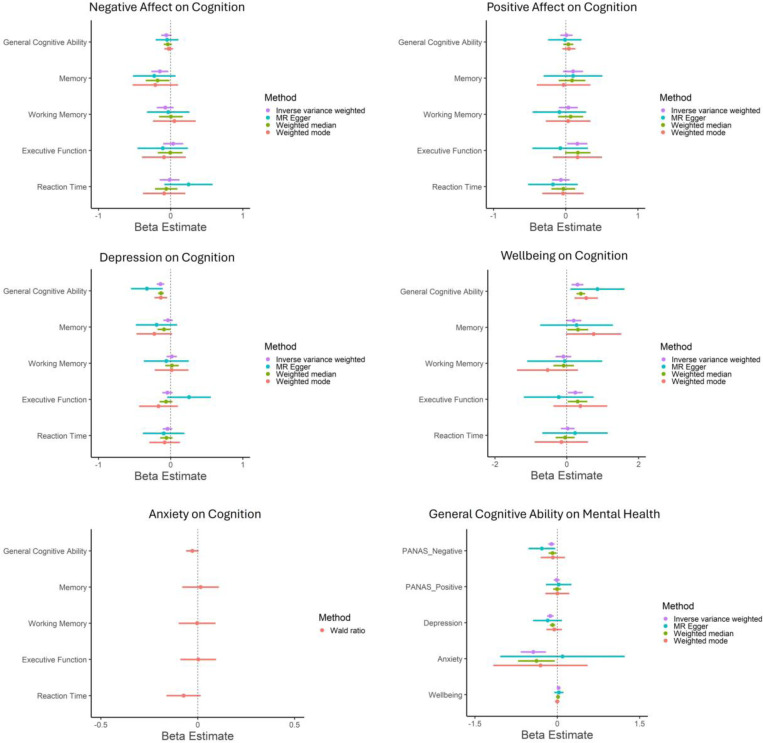
Altered affect and cognitive dysfunction are transdiagnostic, burdensome, and pervasive features of many psychiatric conditions which remain poorly understood and have few efficacious treatments. Research on the genetic architecture of these phenotypes and causal relationships between them may provide insight into their aetiology and comorbidity. Using data from the Lifelines Cohort Study, we conducted genome-wide association studies (GWAS) on positive and negative affect and four cognitive domains (working memory, reaction time, visual learning and memory, executive function). Using publicly available large GWAS on related - albeit distinct-phenotypes (depression, anxiety, wellbeing, general cognitive ability [GCA]) we conducted genetic correlation and Mendelian randomization (MR) analyses to examine genetic overlap and causal relationships. We identified one genome-wide hit (<5×10) for reaction time, and many loci with suggestive associations (<5×10; N range= 11-20 independent hits) for other phenotypes. For most phenotypes, gene mapping and tissue expression analysis of suggestive hits from the GWAS showed increased gene expression in brain tissue compared to other tissues. As predicted, negative affect is genetically correlated with mental health phenotypes (depression =0.51; anxiety =0.70; wellbeing = -0.71) and cognitive domains are genetically correlated with GCA and brain volume ( ≤ 0.66). Genetic correlations between negative and positive affect suggest that they are dissociable constructs ( = -0.18) with negative affect having higher genetic overlap with GCA than positive affect ( =-0.19 vs -0.06). This could indicate that negative affect has a higher shared neural basis with GCA than positive affect and/or GCA and negative affect may exhibit causal relationships. MR analyses suggest potential causal effects of higher GCA on reduced negative affect, reduced risk of depression and anxiety, and higher wellbeing, but little impact on positive affect. We also report evidence for potential causal effects of depression and lower wellbeing on reduced GCA. Taken together, these results suggests that GCA may be a valid target for negative affect (but not positive affect) and depression and wellbeing may be valid targets for GCA.
情感改变和认知功能障碍具有跨诊断性、负担重且普遍存在于多种精神疾病中,目前对其了解甚少且有效治疗方法寥寥。对这些表型的遗传结构及其之间因果关系的研究可能有助于深入了解其病因和共病情况。利用生命线队列研究的数据,我们对积极和消极情感以及四个认知领域(工作记忆、反应时间、视觉学习和记忆、执行功能)进行了全基因组关联研究(GWAS)。利用公开可得的针对相关但不同表型(抑郁、焦虑、幸福感、一般认知能力[GCA])的大型GWAS,我们进行了遗传相关性和孟德尔随机化(MR)分析,以检验遗传重叠和因果关系。我们确定了一个全基因组水平的反应时间关联信号(<5×10),以及许多其他表型的提示性关联位点(<5×10;独立关联信号数量范围为11 - 20个)。对于大多数表型,GWAS提示性关联位点的基因定位和组织表达分析表明,与其他组织相比,脑组织中的基因表达增加。如预期的那样,消极情感与心理健康表型存在遗传相关性(抑郁 =0.51;焦虑 =0.70;幸福感 = -0.71),认知领域与GCA和脑容量存在遗传相关性(≤0.66)。消极和积极情感之间的遗传相关性表明它们是可分离的结构( = -0.18),消极情感与GCA的遗传重叠高于积极情感( = -0.19对 -0.06)。这可能表明消极情感与GCA的共享神经基础比积极情感更高,和/或GCA与消极情感可能存在因果关系。MR分析表明,较高的GCA对降低消极情感、降低抑郁和焦虑风险以及提高幸福感具有潜在因果效应,但对积极情感影响不大。我们还报告了抑郁和较低幸福感对降低GCA具有潜在因果效应的证据。综上所述这些结果表明,GCA可能是消极情感(而非积极情感)的有效靶点,抑郁和幸福感可能是GCA的有效靶点。