Suddell Steph, Mahedy Liam, Skirrow Caroline, Penton-Voak Ian S, Munafò Marcus R, Wootton Robyn E
School of Psychological Science, University of Bristol, Bristol, UK.
National Institute for Health Research Biomedical Research Centre at the University Hospitals Bristol NHS Foundation Trust, University of Bristol, Bristol, UK.
R Soc Open Sci. 2023 Aug 9;10(8):221161. doi: 10.1098/rsos.221161. eCollection 2023 Aug.
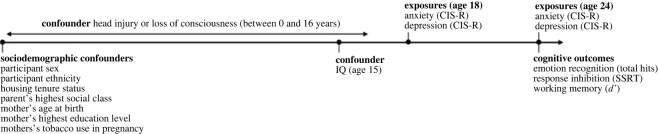
Anxiety and depression are associated with a range of impairments in cognitive functioning. Understanding the nature of these deficits may identify targets for intervention and prevent functional decline. We used observational and genetic methods to investigate the relationship of anxiety and depression with three cognitive domains: emotion recognition, response inhibition, and working memory, in the Avon Longitudinal Study of Parents and Children (ALSPAC). We examined: (i) cross-sectional associations between anxiety, depression, and cognition at age 24 ( = 2187), (ii) prospective associations between anxiety and depression at age 18 and cognition at age 24 ( = 1855), and (iii) the casual effect of anxiety and depression on cognition using Mendelian randomization (MR). Both disorders were associated with altered emotion recognition; anxiety with decreased happiness recognition (0.27 [-0.54,0.01], = 0.045), and depression with increased sadness recognition ( 0.35 [0.07,0.64], = 0.016). Anxiety was also associated with poorer working memory (0.14 [-0.24,0.04], = 0.005). There was no evidence for an association with response inhibition. MR provided no clear evidence of causal relationships between mental health and cognition, but these analyses were underpowered. Overall, there was little evidence for impairments in executive functioning, but moderate alterations in emotion recognition. This may inform the development of psychosocial interventions.
焦虑和抑郁与一系列认知功能障碍有关。了解这些缺陷的本质可能有助于确定干预目标并预防功能衰退。在阿冯父母与儿童纵向研究(ALSPAC)中,我们使用观察性和基因方法来研究焦虑和抑郁与三个认知领域的关系:情绪识别、反应抑制和工作记忆。我们考察了:(i)24岁时焦虑、抑郁与认知之间的横断面关联(n = 2187),(ii)18岁时焦虑和抑郁与24岁时认知之间的前瞻性关联(n = 1855),以及(iii)使用孟德尔随机化(MR)研究焦虑和抑郁对认知的因果效应。两种障碍都与情绪识别改变有关;焦虑与幸福感识别降低有关(β = 0.27 [-0.54,0.01],p = 0.045),抑郁与悲伤感识别增加有关(β = 0.35 [0.07,0.64],p = 0.016)。焦虑还与较差的工作记忆有关(β = 0.14 [-0.24,0.04],p = 0.005)。没有证据表明与反应抑制有关。MR没有提供心理健康与认知之间因果关系的明确证据,但这些分析的效力不足。总体而言,几乎没有证据表明执行功能存在障碍,但情绪识别有中度改变。这可能为心理社会干预的发展提供参考。