Song Siyuan, Ni Jing, Sun Yuqing, Pu Qiang, Zhang Li, Yan Qianhua, Yu Jiangyi
Affiliated Hospital of Nanjing University of Chinese Medicine, Nanjing, China.
Department of Endocrinology, Nanjing University of Chinese Medicine, Nanjing, China.
Front Med (Lausanne). 2024 Nov 7;11:1459752. doi: 10.3389/fmed.2024.1459752. eCollection 2024.
Previous observational studies have suggested associations between various inflammatory cytokines with type 2 diabetes mellitus and diabetic nephropathy. However, the causal association remains uncertain.
Summary statistics for type 2 diabetes mellitus and diabetic nephropathy were obtained from a publicly available genome-wide association study. Data on inflammatory cytokines were sourced from a genome-wide association study on protein quantitative trait loci. The inverse variance-weighted method was applied as the primary method for causal inference. MR-Egger, weighted mode, and weighted median method were employed as supplementary analyses. Sensitivity analyses were performed to detect heterogeneity and potential horizontal pleiotropy in the study.
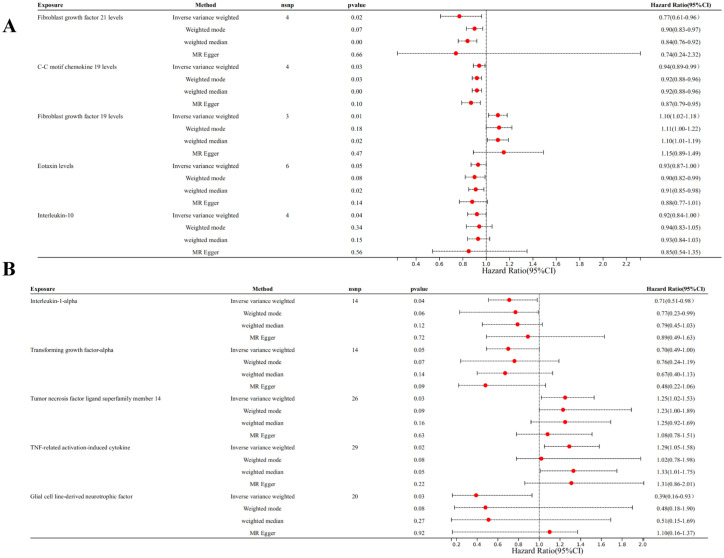
Genetic evidence indicated that elevated levels of fibroblast growth factor 19 levels promoted the occurrence of type 2 diabetes mellitus, and increased concentrations of fibroblast growth factor 21 levels, C-C motif chemokine 19 levels, eotaxin levels, and interleukin-10 mitigated the risk of developing type 2 diabetes mellitus, while type 2 diabetes mellitus did not exert a significant influence on said proteins. Elevated levels of tumor necrosis factor ligand superfamily member 14 and TNF-related activation-induced cytokine were associated with an increased risk of diabetic nephropathy, and increased concentrations of interleukin-1-alpha and transforming growth factor-alpha were potentially correlated with a diminished risk of diabetic nephropathy. Sensitivity analyses further ensure the robustness of our findings.
Mendelian randomization analysis highlights a causal association between inflammatory cytokines with type 2 diabetes mellitus and diabetic nephropathy, offering valuable evidence and reference for future research.
既往观察性研究提示多种炎症细胞因子与2型糖尿病及糖尿病肾病之间存在关联。然而,因果关系仍不明确。
从一项公开的全基因组关联研究中获取2型糖尿病和糖尿病肾病的汇总统计数据。炎症细胞因子的数据来源于一项关于蛋白质定量性状位点的全基因组关联研究。采用逆方差加权法作为因果推断的主要方法。采用MR-Egger法、加权模式法和加权中位数法进行补充分析。进行敏感性分析以检测研究中的异质性和潜在的水平多效性。
遗传证据表明,成纤维细胞生长因子19水平升高促进2型糖尿病的发生,而成纤维细胞生长因子21水平、C-C基序趋化因子19水平、嗜酸性粒细胞趋化因子水平和白细胞介素10浓度升高可降低患2型糖尿病的风险,而2型糖尿病对上述蛋白质无显著影响。肿瘤坏死因子配体超家族成员14和TNF相关激活诱导细胞因子水平升高与糖尿病肾病风险增加相关,白细胞介素1-α和转化生长因子-α浓度升高可能与糖尿病肾病风险降低相关。敏感性分析进一步确保了我们研究结果的稳健性。
孟德尔随机化分析突出了炎症细胞因子与2型糖尿病和糖尿病肾病之间的因果关系,为未来研究提供了有价值的证据和参考。