Ntozis Christos, Barzouka Karolina, Skouras Apostolos Z, Cherouveim Evgenia, Papitsi Flora, Apostolidis Nikolaos, Tsolakis Charilaos
School of Physical Education & Sports Science, National and Kapodistrian University of Athens, Athens, GREECE.
Hellenic Volleyball Federation, GREECE.
Int J Exerc Sci. 2024 Nov 1;17(4):1553-1567. doi: 10.70252/NWKF3764. eCollection 2024.
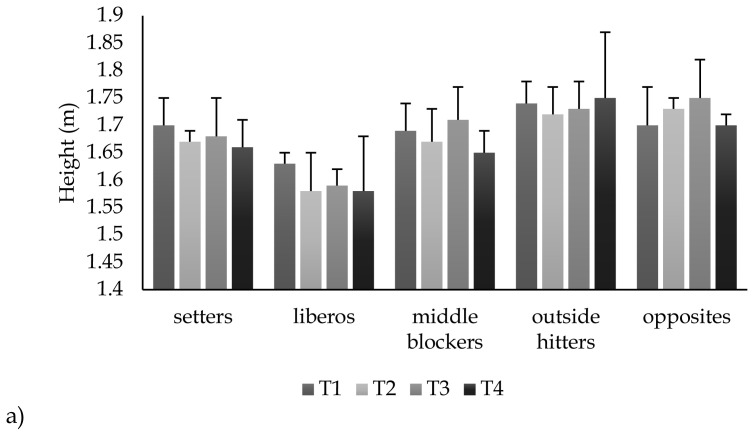
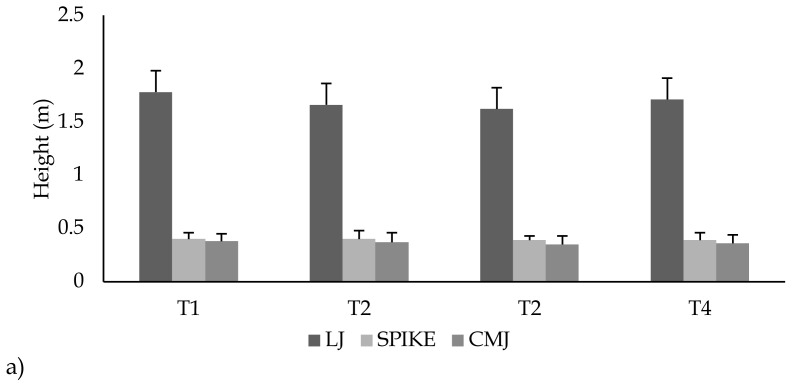
Understanding the Relative Age Effect (RAE) in female volleyball can provide a deeper insight into potential developmental advantages and selection biases between playing positions and volleyball-related performance characteristics. This study aimed to investigate the occurrence of the RAE in adolescent female volleyball players according to the playing position and the possible differences in anthropometric and performance characteristics between the relative age groups. The study involved 193 young female volleyball players from 12 different regions and 108 sports clubs from all over Greece, with an average age of 14.53 ± 0.31 years, height of 1.67 ± 0.07 m, weight of 57.20 ± 9.10 kg, and body mass index (BMI) of 20.34 ± 2.50. RAE was identified by the birth quarter of each player, categorizing thus the total sample into four sub-groups: Q1 (January-March), Q2 (April-June), Q3 (July-September), and Q4 (October-December). Anthropometrics, upper and lower limb power, agility, flexibility, and trunk strength were also assessed. The distribution of volleyball players differed significantly across birth quarters (34.19% of Q1, 25.9% of Q2, 22.79% of Q3, 17.09% of Q4; χ = 11.788, = 0.008). Analysis revealed no significant association between birth quarter and playing position (χ = 11.314, = 0.730). Present study's results indicated no RAE in young female volleyball players regarding their playing position. Also, performance tests did not differ significantly among the RAE groups. Moreover, despite athletes' early specialization based on assigned playing positions, no differences in athletes' position-related performance characteristics were observed. These findings suggest that interventions to mitigate RAE should be considered to ensure equitable development opportunities across all playing positions.
了解女子排球中的相对年龄效应(RAE),可以更深入地洞察不同比赛位置之间潜在的发展优势以及选拔偏见与排球相关的表现特征。本研究旨在调查青少年女子排球运动员中RAE的发生情况,具体依据比赛位置以及相对年龄组之间在人体测量学和表现特征方面可能存在的差异。该研究涉及来自希腊各地12个不同地区和108个体育俱乐部的193名年轻女子排球运动员,她们的平均年龄为14.53±0.31岁,身高为1.67±0.07米,体重为57.20±9.10千克,身体质量指数(BMI)为20.34±2.50。通过每位运动员的出生季度来确定RAE,从而将总样本分为四个亚组:第一季度(1月至3月)、第二季度(4月至6月)、第三季度(7月至9月)和第四季度(10月至12月)。同时还评估了人体测量学指标、上下肢力量、敏捷性、柔韧性和躯干力量。排球运动员在不同出生季度的分布存在显著差异(第一季度占34.19%,第二季度占25.9%,第三季度占22.79%,第四季度占17.09%;χ = 11.788,P = 0.008)。分析表明出生季度与比赛位置之间没有显著关联(χ = 11.314,P = 0.730)。本研究结果表明,年轻女子排球运动员在比赛位置方面不存在RAE。此外,在RAE组之间,性能测试也没有显著差异。而且,尽管运动员根据分配的比赛位置进行了早期专项化训练,但在与运动员位置相关的表现特征方面未观察到差异。这些发现表明,应考虑采取干预措施来减轻RAE,以确保所有比赛位置都有公平的发展机会。