Department of Neuromedicine and Movement Science, Faculty of Medicine and Health Sciences, NTNU, Trondheim, Norway.
Department of Sports Science, Faculty of Education and Arts, Nord University, Levanger, Norway.
PLoS One. 2022 Apr 28;17(4):e0264813. doi: 10.1371/journal.pone.0264813. eCollection 2022.
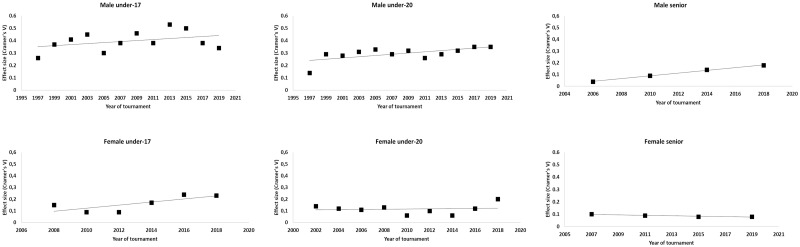
The relative age effect (RAE) is a statistical bias observed across sport contexts and consists of a systematic skewness in birth date distribution within an annual-age cohort. In soccer, January 1st is the common cut-off date when categorizing players in competitions according to their chronological age, which potentially disadvantages those within the cohort who were born later in the year. Thus, relatively older soccer players in their cohort can be favored in talent identification, selection, and development. The aim of the current study was to investigate the variations in RAE in male and female international youth world-cup tournaments (U17 and U20) in the period from 1997-2019 and in international senior world-cup-tournaments from 2006-2019. A total of 20,401 soccer players participating in 47 different tournaments were analyzed. The birthdate distributions were categorized into four quartiles (January-March, Q1; April-June, Q2; July-September, Q3; October-December, Q4) and compared to a uniform distribution using Chi-square analysis with Cramer's V (Vc) as a measure of effect size. Based on the existing data concerning RAE in elite junior and senior soccer, it was hypothesized that: (I) the RAE is present in youth soccer world cup tournaments but is stronger in male players than in female players; (II) the younger the soccer players, the stronger the RAE; and (III) the RAE in world cup soccer tournaments has strengthened over time. All these hypotheses were supported by the data; novel findings included that the effect has now entered women's soccer, and in men's soccer it persists into senior world cup tournaments. Thus, a strong RAE bias occurs in selection among elite soccer players competing in international world cup tournaments.
相对年龄效应(RAE)是在运动环境中观察到的一种统计偏差,它由年度年龄队列中出生日期分布的系统偏斜组成。在足球中,1 月 1 日是根据球员的实际年龄对比赛进行分类的常见截止日期,这对那些在该年度出生较晚的球员不利。因此,在同一年龄组中,相对较年长的足球运动员在人才识别、选拔和发展中可能会受到青睐。本研究的目的是调查 1997 年至 2019 年期间男子和女子国际青年世界杯(U17 和 U20)以及 2006 年至 2019 年期间国际高级世界杯比赛中 RAE 的变化。共有 20401 名参加 47 个不同比赛的足球运动员被分析。出生日期分布分为四个四分位数(1 月至 3 月,Q1;4 月至 6 月,Q2;7 月至 9 月,Q3;10 月至 12 月,Q4),并使用卡方分析与克拉默 V(Vc)进行比较,作为衡量效应大小的指标。基于有关精英青少年和高级足球 RAE 的现有数据,假设:(I)RAE 存在于青年世界杯足球赛中,但在男性球员中比女性球员更强;(II)足球运动员越年轻,RAE 越强;(III)世界杯足球赛中的 RAE 随着时间的推移而加强。所有这些假设都得到了数据的支持;新的发现包括,这种影响现在已经进入了女子足球,而在男子足球中,它在高级世界杯比赛中仍然存在。因此,在参加国际世界杯比赛的精英足球运动员中,选拔存在强烈的 RAE 偏差。