Medical Education Collaboration Cluster, Indonesian Medical Education and Research Institute (IMERI), Faculty of Medicine Universitas Indonesia, Jakarta, Indonesia.
Department of Public Health, Faculty of Medicine Universitas Sebelas Maret, Solo, Indonesia.
PLoS One. 2024 Nov 22;19(11):e0313525. doi: 10.1371/journal.pone.0313525. eCollection 2024.
Professionalism represents a contract between physicians and society, with humanism at its core. Humanism must be developed in medical education, especially in clinical settings, as students meet real-life professional situations. However, dynamic and unpredictable clinical settings might expose students to authentic yet unexpected far-from-ideal situations that might hinder the humanism and professionalism process. Furthermore, culture plays an influential role, highlighting the importance of developing an appropriate and contextual learning strategy. Hence, this study aims to conceptualize strategies to teach humanism and professionalism in high-power distance and collectivistic settings.
This multicenter qualitative phenomenological study used maximum variation sampling to recruit participants, consisting of clinical students, teachers, and coordinators from three medical schools in Indonesia. Data were collected through focus group discussions (FGDs) and in-depth interviews. Thematic analysis was conducted using the steps of coding and theorization methods.
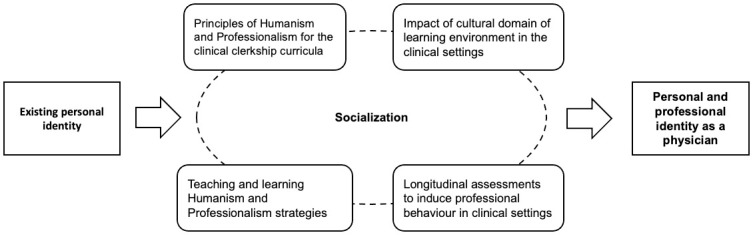
A total of 15 FGDs and one in-depth interview were conducted with 57 students, 39 teachers, and 18 coordinators. Socialization theory was used to analyze themes, leading to a culturally related approach to learning. Professional identity formation (PIF) was highlighted as the center of learning humanism and professionalism, with character building as the main principle. Designing a curriculum for humanism and professionalism for clinical learning should consider the longitudinal nature of PIF and ensure that professionalism explicitly exists in the curricula. As cultural impact might pose challenges, it must also be acknowledged and addressed. Meaningful integrated learning experiences, patient exposure, and reflection serve as the cornerstones of teaching-learning strategies while considering longitudinally explicit assessments.
Nurturing humanism and professionalism in undergraduate clinical settings is a longitudinal character-building process, with PIF as its center. Longitudinal, explicit, and dynamic strategies should be considered as part of the framework of teaching-learning and assessment of humanism and professionalism, as well as faculty development efforts with close attention to cultural factors.
专业精神代表了医生和社会之间的契约,其核心是人文主义。人文主义必须在医学教育中得到发展,尤其是在临床环境中,因为学生要面对现实生活中的专业情况。然而,动态和不可预测的临床环境可能会让学生接触到真实但出乎意料的远非理想的情况,这可能会阻碍人文主义和专业精神的发展。此外,文化起着重要的影响作用,突出了制定适当和具有文化背景的学习策略的重要性。因此,本研究旨在构建在高权力距离和集体主义环境中教授人文主义和专业精神的策略。
这是一项多中心定性现象学研究,采用最大变异抽样法招募参与者,包括来自印度尼西亚三所医学院的临床学生、教师和协调员。通过焦点小组讨论(FGD)和深入访谈收集数据。使用编码和理论化方法的步骤进行主题分析。
共进行了 15 次 FGD 和一次深入访谈,参与者包括 57 名学生、39 名教师和 18 名协调员。社会化理论被用于分析主题,形成了一种与文化相关的学习方法。专业身份形成(PIF)被强调为学习人文主义和专业精神的中心,以品格塑造为主要原则。为临床学习设计人文主义和专业精神课程时,应考虑到 PIF 的纵向性质,并确保专业精神明确存在于课程中。由于文化的影响可能带来挑战,因此必须承认并解决这些挑战。有意义的综合学习体验、患者接触和反思是教学策略的基石,同时要考虑到纵向明确的评估。
在本科临床环境中培养人文主义和专业精神是一个长期的品格塑造过程,以 PIF 为中心。应考虑将长期、明确和动态的策略作为教授和评估人文主义和专业精神以及教师发展工作的框架的一部分,并密切关注文化因素。