Keshmiri Fatemeh, Raadabadi Mehdi
Medical Education Department, Education Development Center, Shahid Sadoughi University of Medical Sciences, Yazd, Iran.
Health Policy and Management Research Center, School of Public Health, Shahid Sadoughi University of Medical Sciences, Yazd, Iran.
BMC Med Educ. 2022 Apr 26;22(1):321. doi: 10.1186/s12909-022-03387-7.
The present study was conducted to examine the interns' perceptions of safety attitude and professionalism and to explore their experiences about adherence to the principles during the COVID-19 pandemic.
The present study was a mixed-method that was performed in two quantitative and qualitative stages. The medical interns at X University (n = 140) were entered. In the quantitative phase, the assessment of the interns' Safety Attitudes and Professionalism was conducted by a survey. In the qualitative phase, data were gathered by semi-structured interviews. The experiences of participants were analyzed by the inductive content analysis approach of Graneheim and Lundman.
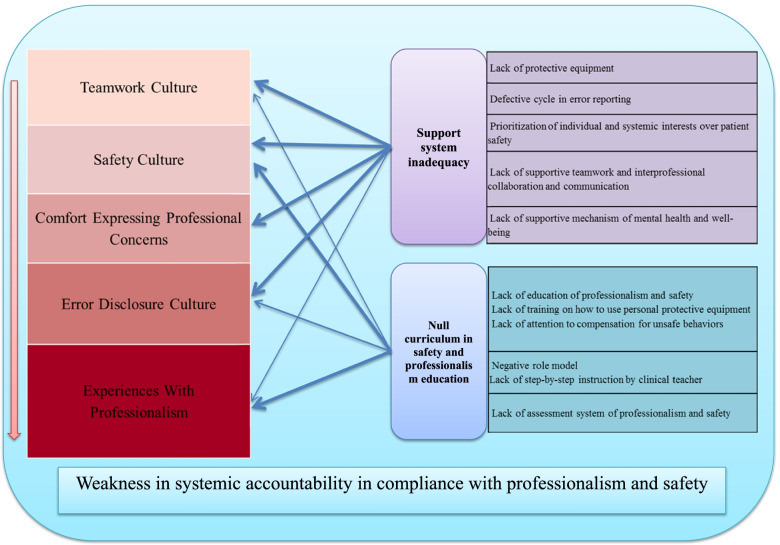
Participants' perception scores on safety attitude and professionalism were 98.02 (14.78). The results were explained in a theme of "weakness in systemic accountability in compliance with professionalism and safety". The theme included three categories: 'support system inadequacy', and 'null curriculum in safety and professionalism education'.
The present results showed participants' perception scores on safety attitude and professionalism were below the moderate level. The systemic issues were explored as influencing factors in the occurrence of unsafe and unprofessional behaviors. They reported the weakness of the support system (individual, teamwork, mental health, well-being, management, and culture), and the null curriculum in education of professional, and safety principles effective on unprofessional and unsafe behaviors. During the COVID-19 pandemic, it is recommended to create mechanisms to support the development of professionalism of healthcare workers, especially, novice providers and students, and pay attention to the safety and professionalism in formal and informal educational programs.
本研究旨在调查实习生对安全态度和专业精神的认知,并探讨他们在新冠疫情期间遵守相关原则的经历。
本研究采用混合方法,分定量和定性两个阶段进行。纳入了X大学的医学实习生(n = 140)。在定量阶段,通过一项调查对实习生的安全态度和专业精神进行评估。在定性阶段,通过半结构化访谈收集数据。采用格兰海姆和伦德曼的归纳性内容分析方法对参与者的经历进行分析。
参与者在安全态度和专业精神方面的认知得分是98.02(14.78)。结果在一个“在遵守专业精神和安全方面系统问责制薄弱”的主题下得到解释。该主题包括三个类别:“支持系统不足”以及“安全与专业精神教育课程缺失”。
目前的结果表明,参与者在安全态度和专业精神方面的认知得分低于中等水平。系统性问题被探究为不安全和不专业行为发生的影响因素。他们报告了支持系统(个人、团队合作、心理健康、福祉、管理和文化)的薄弱,以及专业和安全原则教育课程的缺失,这些对不专业和不安全行为有影响。在新冠疫情期间,建议建立机制以支持医护人员,特别是新手提供者和学生的专业精神发展,并在正式和非正式教育项目中关注安全和专业精神。