World Resources Institute, Washington, DC, 20002, USA.
US Department of Agriculture, Animal and Plant Health Inspection Service, Riverdale, MD, 20737, USA.
Sci Data. 2024 Nov 22;11(1):1269. doi: 10.1038/s41597-024-04125-y.
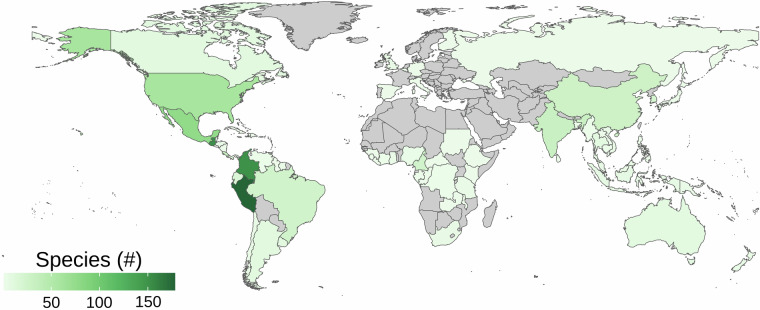
Discerning whether certain timber species were harvested from natural forests versus often less restricted planted forests can help ascertain the legality of wood products that enter the global market. However, readily available global planted forest data to the species level have been scarce. We confronted the need for such data by developing a two-pronged dataset, consisting of 'polygon' and 'non-polygon' location-based data, collectively, Planted Forest Timber Data. We obtained the polygon data from the World Resources Institute's Spatial Database of Planted Trees v2.0, extracting data specific to traded timber species. We derived the non-polygon data from peer-reviewed literature and government documents. The polygon dataset encompasses 27 countries and 253 species and the non-polygon dataset spans 91 countries and 447 species. We envision that the more these two living datasets grow, the more they will mutually benefit from one another for data cross-validation. This assembled information is meant to equip global leaders in forest governance, policy, enforcement, and research with vetted data for promoting legal timber trade and protecting biodiversity.
辨别某些木材品种是来自天然林还是限制较少的人工种植林,可以帮助确定进入全球市场的木材产品的合法性。然而,目前全球人工种植林的数据在物种层面上还很缺乏。我们通过开发一个由“多边形”和“非多边形”基于位置的数据组成的双管齐下的数据集来应对这一需求,统称为“人工林木材数据”。我们从世界资源研究所的“种植树木空间数据库 v2.0”中获取多边形数据,提取特定于交易木材品种的数据。我们从同行评议的文献和政府文件中推导出非多边形数据。多边形数据集涵盖 27 个国家和 253 个物种,非多边形数据集跨越 91 个国家和 447 个物种。我们设想,随着这两个活数据集的不断增长,它们将从彼此的数据交叉验证中受益更多。这些收集到的信息旨在为森林治理、政策、执法和研究领域的全球领导者提供经过审查的数据,以促进合法木材贸易和保护生物多样性。