Psychological Sciences, School of Social Sciences, Humanities, and Arts, University of California Merced, 5200 North Lake Road, Merced, CA, 95343, USA.
Health Sciences Research Institute, University of California Merced, 5200 North Lake Road, Merced, CA, 95343, USA.
Sci Rep. 2024 Nov 22;14(1):28939. doi: 10.1038/s41598-024-80532-w.
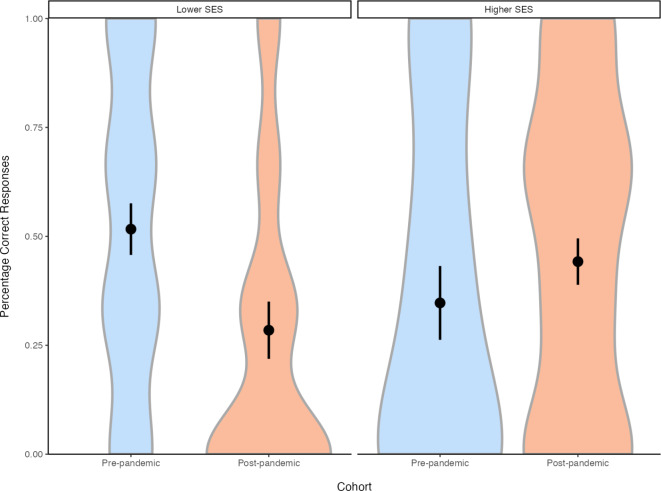
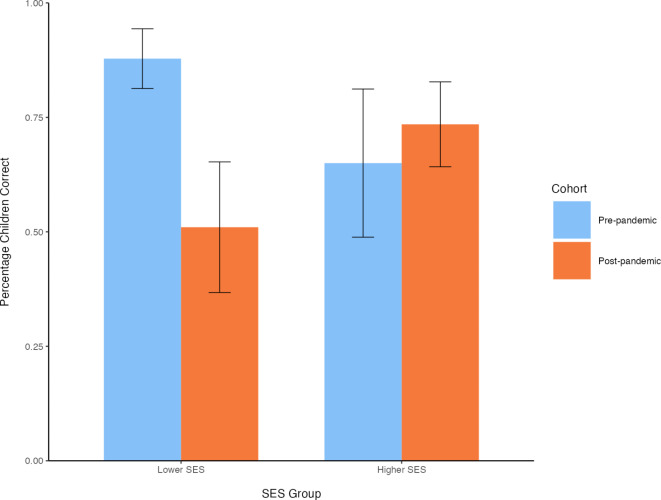
The COVID-19 pandemic and ensuing lockdowns led to sweeping changes in the everyday lives of children and families, including school closures, remote work and learning, and social distancing. To date no study has examined whether these profound changes in young children's day to day social interactions impacted the development of social cognition skills in early childhood. To address this question, we compared the performance of two cohorts of 3.5- to 5.5-year-old children tested before and after the COVID-19 lockdowns on several measures of false-belief understanding, a critical social cognition skill that undergoes important developments in this age range. Controlling for age and language skills, children tested after the pandemic demonstrated significantly worse false-belief understanding than those tested before the pandemic, and this difference was larger for children from lower socioeconomic status (SES) backgrounds. These results suggest that the pandemic negatively impacted the development of social cognition skills in early childhood, especially for lower SES children.
新冠疫情和随后的封锁导致儿童和家庭的日常生活发生了重大变化,包括学校关闭、远程工作和学习以及社交距离。迄今为止,尚无研究探讨幼儿日常生活中的这些深刻变化是否会影响其早期社交认知技能的发展。为了解决这个问题,我们比较了两组 3.5 至 5.5 岁的儿童在新冠疫情封锁前后在几个错误信念理解测量上的表现,错误信念理解是一种关键的社交认知技能,在这个年龄段会有重要的发展。在控制年龄和语言技能的情况下,疫情后接受测试的儿童在错误信念理解方面的表现明显差于疫情前接受测试的儿童,而来自社会经济地位较低(SES)背景的儿童的差异更大。这些结果表明,疫情对儿童早期社交认知技能的发展产生了负面影响,尤其是对 SES 较低的儿童。