Neurovascular Research Group, Hospital del Mar Medical Research Institute, Barcelona, Spain.
Department of Neurology, Hospital Del Mar and Universitat Pompeu Fabra, Barcelona, Spain.
Genome Med. 2024 Nov 22;16(1):135. doi: 10.1186/s13073-024-01408-2.
The association between increased cancer risk following a cerebrovascular event (CVE) has been previously reported. We hypothesize that biological age (B-age) acceleration is involved in this association. Our study aims to examine B-age as a novel contributing factor to cancer development post-CVE.
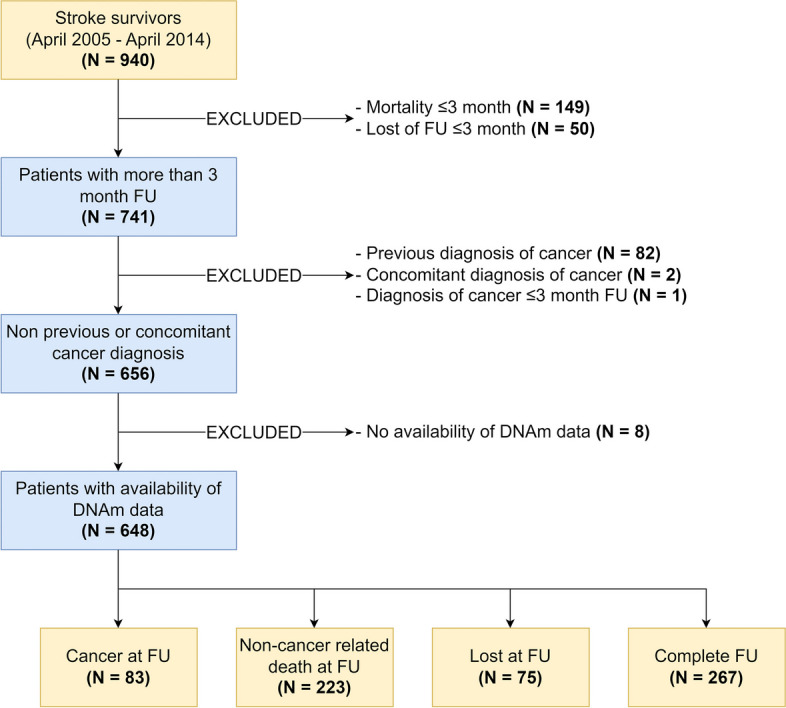
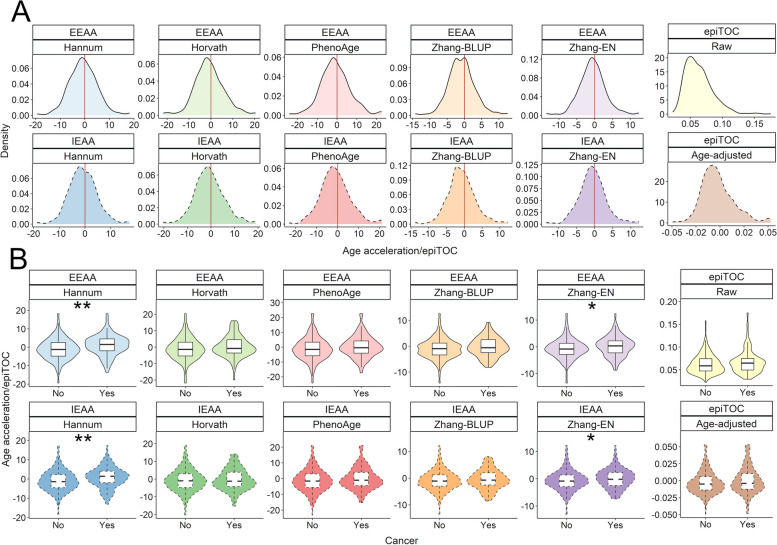
From our prospective stroke registry (BasicMar), we selected 940 cases with epigenetic data. For this study, we specifically analyzed 648 of these patients who had available data, no prior history of cancer, and a minimum follow-up of 3 months. The primary outcome was cancer incidence. B-age was estimated using DNA methylation data derived from whole blood samples obtained within 24 h of stroke onset, employing various epigenetic clocks (including Hannum, Horvath, PhenoAge, Zhang, Zhang, and the mitotic epiTOC). Extrinsic epigenetic age acceleration (EEAA) was calculated as the residuals from the regression of B-age against chronological age (C-age). For epiTOC, the age-adjusted values were obtained by regressing out the effect of age from the raw epiTOC measurements. Estimated white cell counts were derived from DNA methylation data, and these cell fractions were used to compute the intrinsic epigenetic age acceleration (IEAA). Subsequently, we evaluated the independent association between EEAA, IEAA, and cancer incidence while controlling for potential confounding variables.
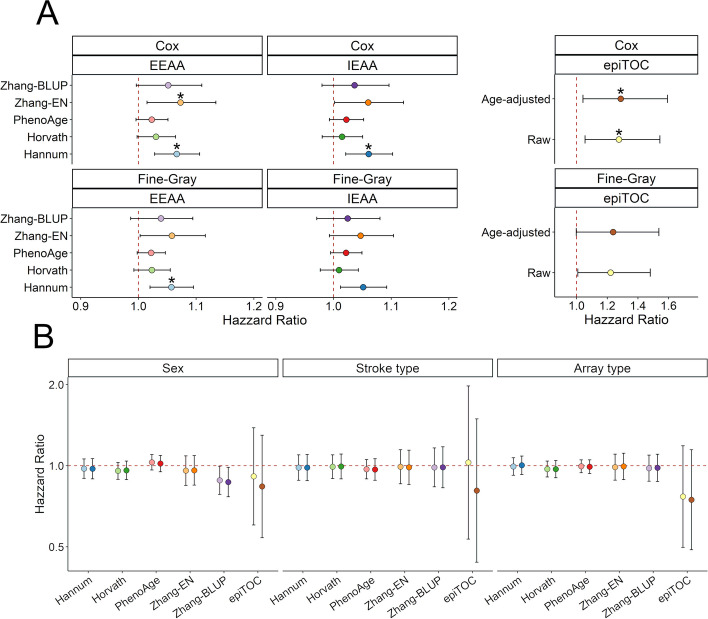
Among 648 patients with a median follow-up of 8.15 years, 83 (12.8%) developed cancer. Cox multivariable analyses indicated significant associations between Hannum, Zhang, and epiTOC EEAA and the risk of cancer after CVE. After adjusting for multiple testing and competing risks, EEAA measured by Hannum clock maintained an independent association with cancer risk. Specifically, for each year increase in Hannum's EEAA, we observed a 6.0% increased incidence of cancer (HR 1.06 [1.02-1.10], p value = 0.002).
Our findings suggest that epigenetic accelerated aging, as indicated by Hannum's EEAA, may play a significant role in the increased cancer risk observed in CVE survivors.
先前已有报道称,脑血管事件(CVE)后癌症风险增加。我们假设生物年龄(B-age)加速与此相关。我们的研究旨在探讨 B-age 是否为 CVE 后癌症发展的新致病因素。
从我们的前瞻性卒中登记库(BasicMar)中,我们选择了 940 例具有表观遗传数据的病例。在这项研究中,我们特别分析了其中 648 例具有可用数据、无癌症既往史且随访时间至少 3 个月的患者。主要结局是癌症发病率。B-age 是通过对卒中发病后 24 小时内获得的全血样本的 DNA 甲基化数据进行计算得出的,采用了多种表观遗传钟(包括 Hannum、Horvath、PhenoAge、Zhang、Zhang 和 mitotic epiTOC)。外在表观遗传年龄加速(EEAA)是通过将 B-age 与实际年龄(C-age)进行回归计算出的残差。对于 epiTOC,通过从原始 epiTOC 测量值中剔除年龄的影响来获得年龄调整值。从 DNA 甲基化数据中得出估计的白细胞计数,并使用这些细胞分数来计算内在表观遗传年龄加速(IEAA)。随后,我们评估了在控制潜在混杂因素的情况下,EEAA、IEAA 与癌症发病率之间的独立相关性。
在中位随访 8.15 年的 648 例患者中,有 83 例(12.8%)发生了癌症。Cox 多变量分析表明,在 CVE 后,Hannum、Zhang 和 epiTOC EEAA 与癌症风险之间存在显著关联。在进行多次检验和竞争风险调整后,Hannum 时钟测量的 EEAA 与癌症风险仍存在独立关联。具体来说,Hannum EEAA 每增加 1 年,癌症发病率增加 6.0%(HR 1.06 [1.02-1.10],p 值=0.002)。
我们的研究结果表明,Hannum 的 EEAA 所示的表观遗传加速老化可能在 CVE 幸存者中观察到的癌症风险增加中起重要作用。