Davis Christal N, Ramer Nolan E, Squeglia Lindsay M, Gex Kathryn S, McRae-Clark Aimee L, McKee Sherry A, Roberts Walter, Gray Kevin M, Baker Nathaniel L, Tomko Rachel L
Department of Psychiatry and Behavioral Services, College of Medicine, Medical University of South Carolina, Charleston, South Carolina, USA.
Ralph H. Johnson VA Medical Center, Charleston, South Carolina, USA.
Alcohol Clin Exp Res (Hoboken). 2024 Dec;48(12):2331-2340. doi: 10.1111/acer.15461. Epub 2024 Nov 23.
Alcohol and cannabis are commonly used together by young adults. With frequent pairings, use of one substance may become a conditioned cue for use of a second, commonly co-used substance. Although this has been examined for alcohol and cannabis in laboratory conditions and with remote monitoring, no research has examined whether pharmacologically induced cross-substance craving occurs in naturalistic conditions.
In a sample of 63 frequent cannabis-using young adults (54% female) who completed 2 weeks of ecological momentary assessment, we tested whether alcohol use was associated with stronger in-the-moment cannabis craving. We also examined whether sex moderated this association and whether cannabis craving was stronger at higher levels of alcohol consumption.
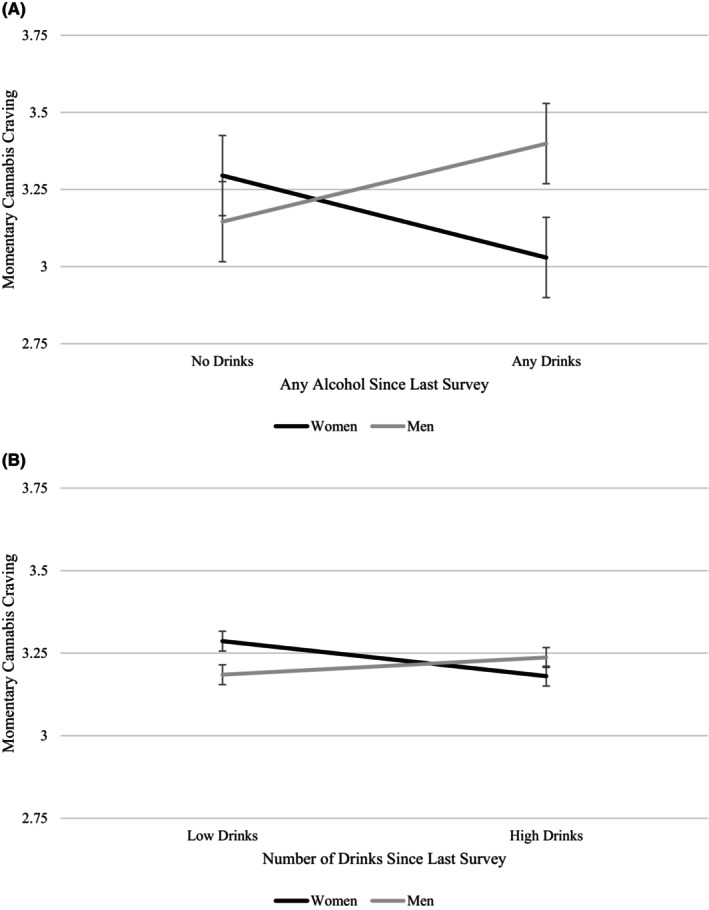
Although alcohol use and cannabis craving were not significantly associated at the momentary level, there was evidence that this relation significantly differed by sex. Among female participants, there was a negative association between alcohol use since the last prompt and momentary cannabis craving (b = -0.33, SE = 0.14, p = 0.02), while the association among male participants was positive (b = 0.32, SE = 0.13, p = 0.01). Similarly, alcohol quantity was negatively associated with cannabis craving at the momentary level for female participants (b = -0.10, SE = 0.04, p = 0.009) but was not significantly associated for male participants (b = 0.05, SE = 0.04, p = 0.18).
Alcohol may enhance cannabis craving among male individuals but reduce desire for cannabis among female individuals. This may point to differing functions of co-use by sex, highlighting a need for research to elucidate the mechanisms underlying this increasingly common pattern of substance use.
酒精和大麻在年轻人中常常同时被使用。随着频繁的搭配使用,一种物质的使用可能会成为另一种通常共同使用的物质使用的条件性线索。尽管这已经在实验室条件下以及通过远程监测对酒精和大麻进行了研究,但尚无研究考察在自然环境中是否会出现药物诱导的跨物质渴望。
在一个由63名经常使用大麻的年轻人(54%为女性)组成的样本中,他们完成了为期2周的生态瞬时评估,我们测试了酒精使用是否与即时的大麻渴望增强有关。我们还考察了性别是否调节了这种关联,以及在更高酒精消费水平下大麻渴望是否更强。
尽管在瞬时水平上酒精使用和大麻渴望没有显著关联,但有证据表明这种关系在性别上存在显著差异。在女性参与者中,自上次提示以来的酒精使用与即时的大麻渴望之间存在负相关(b = -0.33,标准误 = 0.14,p = 0.02),而男性参与者之间的关联是正相关(b = 0.32,标准误 = 0.13,p = 0.01)。同样,在瞬时水平上,酒精量与女性参与者的大麻渴望呈负相关(b = -0.10,标准误 = 0.04,p = 0.009),但与男性参与者没有显著关联(b = 0.05,标准误 = 0.04,p = 0.18)。
酒精可能会增强男性个体对大麻的渴望,但会降低女性个体对大麻的欲望。这可能表明性别在共同使用中的不同作用,凸显了开展研究以阐明这种日益常见的物质使用模式背后机制的必要性。