Department of Urology, University Hospital Tübingen, Hoppe-Seyler-Str. 3, D-72076, Tübingen, Germany.
Department of Urology, RWTH University Hospital Aachen, Aachen, Germany.
Urolithiasis. 2024 Nov 23;52(1):166. doi: 10.1007/s00240-024-01664-2.
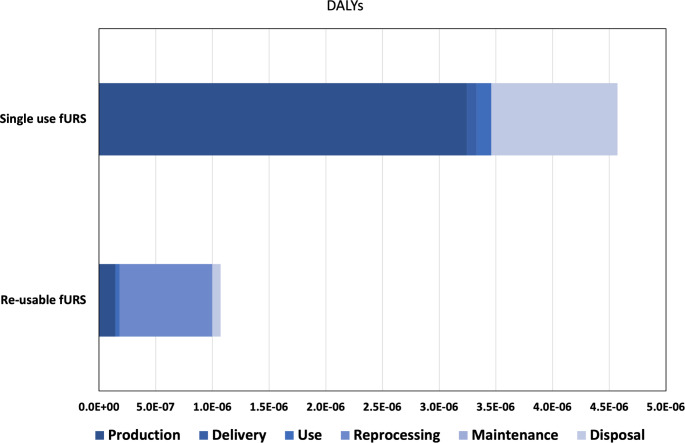
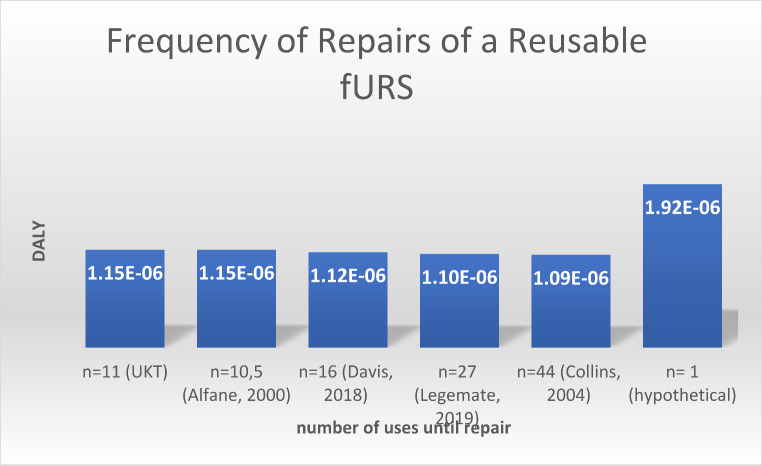
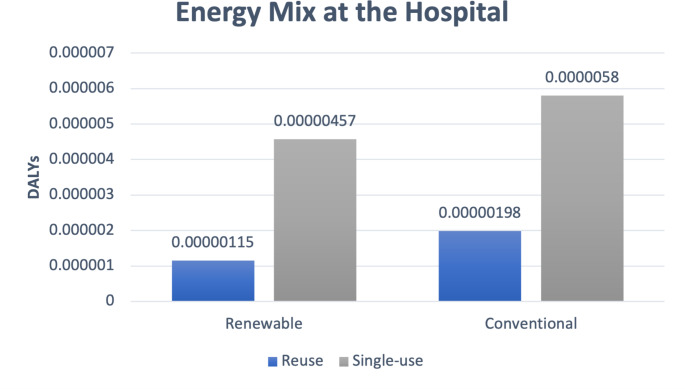
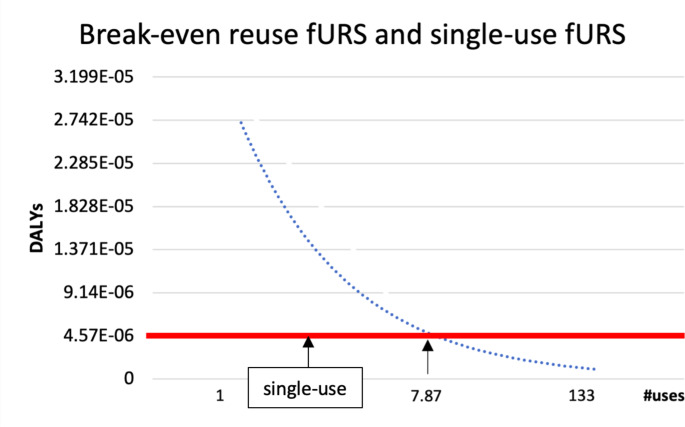
Climate change poses a significant global health challenge, with medical procedures contributing substantially to CO emissions. Urology, as part of the broader healthcare sector, has begun integrating Planetary Health concepts to address this issue. While earlier studies have focused on Life Cycle Assessments (LCA) of urological procedures, these evaluations remain data-dependent, and insights into intra-hospital emissions are limited. This study introduces a methodical approach for analyzing intra-institutional processes of LCA for single-use and reusable flexible ureterorenoscopes (fURS). The LCA method was applied to assess the greenhouse gas emissions (CO equivalents, CO-eq) generated across the life cycle of fURS, including production, use-phase, reprocessing, maintenance, and disposal. The study approximated the Global Warming Potential (GWP) per one-hour use and evaluated associated health impacts using the ReCiPe2016(H) method, which measures Disability-Adjusted Life Years (DALYs). Results showed that for reusable fURS, assuming 133 usages per device and maintenance after every 11th use, each application generated 1.24 kg CO-eq, equivalent to 1.15E-06 DALYs. In contrast, single-use fURS generated 4.93 kg CO-eq and 4.57E-06 DALYs per application. The production and reprocessing stages were identified as having the greatest environmental and health impacts. For reusable fURS, electricity required during refurbishment and use phases was a key contributor, whereas the production phase accounted for most of the impact in single-use devices. Overall, singleuse fURS had a substantially higher potential environmental and health impact than their reusable counterparts. This study underscores the environmental and health impacts of ureterorenoscopy and highlights the importance of incorporating Planetary Health principles into healthcare practices. It provides a foundation for further analyses and research, aiming to drive transformative action in the healthcare sector toward sustainability.
气候变化对全球健康构成重大挑战,医疗程序对 CO 排放有重大贡献。泌尿科作为更广泛的医疗保健部门的一部分,已经开始整合行星健康概念来解决这个问题。虽然早期的研究集中在泌尿科程序的生命周期评估(LCA)上,但这些评估仍然依赖数据,并且对医院内排放的了解有限。本研究介绍了一种系统的方法,用于分析单用途和可重复使用的柔性输尿管镜(fURS)的机构内 LCA 过程。应用 LCA 方法评估 fURS 生命周期内产生的温室气体排放(CO 当量,CO-eq),包括生产、使用阶段、再处理、维护和处置。该研究使用 ReCiPe2016(H) 方法评估了每小时使用一次的全球变暖潜能 (GWP) 以及相关的健康影响,该方法衡量残疾调整生命年 (DALY)。结果表明,对于可重复使用的 fURS,假设每个设备使用 133 次,每次使用后第 11 次维护,每次应用产生 1.24 公斤 CO-eq,相当于 1.15E-06 DALY。相比之下,单次使用的 fURS 每次应用产生 4.93 公斤 CO-eq 和 4.57E-06 DALY。生产和再处理阶段被确定为对环境和健康影响最大的阶段。对于可重复使用的 fURS,翻新和使用阶段所需的电力是一个关键因素,而生产阶段在一次性设备中占了大部分影响。总体而言,一次性使用的 fURS 对环境和健康的潜在影响明显高于可重复使用的 fURS。本研究强调了输尿管镜检查的环境和健康影响,并强调了将行星健康原则纳入医疗保健实践的重要性。它为进一步的分析和研究提供了基础,旨在推动医疗保健部门向可持续性方向采取变革性行动。