
手术应激期间的适应性。糖皮质激素作用的重新评估。
Adaptation during surgical stress. A reevaluation of the role of glucocorticoids.
作者信息
Udelsman R, Ramp J, Gallucci W T, Gordon A, Lipford E, Norton J A, Loriaux D L, Chrousos G P
出版信息
J Clin Invest. 1986 Apr;77(4):1377-81. doi: 10.1172/JCI112443.
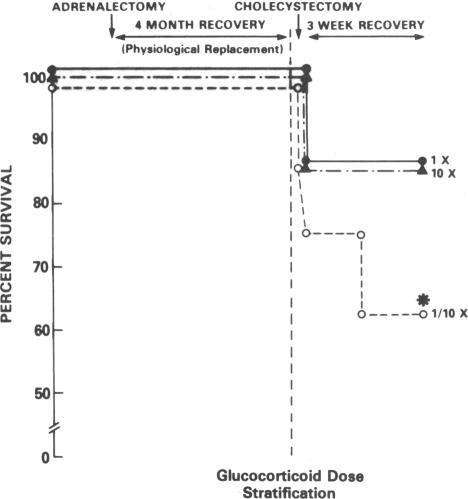
Pharmacologic doses of glucocorticoids are administered to patients with adrenal insufficiency during operative procedures to prevent hemodynamic instability, cardiovascular collapse, and death. Since these supraphysiologic doses might not be necessary and might have adverse effects, we examined the effects of different doses of glucocorticoids on hemodynamic adaptation during surgical stress in adrenalectomized primates. Sham-adrenalectomized placebo-treated animals served as controls. Adrenalectomized monkeys were maintained for 4 mo on physiologic glucocorticoid and mineralocorticoid replacement. The adrenalectomized monkeys were then stratified into three groups receiving, respectively, subphysiological (one-tenth the normal cortisol production rate), physiological, or supraphysiological (10 times the normal cortisol production rate) cortisol (hydrocortisone) treatment. 4 d later a cholecystectomy was performed. The intraoperative hemodynamic and metabolic parameters, perioperative survival rates, and postoperative wound healing were compared. The subphysiologically treated group was hemodynamically unstable before, during, and after surgery and had a significantly higher mortality rate than control. In this group, arterial blood pressure was low, and the cardiac index, systemic vascular resistance index, and left ventricular stroke work index were all reduced, suggesting decreased cardiac contractility and blood vessel tone. In contrast, the physiologically replaced group was indistinguishable from either supraphysiologically treated animals or sham-operated controls. All groups had similar metabolic profiles and normal wound healing. These findings suggest that the permissive actions of physiologic glucocorticoid replacement are both necessary and sufficient for primates to tolerate surgical stress. Supraphysiological glucocorticoid treatment has no apparent advantage during this form of stress in the primate.
在手术过程中,会给肾上腺功能不全的患者使用药理剂量的糖皮质激素,以防止血流动力学不稳定、心血管虚脱和死亡。由于这些超生理剂量可能并非必要,且可能有不良反应,我们研究了不同剂量的糖皮质激素对肾上腺切除的灵长类动物手术应激期间血流动力学适应的影响。假手术肾上腺切除并用安慰剂治疗的动物作为对照。肾上腺切除的猴子接受生理剂量的糖皮质激素和盐皮质激素替代治疗4个月。然后将肾上腺切除的猴子分为三组,分别接受亚生理剂量(正常皮质醇产生率的十分之一)、生理剂量或超生理剂量(正常皮质醇产生率的10倍)的皮质醇(氢化可的松)治疗。4天后进行胆囊切除术。比较术中血流动力学和代谢参数、围手术期生存率和术后伤口愈合情况。亚生理剂量治疗组在手术前、手术中和手术后血流动力学不稳定,死亡率显著高于对照组。在该组中,动脉血压低,心脏指数、全身血管阻力指数和左心室每搏功指数均降低,提示心脏收缩力和血管张力下降。相比之下,生理剂量替代治疗组与超生理剂量治疗的动物或假手术对照组没有区别。所有组的代谢情况相似,伤口愈合正常。这些发现表明,生理剂量的糖皮质激素替代治疗所起的允许作用对于灵长类动物耐受手术应激既是必要的也是充分的。在这种形式的应激中,超生理剂量的糖皮质激素治疗对灵长类动物没有明显优势。

 Zotero 插件