Department of Chemical, Paper and Biomedical Engineering, Miami University, 650 E. High St., Engineering Building 64, Oxford, OH, 45056, USA.
Department of Chemical and Biological Engineering, University of Colorado, Boulder, CO, 80309, USA.
Microb Cell Fact. 2024 Nov 25;23(1):319. doi: 10.1186/s12934-024-02585-w.
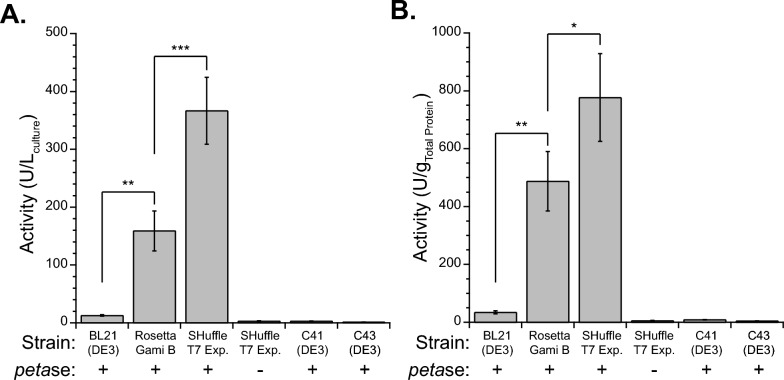
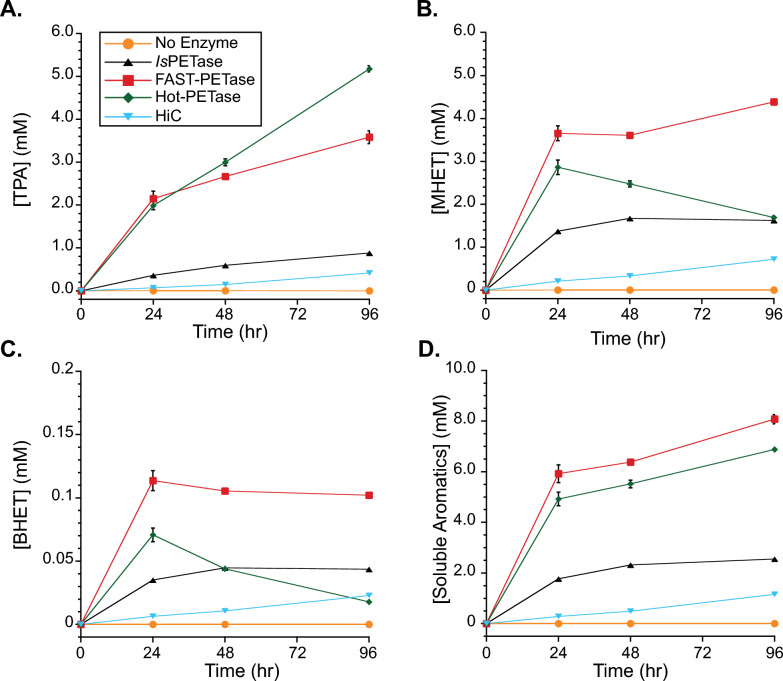
Depolymerizing polyethylene terephthalate (PET) plastics using enzymes, such as PETase, offers a sustainable chemical recycling route. To enhance degradation, many groups have sought to engineer PETase for faster catalysis on PET and elevated stability. Considerably less effort has been focused toward expressing large quantities of the enzyme, which is necessary for large-scale application and widespread use. In this work, we evaluated several E. coli strains for their potential to produce soluble, folded, and active IsPETase, and moved the production to a benchtop bioreactor. As PETase is known to require disulfide bonds to be functional, we screened several disulfide-bond promoting strains of E. coli to produce IsPETase, FAST-PETase and Hot-PETase.
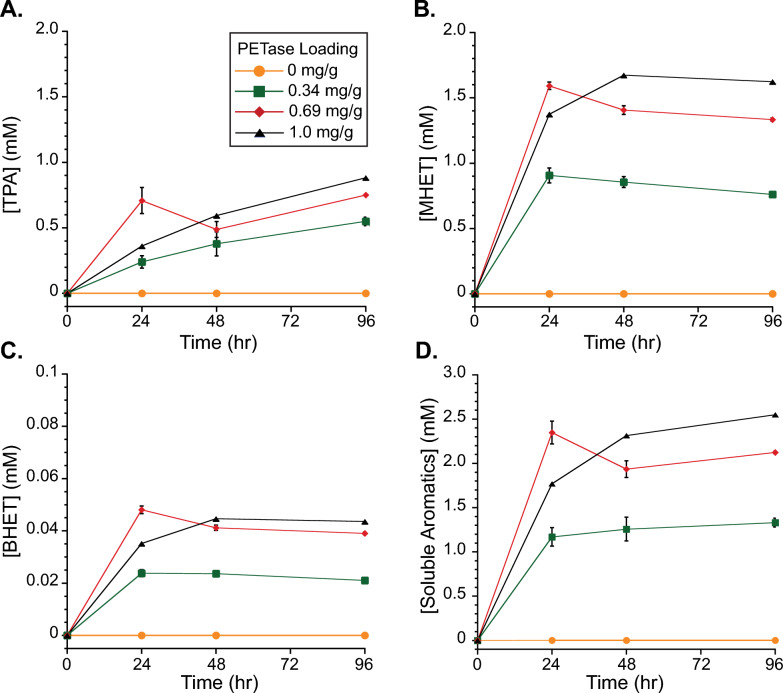
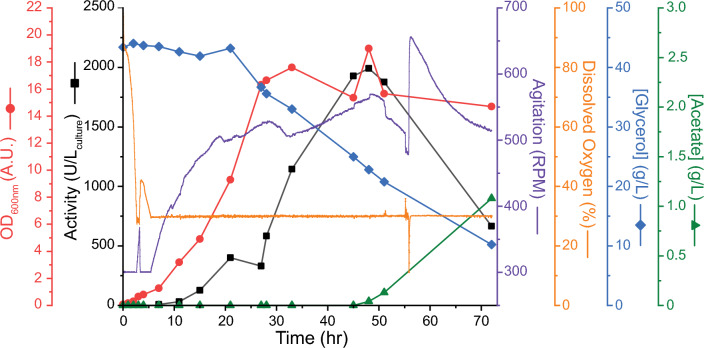
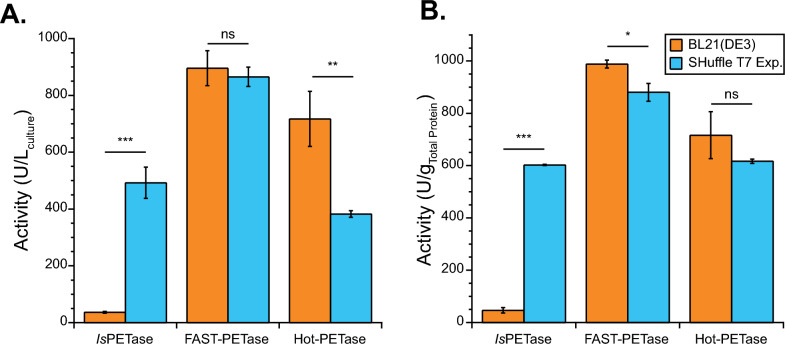
We found expression in SHuffle T7 Express results in higher active expression of IsPETase compared to standard E. coli production strains such as BL21(DE3), reaching a purified titer of 20 mg enzyme per L of culture from shake flasks using 2xLB medium. We characterized purified IsPETase on 4-nitrophenyl acetate and PET microplastics, showing the enzyme produced in the disulfide-bond promoting host has high activity. Using a complex medium with glycerol and a controlled bioreactor, IsPETase titer reached 104 mg per L for a 46-h culture. FAST-PETase was found to be produced at similar levels in BL21(DE3) or SHuffle T7 Express, with purified production reaching 65 mg per L culture when made in BL21(DE3). Hot-PETase titers were greatest in BL21(DE3) reaching 77 mg per L culture.
We provide protein expression methods to produce three important PETase variants. Importantly, for IsPETase, changing expression host, medium optimization and movement to a bioreactor resulted in a 50-fold improvement in production amount with a per cell dry weight productivity of 0.45 mg g h, which is tenfold greater than that for K. pastoris. We show that the benefit of using SHuffle T7 Express for expression only extends to IsPETase, with FAST-PETase and Hot-PETase better produced and purified from BL21(DE3), which is unexpected given the number of cysteines present. This work represents a systematic evaluation of protein expression and purification conditions for PETase variants to permit further study of these important enzymes.
使用酶(如 PETase)将聚对苯二甲酸乙二醇酯(PET)塑料解聚为可提供可持续的化学回收途径。为了增强降解,许多研究小组试图对 PETase 进行工程改造,以提高其对 PET 的催化速度和稳定性。然而,人们很少关注大量表达该酶,这对于大规模应用和广泛使用是必要的。在这项工作中,我们评估了几种大肠杆菌菌株在生产可溶性、折叠和活性 IsPETase 方面的潜力,并将生产转移到台式生物反应器中。由于已知 PETase 需要二硫键才能发挥功能,我们筛选了几种促进二硫键形成的大肠杆菌菌株来生产 IsPETase、FAST-PETase 和 Hot-PETase。
我们发现,与 BL21(DE3) 等标准大肠杆菌生产菌株相比,在 SHuffle T7 Express 中表达可导致 IsPETase 的活性表达更高,从摇瓶中使用 2xLB 培养基可达到每升培养物 20mg 酶的纯化滴度。我们对 4-硝基苯乙酸酯和 PET 微塑料上的纯化 IsPETase 进行了表征,结果表明在促进二硫键形成的宿主中产生的酶具有高活性。使用含有甘油的复杂培养基和控制生物反应器,在 46 小时的培养物中,IsPETase 的滴度达到 104mg/L。发现 FAST-PETase 在 BL21(DE3) 或 SHuffle T7 Express 中以相似的水平产生,当在 BL21(DE3) 中产生时,纯化产量达到每升培养物 65mg。Hot-PETase 的产量在 BL21(DE3) 中最大,达到每升培养物 77mg。
我们提供了生产三种重要 PETase 变体的蛋白质表达方法。重要的是,对于 IsPETase,改变表达宿主、培养基优化和转移到生物反应器可使产量提高 50 倍,每细胞干重的生产力为 0.45mg g h,比毕赤酵母高 10 倍。我们表明,仅使用 SHuffle T7 Express 进行表达的好处仅扩展到 IsPETase,而 FAST-PETase 和 Hot-PETase 则更好地从 BL21(DE3)中进行生产和纯化,这与存在的半胱氨酸数量出乎意料。这项工作代表了对 PETase 变体的蛋白质表达和纯化条件的系统评估,以允许对这些重要酶进行进一步研究。