Department of Cardiology, University Hospital, Zhejiang Normal University, Jinhua, 321000, Zhejiang, China.
Department of Cardiology, Yiwu Central Hospital, Yiwu, 322000, Zhejiang, China.
Sci Rep. 2024 Nov 24;14(1):29110. doi: 10.1038/s41598-024-80763-x.
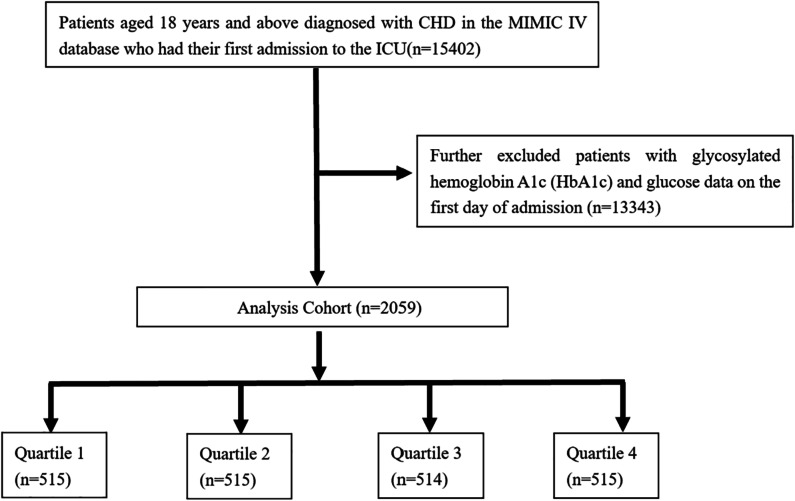
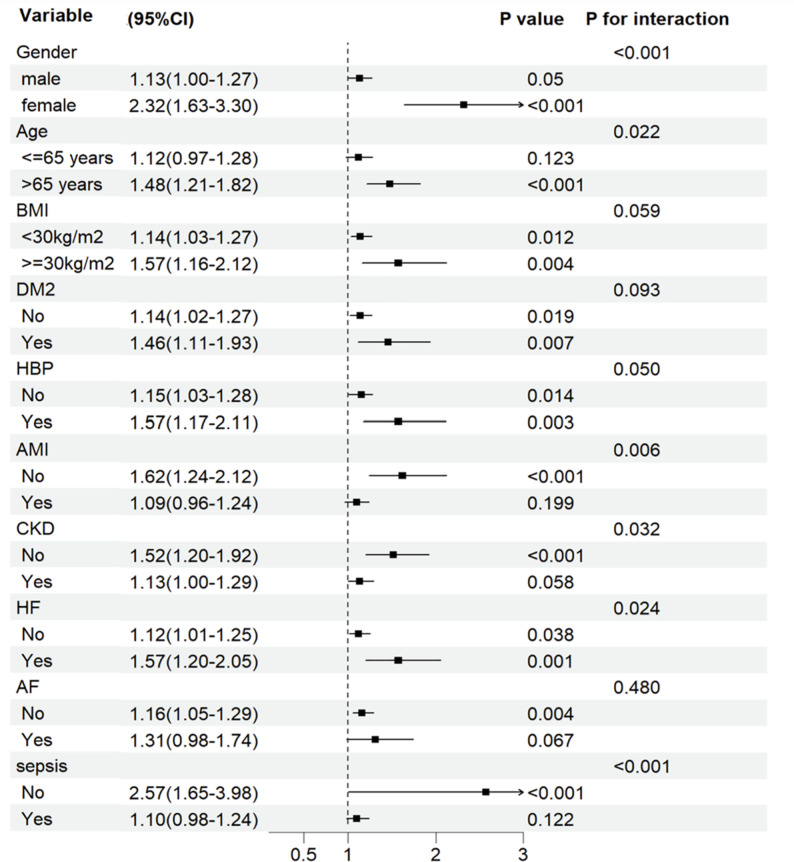
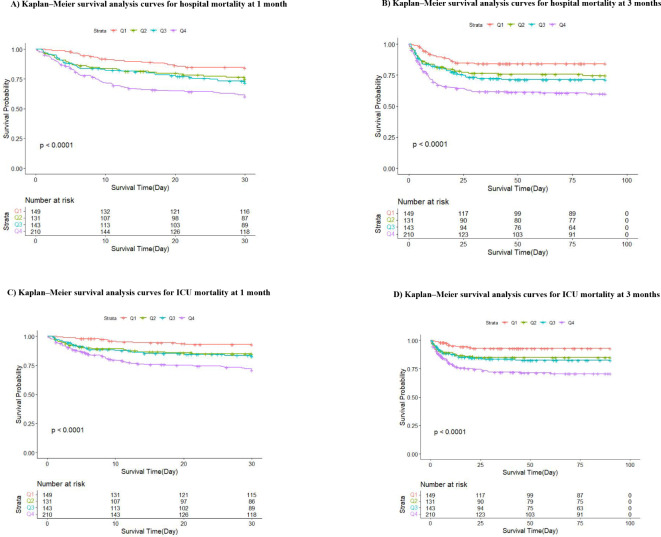
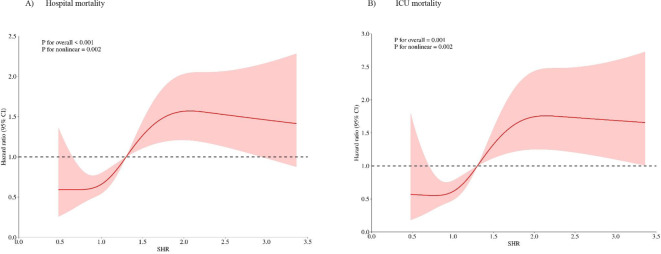
Background The stress hyperglycemia ratio (SHR) indicates relative hyperglycemia levels. Research on the impact of SHR on mortality in coronary heart disease (CHD) patients in intensive care is limited. This study explores the predictive accuracy of SHR for the prognosis of CHD patients in the ICU. Methods This study included 2,059 CHD patients from the American Medical Information Mart for Intensive Care (MIMIC-IV) database. SHR was determined using the formula: SHR = (admission glucose) (mmol/L) / (1.59 * HbA1c [%] - 2.59). Subjects were stratified into quartiles based on SHR levels to examine the correlation between SHR and in-hospital mortality. The restricted cubic splines and Cox proportional hazards models were employed to assess this association, while Kaplan-Meier survival analysis was executed to ascertain the mortality rates across the SHR quartiles. Results Among the 2059 participants (1358 men), the rates of in-hospital and ICU mortality were 8.5% and 5.25%, respectively. Analysis showed SHR as a significant predictor of increased risk for both in-hospital (HR,1.16, 95% CI: 1.02-1.32, P = 0.022) and ICU mortality (HR, 1.16, 95% CI: 1.01-1.35, P = 0.040) after adjustments. A J-shaped relationship was noted between SHR and mortality risks (p for non-linearity = 0.002, respectively). Kaplan-Meier analysis confirmed substantial differences in in-hospital and ICU mortality across SHR quartiles. Conclusions SHR significantly predicts in-hospital and ICU mortality in critically ill CHD patients, indicating that higher SHR levels correlate with longer ICU stays and increased mortality. This underscores the potential of SHR as a prognostic marker for ICU CHD patients.
应激性高血糖比值(SHR)表示相对高血糖水平。关于 SHR 对重症监护中冠心病(CHD)患者死亡率影响的研究有限。本研究旨在探讨 SHR 对 ICU 中 CHD 患者预后的预测准确性。
本研究纳入了来自美国医疗信息集市重症监护数据库(MIMIC-IV)的 2059 例 CHD 患者。SHR 采用公式:SHR =(入院时血糖)(mmol/L)/(1.59*HbA1c [%]-2.59)确定。根据 SHR 水平将受试者分为四组,以检查 SHR 与住院死亡率之间的相关性。采用限制性立方样条和 Cox 比例风险模型评估这种关联,同时进行 Kaplan-Meier 生存分析以确定 SHR 四分位数之间的死亡率。
在 2059 名参与者(1358 名男性)中,住院和 ICU 死亡率分别为 8.5%和 5.25%。分析表明,SHR 是住院(HR,1.16,95%CI:1.02-1.32,P=0.022)和 ICU 死亡率(HR,1.16,95%CI:1.01-1.35,P=0.040)的显著预测因素,调整后。SHR 与死亡率风险之间呈 J 形关系(非线性 P 值分别为 0.002)。Kaplan-Meier 分析证实,SHR 四分位数之间在住院和 ICU 死亡率方面存在显著差异。
SHR 显著预测重症 CHD 患者的住院和 ICU 死亡率,表明较高的 SHR 水平与 ICU 停留时间延长和死亡率增加相关。这突显了 SHR 作为 ICU 中 CHD 患者预后标志物的潜力。