Department of Ophthalmology, Show Chwan Memorial Hospital, Changhua, Taiwan.
Institute of Medicine, Chung Shan Medical University, Taichung, Taiwan.
Sci Rep. 2024 Nov 25;14(1):29184. doi: 10.1038/s41598-024-79765-6.
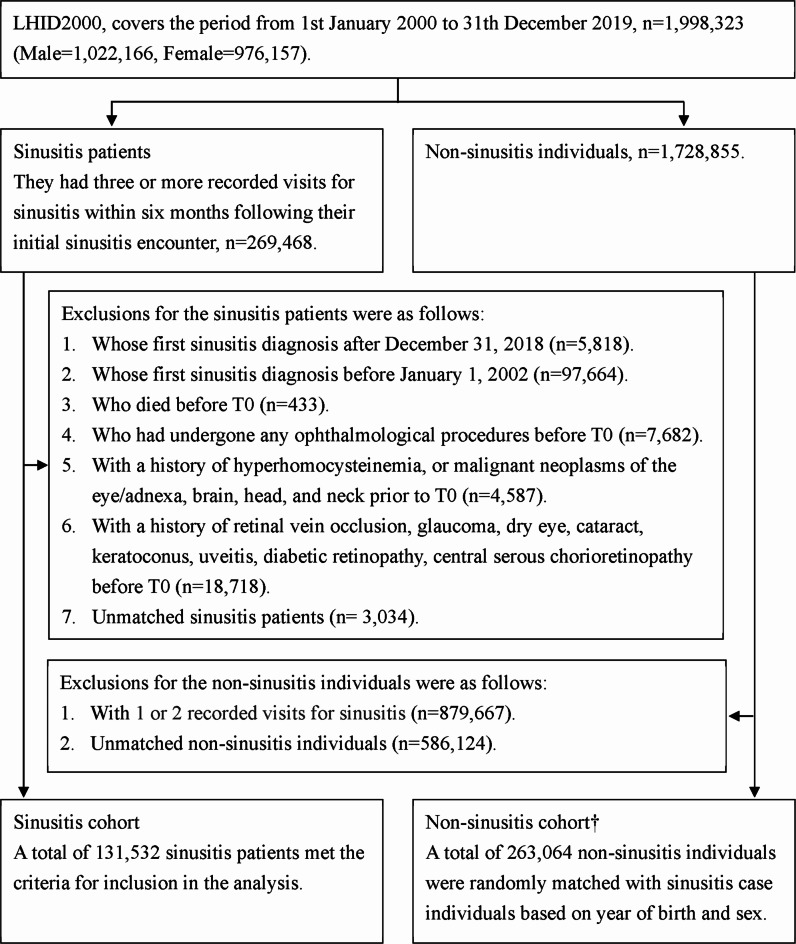
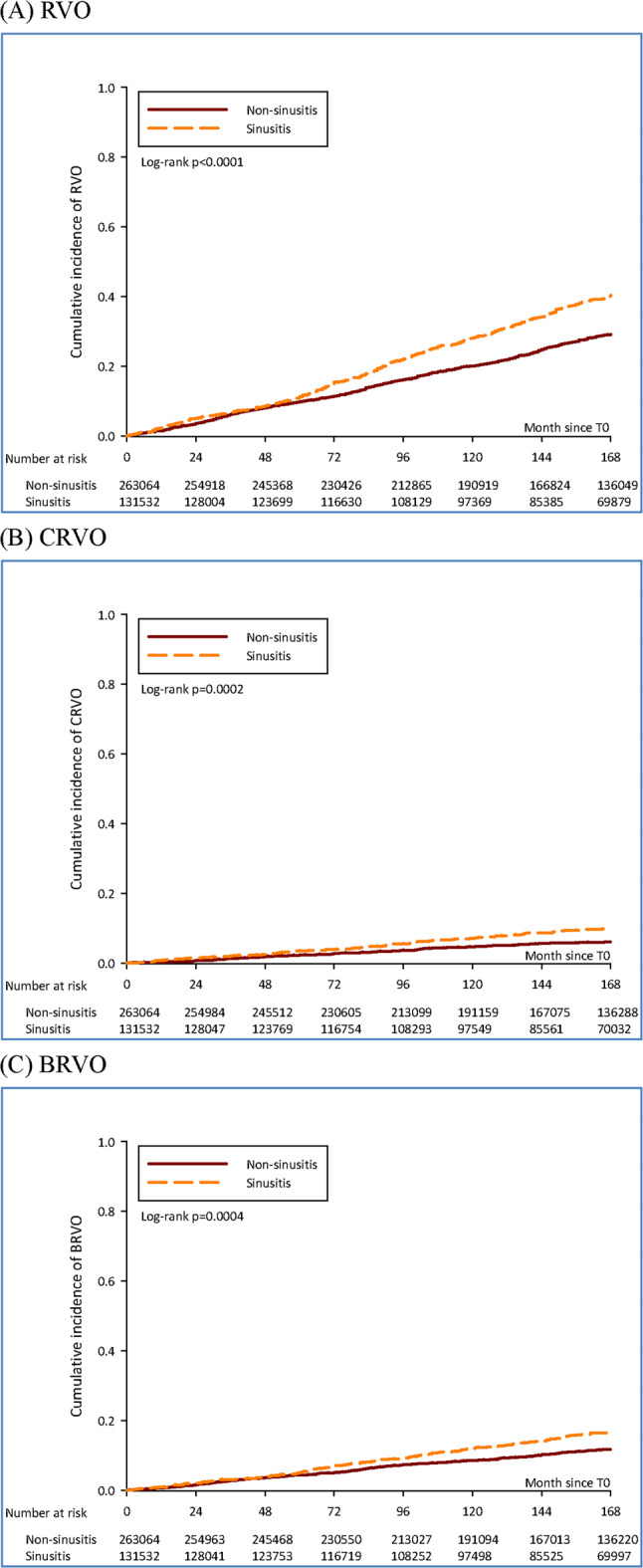
Retinal vein occlusion (RVO) is a common retinal vascular disease that causes visual impairment. However, there is limited evidence regarding the relationship between sinusitis and risk of RVO. This study investigated the association between sinusitis and the subsequent risk of RVO disease. A retrospective cohort study was conducted and patients with sinusitis or RVO were selected from the National Health Insurance Research Database (NHIRD) of Taiwan. In this population-based study, we identified a total of 131,532 sinusitis patients, who were matched with 263,064 non-sinusitis individuals based on sex and age. The Cox proportional hazard regression was applied to demonstrate the adjusted hazard ratio (aHR) with 95% confidence interval (CI) of main outcomes. Our results showed that the crude hazard ratio (cHR) for the risk of RVO was 1.35 (95% CI: 1.20-1.52) in the sinusitis cohort compared with the non-sinusitis cohort. After adjustment for demographics and comorbidities in the multivariable cox regression, the adjusted hazard ratio (aHR) was 1.28 (95% CI: 1.13-1.44). Moreover, statistically significant differences were observed in the 14-year cumulative incidence of RVO (p < 0.0001), central RVO (p = 0.0002), and branch RVO (p = 0.0004) between the sinusitis and non-sinusitis cohorts. In conclusion, our study revealed that patients with sinusitis were at higher risk of being diagnosed with RVO.
视网膜静脉阻塞 (RVO) 是一种常见的视网膜血管疾病,可导致视力障碍。然而,关于鼻窦炎与 RVO 风险之间的关系,证据有限。本研究调查了鼻窦炎与 RVO 疾病风险之间的关联。进行了一项回顾性队列研究,从台湾全民健康保险研究数据库 (NHIRD) 中选择了鼻窦炎或 RVO 患者。在这项基于人群的研究中,我们共确定了 131532 例鼻窦炎患者,并根据性别和年龄与 263064 例非鼻窦炎个体进行了匹配。应用 Cox 比例风险回归来显示主要结局的调整后危险比 (aHR) 和 95%置信区间 (CI)。我们的结果表明,与非鼻窦炎队列相比,鼻窦炎队列中 RVO 的粗危险比 (cHR) 为 1.35 (95%CI: 1.20-1.52)。在校正多变量 Cox 回归中的人口统计学和合并症后,调整后的危险比 (aHR) 为 1.28 (95%CI: 1.13-1.44)。此外,在 14 年的 RVO (p < 0.0001)、中心 RVO (p = 0.0002) 和分支 RVO (p = 0.0004) 的累积发生率方面,鼻窦炎和非鼻窦炎队列之间存在统计学显著差异。总之,我们的研究表明,鼻窦炎患者患 RVO 的风险更高。