Health and Biosecurity, Commonwealth Scientific and Industrial Research Organisation (CSIRO), Adelaide, South Australia, Australia.
Health and Biosecurity, Commonwealth Scientific and Industrial Research Organisation (CSIRO), Westmead, New South Wales, Australia.
J Hum Nutr Diet. 2025 Feb;38(1):e13398. doi: 10.1111/jhn.13398.
Effective interventions to increase vegetable intake are urgently needed. This systematic rapid review aimed to summarise the effectiveness of interventions targeting increased vegetable intakes across diverse settings.
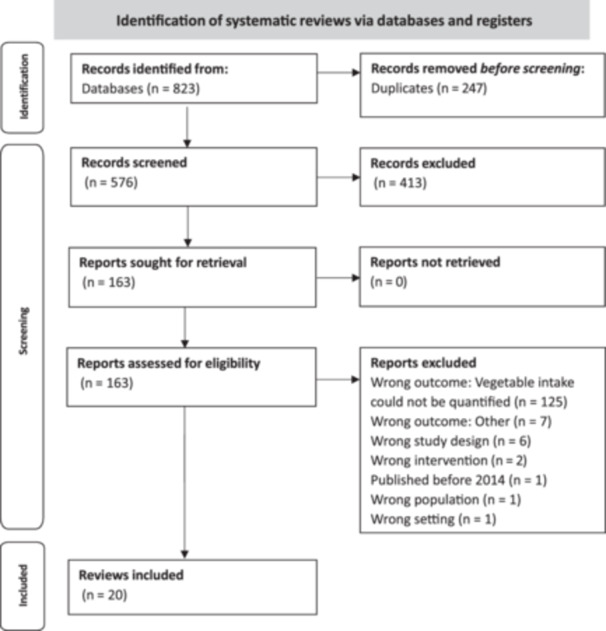
The review was guided by the conduct of rapid reviews from the Cochrane Handbook. The literature was searched in February 2024 across PubMed, Web of Science and Cochrane Central for systematic review articles published since 2014. The Risk of Bias In Systematic Reviews tool was used and characteristics of reviews synthesised narratively with intervention effectiveness results were summarised.
A total of 20 systematic reviews met the eligibility criteria. Most targeted school-based settings (n = 7) or community/home-based settings (n = 4). Early childhood education and workplaces had one review each, with none in retail, secondary or tertiary education, food service, food relief or aged care. The mean change in vegetable consumption was +0.12 serves per day, with increases of up to +0.42 serves reported (range -0.09 to +0.42). By setting, the largest increases were reported for interventions in school settings (+0.42 serves/day), followed by home (+0.38 serves/day). Almost half the studies reporting effect sizes suggested no effect on intake (46%), 41% suggested a small effect and 13% suggested a medium effect. Greater effect sizes were achieved in interventions implemented across multiple settings.
Review findings indicate that the average increase in vegetable intake following interventions is about one-eighth of a serve but up to almost half a serve in some settings. An increase of this magnitude could have a substantial population impact, particularly in population groups with persistently low intakes.
迫切需要有效的干预措施来增加蔬菜摄入量。本系统快速评价旨在总结针对不同环境下增加蔬菜摄入量的干预措施的有效性。
本综述遵循 Cochrane 手册中快速评价的指导原则。2024 年 2 月,在 PubMed、Web of Science 和 Cochrane Central 中检索了自 2014 年以来发表的系统评价文章。使用了系统评价中的偏倚风险工具,并对综述的特点进行了叙述性综合,同时总结了干预效果的结果。
共有 20 篇系统评价符合纳入标准。大多数针对学校(n=7)或社区/家庭(n=4)环境。仅有一项评价针对幼儿教育,另一项评价针对工作场所,而零售、中学或高等教育、食品服务、食品救济或老年护理均没有评价。蔬菜摄入量的平均变化为+0.12 份/天,最高可达+0.42 份(范围为-0.09 至+0.42)。按环境划分,学校环境中的干预措施报告的增幅最大(+0.42 份/天),其次是家庭(+0.38 份/天)。报告效应量的研究中,近一半(46%)表明对摄入量没有影响,41%表明有较小影响,13%表明有中等影响。在跨多个环境实施的干预措施中,实现了更大的效应量。
综述结果表明,干预后蔬菜摄入量的平均增加量约为一份的八分之一,但在某些环境下可增加近半份。这种幅度的增加可能对人群产生重大影响,特别是在摄入量一直较低的人群中。