Wray Anita, Petrou Eleni, Nichols Krista M, Pacunski Robert, LeClair Larry, Andrews Kelly S, Haggarty Dana, Hauser Lorenz
School of Aquatic and Fishery Sciences, University of Washington, Seattle, Washington, USA.
Conservation Biology Division, Northwest Fisheries Science Center, National Marine Fisheries Service, NOAA, Seattle, Washington, USA.
Mol Ecol. 2025 Jan;34(1):e17590. doi: 10.1111/mec.17590. Epub 2024 Nov 25.
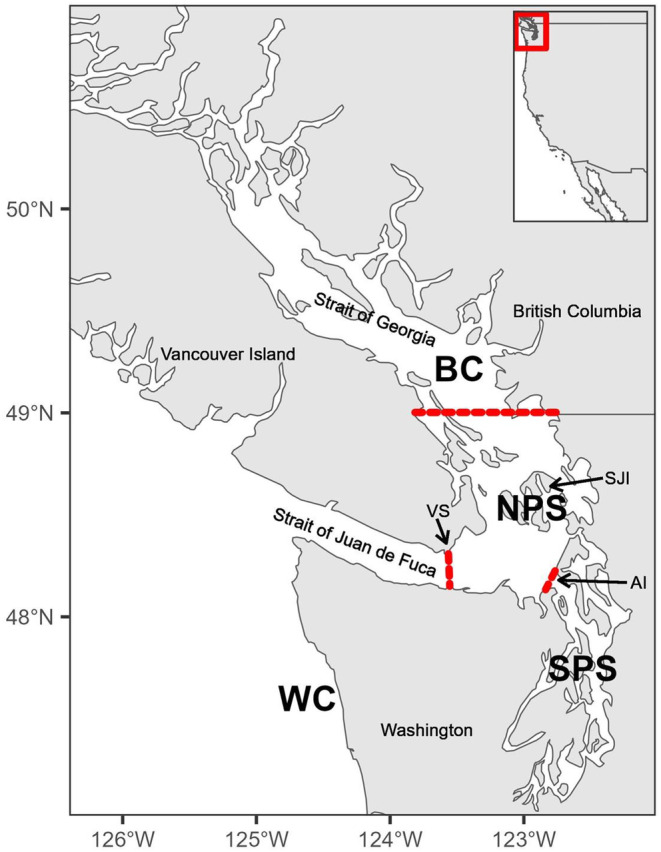
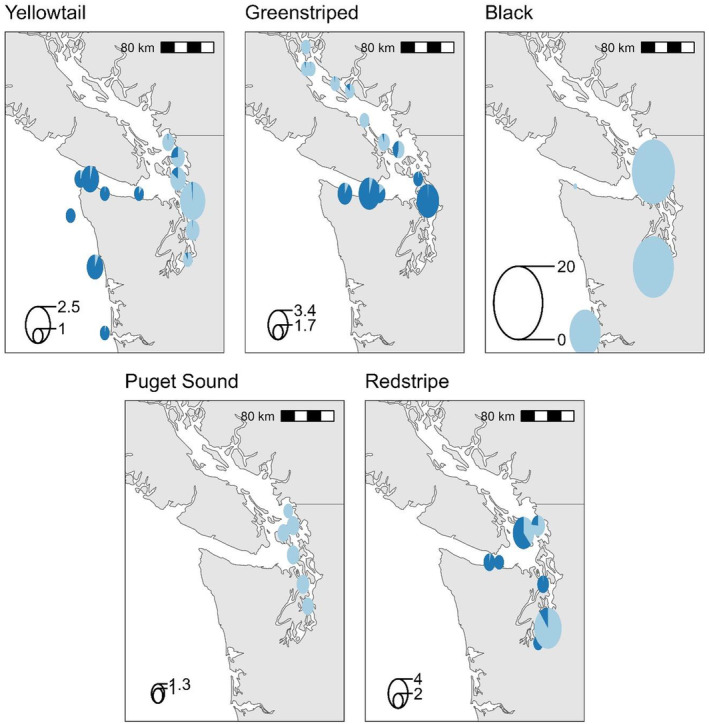
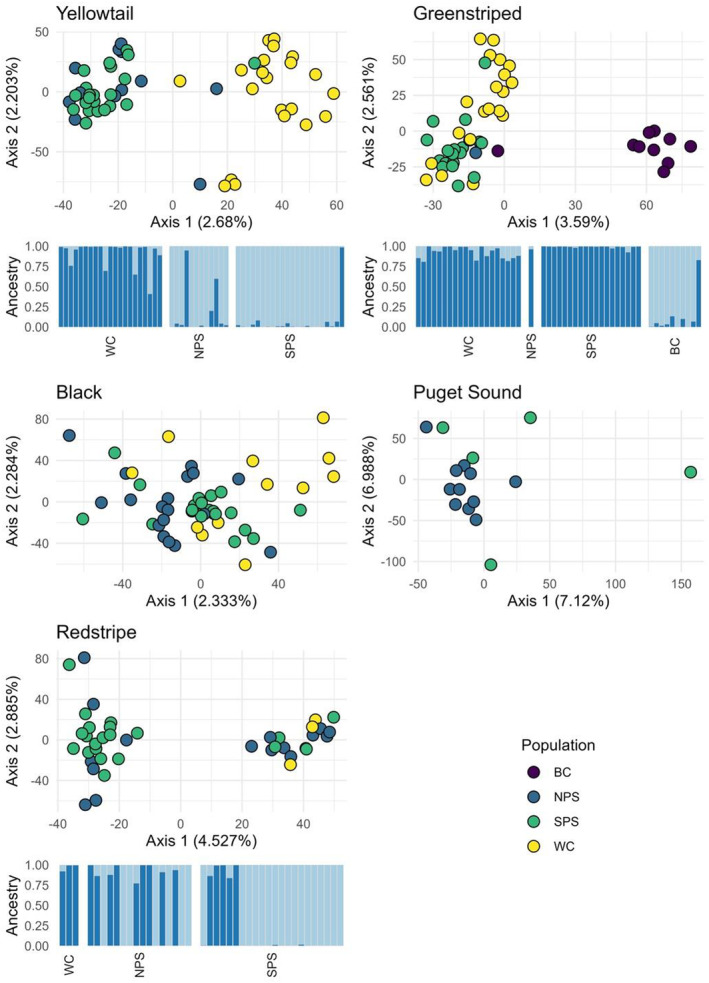
Quantifying connectivity between endangered or threatened marine populations is critical information for management and conservation, especially where abundance and productivity differ among such populations. Spatial patterns of such connectivity depend not only on extrinsic factors such as oceanography and bathymetry but also on intrinsic species-specific factors such as life history, demography and the location of glacial refugia. Nevertheless, population structure is often inferred from related or ecologically similar species. For example, the population structure in most rockfish species (Sebastes spp.) in the Salish Sea and the US West Coast is currently inferred from genetic data of three species that are known to hybridise in Puget Sound. Here, we determined the population structure and connectivity in five Puget Sound Rockfish species (Black [Sebastes melanops], Yellowtail [S. flavidus], Redstripe [S. proriger], Greenstriped [S. elongatus], and Puget Sound Rockfish [S. emphaeus]) from over 12,000 restriction-site associated DNA sequencing (RADseq) loci. We found species-specific patterns of genetic differentiation, attributable to both extrinsic and intrinsic factors. Specifically, Black and Puget Sound rockfishes showed no genetic differentiation; Yellowtail and Greenstriped rockfishes were structured according to known geographic barriers; and Redstripe Rockfish revealed evidence for temporal genetic differentiation, suggesting irregular recruitment influences population structure. Only Yellowtail Rockfish followed the federal DPS boundaries generally assumed for rockfish, further emphasizing the importance of species-specific management for the effective recovery and management of these rockfish populations and of marine species in general.
量化濒危或受威胁海洋种群之间的连通性是管理和保护的关键信息,特别是在这些种群的丰度和生产力存在差异的情况下。这种连通性的空间模式不仅取决于海洋学和水深测量等外在因素,还取决于内在的物种特异性因素,如生活史、种群统计学和冰川避难所的位置。然而,种群结构通常是从相关或生态相似的物种推断出来的。例如,萨利希海和美国西海岸大多数岩鱼物种(Sebastes spp.)的种群结构目前是根据已知在普吉特海湾杂交的三个物种的遗传数据推断出来的。在这里,我们从超过12000个限制性位点相关DNA测序(RADseq)位点确定了五种普吉特海湾岩鱼物种(黑岩鱼 [Sebastes melanops]、黄尾岩鱼 [S. flavidus]、红纹岩鱼 [S. proriger]、绿纹岩鱼 [S. elongatus] 和普吉特海湾岩鱼 [S. emphaeus])的种群结构和连通性。我们发现了归因于外在和内在因素的物种特异性遗传分化模式。具体而言,黑岩鱼和普吉特海湾岩鱼没有遗传分化;黄尾岩鱼和绿纹岩鱼根据已知的地理屏障形成结构;红纹岩鱼显示出时间遗传分化的证据,表明不规则的补充影响种群结构。只有黄尾岩鱼总体上遵循了通常为岩鱼假定的联邦 DPS 边界,这进一步强调了针对这些岩鱼种群以及一般海洋物种的有效恢复和管理进行物种特异性管理的重要性。