Faculty of Medicine of Tunis - LR99ES09 Research Laboratory «Antimicrobial resistance», University of Tunis El Manar, 1007, Tunis, Tunisia.
Laboratory of Microbiology, Charles Nicolle Hospital, 1006, Tunis, Tunisia.
Sci Rep. 2024 Nov 26;14(1):29324. doi: 10.1038/s41598-024-77844-2.
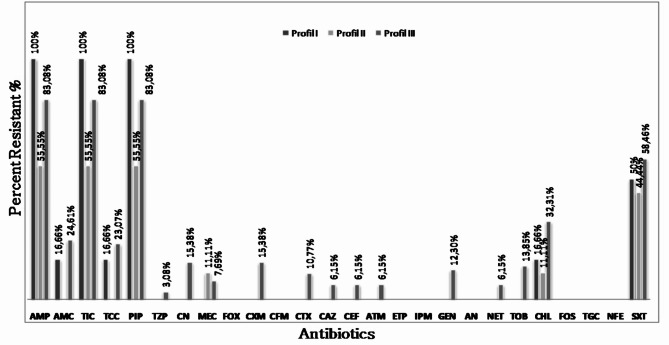
Fluoroquinolone-resistant (FQs-R) microorganisms causing infectious complications after ultrasound-guided needle biopsy of the prostate (TRUS-BP) have become an important challenge in healthcare settings globally, questioning the continued utility of FQ as the preferred prophylactic agent. This study aimed to characterize molecular mechanisms of resistance on FQs-R E. coli isolated from the enteric microbiota of patients undergoing (TRUS-BP) and to highlight their impact on Minimum Inhibitory Concentrations (MICs). From February 2016 to December 2018, the incidence of rectal carriage of Qs-FQs resistant Enterobacterales detected from rectal swabs of patients before undergoing (TRUS-BP) was 61.06% (80/131) all related to E. coli species. Based on the MICs range of Qs (24-256 mg/L) and FQs (0.24-128 mg/L) breakpoint by EUCAST, we categorized these E. coli isolates into three resistance profiles (I, II, and III) associated with the patterns of chromosomal mutations in the quinolone resistance-determining regions (QRDRs) of gyrA and parC and the plasmid-mediated quinolone resistance encoding genes (PMQRs) detected by PCR-based assay and sequencing; MICs increase in an escalation step according to the co-occurrence of multiple molecular mechanisms. The mutation of the gyrA gene was the most frequent on codons (Ser83Leu/Thr/Tyr/Trp and Asp87Asn); mutation on the parC gene was the least on codons (Ser80Iso/Leu and Glu84 Val/Gly/Lys). PMQRs genes (4 qnrB ,7 qnrS, and one aac(6')-Ib-cr) were determined within 15% of the isolates. Allelic variation allows us to report earliest the qnrB81 determinant in an E. coli isolate. Among isolates (35%) belonged to the notorious ST131 lineage. The phylogenetic group showed a predominance of B2 group (51, 25%), however (PFGE) revealed a high level of clonal variability. Worrying incidence of FQs-R E. coli isolates in the rectal flora of our local population showed the potential to cause post-infection. FQ resistance is a complex interplay between mutations in the QRDRs and PMQR determinants that impact MICs. The importance of intestinal microbiota as a reservoir of resistant strains and pandemic clones encourages driving mitigation challenges to characterize molecular mechanisms of antimicrobial resistance to adapt prophylactic therapy, control infection, and ensure epidemiological monitoring.
氟喹诺酮耐药(FQs-R)微生物引起的经超声引导前列腺针吸活检(TRUS-BP)后的感染性并发症已成为全球医疗保健领域的重要挑战,质疑氟喹诺酮作为首选预防剂的持续效用。本研究旨在对从接受 TRUS-BP 的患者肠道微生物群中分离出的 FQs-R 大肠杆菌的耐药分子机制进行特征描述,并强调其对最小抑菌浓度(MIC)的影响。从 2016 年 2 月至 2018 年 12 月,从接受 TRUS-BP 的患者直肠拭子中检测到直肠携带 Qs-FQs 耐药肠杆菌的发生率为 61.06%(80/131),均与大肠杆菌有关。根据 EUCAST 规定的 Qs(24-256mg/L)和 FQs(0.24-128mg/L)的 MIC 范围,我们将这些大肠杆菌分离株分为与染色体突变模式相关的三种耐药谱(I、II 和 III)喹诺酮耐药决定区(QRDRs)中的 gyrA 和 parC 以及通过基于 PCR 的检测和测序检测到的质粒介导的氟喹诺酮耐药编码基因(PMQRs);根据多种分子机制的共存,MIC 按递增步骤增加。gyrA 基因的突变最常见于密码子(Ser83Leu/Thr/Tyr/Trp 和 Asp87Asn);parC 基因的突变最常见于密码子(Ser80Iso/Leu 和 Glu84 Val/Gly/Lys)。在 15%的分离株中确定了 PMQRs 基因(4 qnrB、7 qnrS 和一个 aac(6')-Ib-cr)。等位基因变异使我们能够最早报告大肠杆菌分离株中 qnrB81 决定簇。在分离株中(35%)属于臭名昭著的 ST131 谱系。进化群显示 B2 群(51、25%)占主导地位,然而(PFGE)显示出高水平的克隆变异性。我们当地人群直肠菌群中出现的氟喹诺酮耐药大肠杆菌分离株的发生率令人担忧,这可能导致感染后出现问题。FQ 耐药是 QRDRs 和 PMQR 决定簇突变之间的复杂相互作用,影响 MIC。肠道微生物群作为耐药菌株和流行克隆的储存库的重要性鼓励推动缓解挑战,以对抗菌药物耐药性的分子机制进行特征描述,以适应预防治疗、控制感染和确保流行病学监测。