
紫苏籽油:健康功效、包封策略及其在食品中的应用综述
Perilla Seed Oil: A Review of Health Effects, Encapsulation Strategies and Applications in Food.
作者信息
Li Min, Jiang Nanjie, Guo Guangqi, Lu Shuaijun, Li Ziliang, Mu Yujie, Xia Xiaoyang, Xu Zhenxia, Hu Yong, Xiang Xia
机构信息
Key Laboratory of Fermentation Engineering (Ministry of Education), Hubei Key Laboratory of Industrial Microbiology, National "111" Center for Cellular Regulation and Molecular Pharmaceutics, Hubei Research Center of Food Fermentation Engineering and Technology, Cooperative Innovation Center of Industrial Fermentation (Ministry of Education & Hubei Province), Hubei University of Technology, Wuhan 430068, China.
Oil Crops Research Institute of Chinese Academy of Agricultural Sciences, Oil Crops and Lipids Process Technology National & Local Joint Engineering Laboratory, Key Laboratory of Oilseeds Processing, Ministry of Agriculture and Rural Affairs, Hubei Key Laboratory of Lipid Chemistry and Nutrition, Wuhan 430062, China.
出版信息
Foods. 2024 Nov 13;13(22):3615. doi: 10.3390/foods13223615.
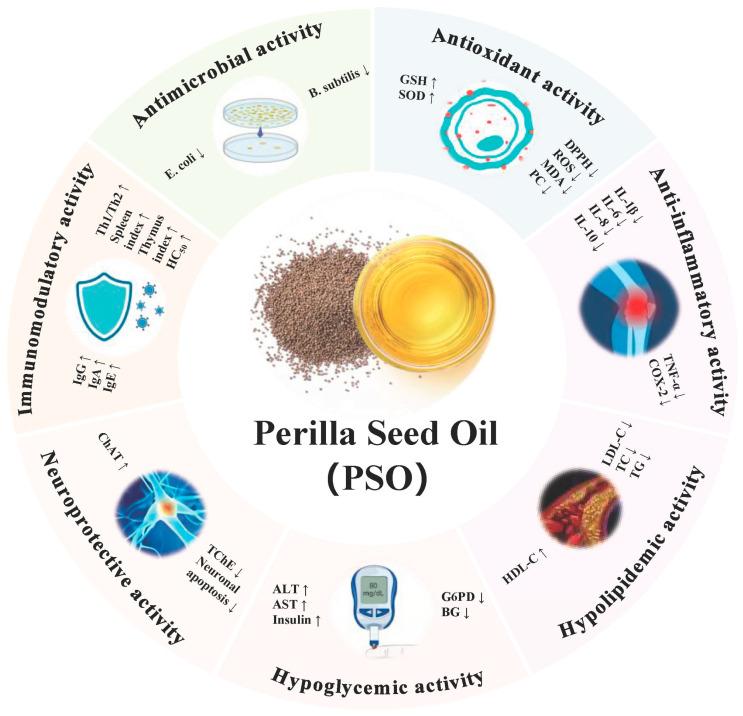
Perilla ( L.) is an annual herbaceous plant whose seed oil is rich in unsaturated fatty acids such as alpha-linolenic acid (ALA). This oil exhibits various health benefits, including antioxidant, anti-inflammatory, lipid-lowering, hypoglycemic, neuroprotective and immunomodulatory activities. In addition, incorporating perilla oil into a diet can effectively increase the abundance of beneficial bacteria in the gut microbiota. However, perilla oil is prone to oxidation, which reduces its nutritional value and lowers its bioavailability. To address these issues, encapsulation technologies such as emulsions, oleogels, liposomes and microcapsules have been employed, showing promising results. Nonetheless, further research is needed to fully elucidate the underlying mechanisms of perilla seed oil's health effects, validate its benefits through large-scale human clinical trials and optimize encapsulation techniques. Future investigations should also explore the synergistic effects of combining perilla seed oil with other functional components and its role in modulating gut microbiota to achieve comprehensive health benefits.
紫苏是一种一年生草本植物,其种子油富含α-亚麻酸(ALA)等不饱和脂肪酸。这种油具有多种健康益处,包括抗氧化、抗炎、降脂、降糖、神经保护和免疫调节活性。此外,将紫苏油纳入饮食可以有效增加肠道微生物群中有益细菌的数量。然而,紫苏油容易氧化,这会降低其营养价值并降低其生物利用度。为了解决这些问题,人们采用了乳液、油凝胶、脂质体和微胶囊等包封技术,并取得了有前景的结果。尽管如此,仍需要进一步研究以充分阐明紫苏籽油健康效应的潜在机制,通过大规模人体临床试验验证其益处,并优化包封技术。未来的研究还应探索将紫苏籽油与其他功能成分结合的协同效应及其在调节肠道微生物群以实现全面健康益处方面的作用。

 Zotero 插件