Chu Longfei, Liu Ancheng, Chang Jiaxi, Zhang Junhao, Hou Xiujiang, Zhu Xinghai, Xing Qiang, Bao Zhenmin
MOE Key Laboratory of Marine Genetics and Breeding, College of Marine Life Sciences, Ocean University of China, 5 Yushan Road, Qingdao 266003, China.
Laboratory for Marine Fisheries Science and Food Production Processes, Qingdao Marine Science and Technology Center, Qingdao 266237, China.
Antioxidants (Basel). 2024 Nov 6;13(11):1359. doi: 10.3390/antiox13111359.
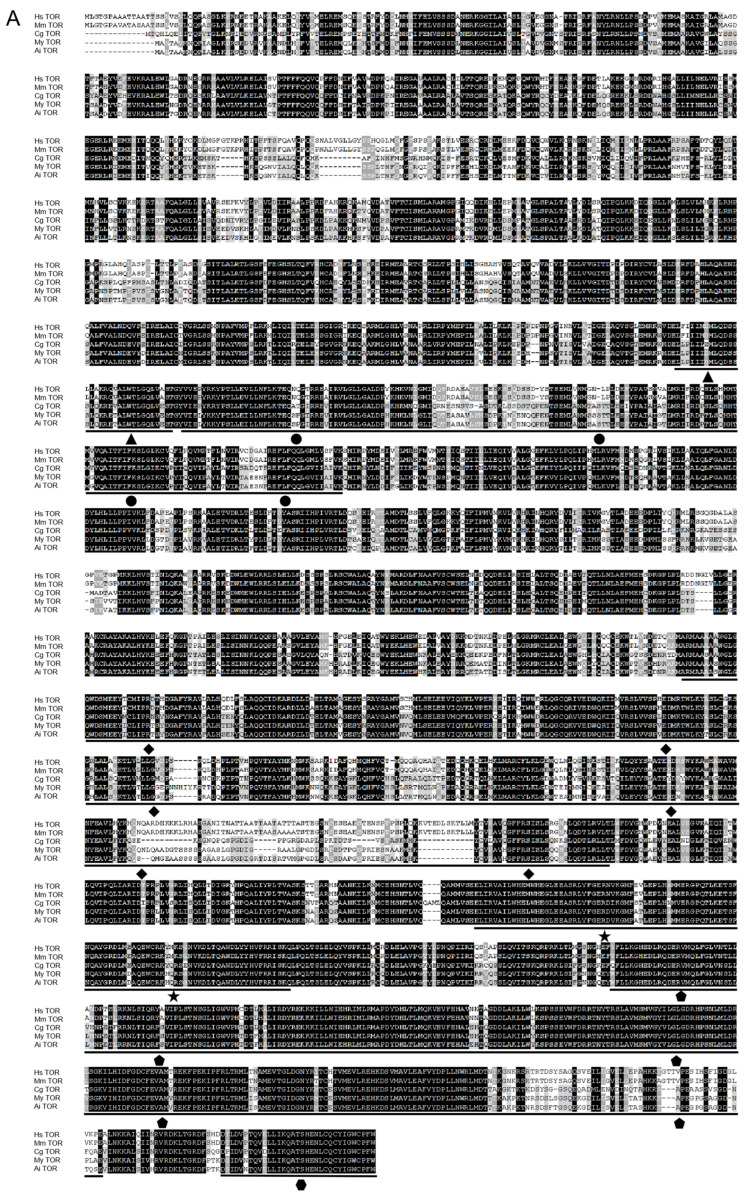
Target of rapamycin complex 1 (TORC1) is a key regulator of metabolism in eukaryotes across multiple pathways. Although TORC1 has been extensively studied in vertebrates and some invertebrates, research on this complex in scallops is limited. In this study, we identified the genes encoding TORC1 complex subunits in the scallop through genome-wide in silico scanning. Five genes, including , , , , and , that encode the subunits of TORC1 complex were identified in the bay scallop. We then conducted structural characterization and phylogenetic analysis of the TORC1 (AiTORC1) subunits to determine their structural features and evolutionary relationships. Next, we analyzed the spatiotemporal expressions of AiTORC1-coding genes during various embryo/larvae developmental stages and across different tissues in healthy adult scallops. The results revealed stage- and tissue-specific expression patterns, suggesting diverse roles in development and growth. Furthermore, the regulation of AiTORC1-coding genes was examined in temperature-sensitive tissues (the mantle, gill, hemocyte, and heart) of bay scallops exposed to high-temperature (32 °C) stress over different durations (0 h, 6 h, 12 h, 24 h, 3 d, 6 d, and 10 d). The expression of AiTORC1-coding genes was predominantly suppressed in the hemocyte but was generally activated in the mantle, gill, and heart, indicating a tissue-specific response to heat stress. Finally, functional validation was performed using the TOR inhibitor rapamycin to suppress AiTORC1, leading to an enhanced catabolism, a decreased antioxidant capacity, and a significant reduction in thermotolerance in bay scallops. Collectively, this study elucidates the presence, structural features, evolutional relationships, expression profiles, and roles in antioxidant capacity and metabolism regulation of AiTORC1 in the bay scallop, providing a preliminary understanding of its versatile functions in response to high-temperature challenges in marine mollusks.
雷帕霉素靶蛋白复合体1(TORC1)是真核生物中多条代谢途径的关键调节因子。尽管TORC1已在脊椎动物和一些无脊椎动物中得到广泛研究,但在扇贝中对该复合体的研究却很有限。在本研究中,我们通过全基因组电子扫描在扇贝中鉴定了编码TORC1复合体亚基的基因。在海湾扇贝中鉴定出了五个编码TORC1复合体亚基的基因,包括[具体基因名称未给出]、[具体基因名称未给出]、[具体基因名称未给出]、[具体基因名称未给出]和[具体基因名称未给出]。然后,我们对TORC1(AiTORC1)亚基进行了结构表征和系统发育分析,以确定它们的结构特征和进化关系。接下来,我们分析了AiTORC1编码基因在各种胚胎/幼虫发育阶段以及健康成年扇贝不同组织中的时空表达。结果揭示了阶段和组织特异性的表达模式,表明其在发育和生长中具有多种作用。此外,我们在暴露于不同时长(0小时、6小时、12小时、24小时、3天、6天和10天)高温(32℃)胁迫的海湾扇贝的温度敏感组织(外套膜、鳃、血细胞和心脏)中检测了AiTORC1编码基因的调控情况。AiTORC1编码基因的表达在血细胞中主要受到抑制,但在外套膜、鳃和心脏中通常被激活,表明对热应激存在组织特异性反应。最后,使用TOR抑制剂雷帕霉素进行功能验证以抑制AiTORC1,导致海湾扇贝的分解代谢增强、抗氧化能力下降以及耐热性显著降低。总体而言,本研究阐明了海湾扇贝中AiTORC1的存在、结构特征、进化关系、表达谱以及在抗氧化能力和代谢调节中的作用,为初步了解其在应对海洋软体动物高温挑战中的多种功能提供了依据。