• 文献检索
  • 文档翻译
  • 深度研究
  • 学术资讯
  • Suppr Zotero 插件Zotero 插件
  • 邀请有礼
  • 套餐&价格
  • 历史记录
应用&插件
Suppr Zotero 插件Zotero 插件浏览器插件Mac 客户端Windows 客户端微信小程序
定价
高级版会员购买积分包购买API积分包
服务
文献检索文档翻译深度研究API 文档MCP 服务
关于我们
关于 Suppr公司介绍联系我们用户协议隐私条款
关注我们

Suppr 超能文献

核心技术专利:CN118964589B侵权必究
粤ICP备2023148730 号-1Suppr @ 2026

文献检索

告别复杂PubMed语法,用中文像聊天一样搜索,搜遍4000万医学文献。AI智能推荐,让科研检索更轻松。

立即免费搜索

文件翻译

保留排版,准确专业,支持PDF/Word/PPT等文件格式,支持 12+语言互译。

免费翻译文档

深度研究

AI帮你快速写综述,25分钟生成高质量综述,智能提取关键信息,辅助科研写作。

立即免费体验

基于可解释机器学习的乳腺癌患者死亡率预测模型

Mortality Prediction Modeling for Patients with Breast Cancer Based on Explainable Machine Learning.

作者信息

Park Sang Won, Park Ye-Lin, Lee Eun-Gyeong, Chae Heejung, Park Phillip, Choi Dong-Woo, Choi Yeon Ho, Hwang Juyeon, Ahn Seohyun, Kim Keunkyun, Kim Woo Jin, Kong Sun-Young, Jung So-Youn, Kim Hyun-Jin

机构信息

Department of Medical Informatics, School of Medicine, Kangwon National University, Chuncheon 24341, Republic of Korea.

Institute of Medical Science, School of Medicine, Kangwon National University, Chuncheon 24341, Republic of Korea.

出版信息

Cancers (Basel). 2024 Nov 12;16(22):3799. doi: 10.3390/cancers16223799.

DOI:10.3390/cancers16223799
PMID:39594754
原文链接:https://pmc.ncbi.nlm.nih.gov/articles/PMC11592669/
Abstract

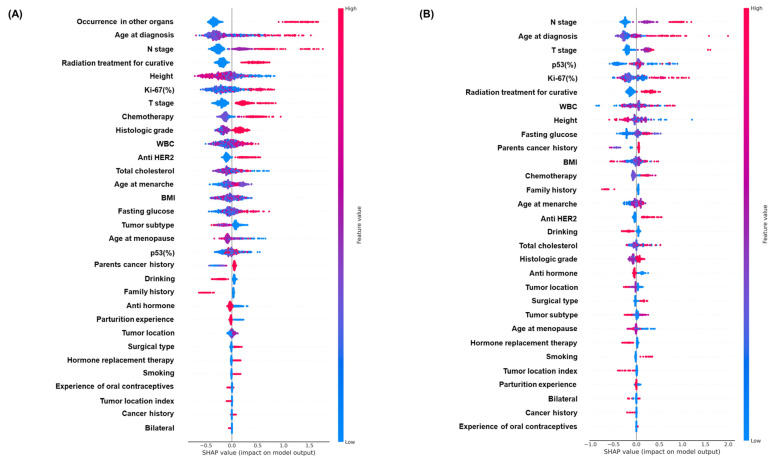
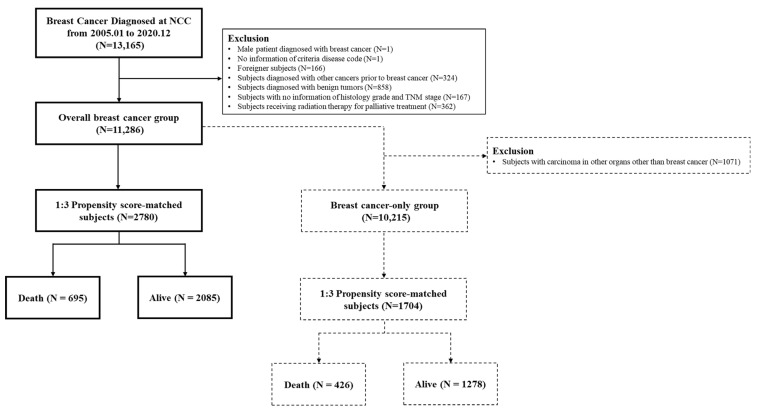
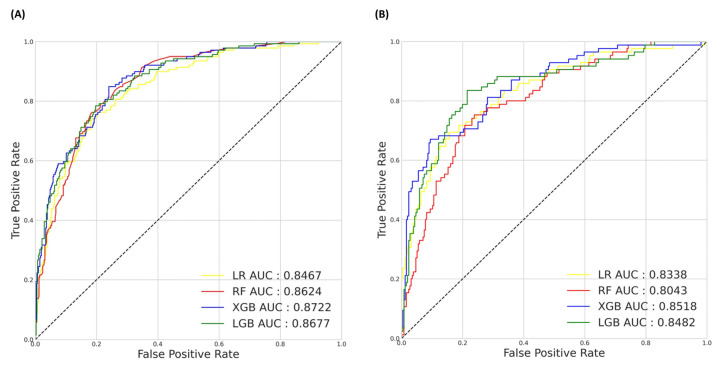
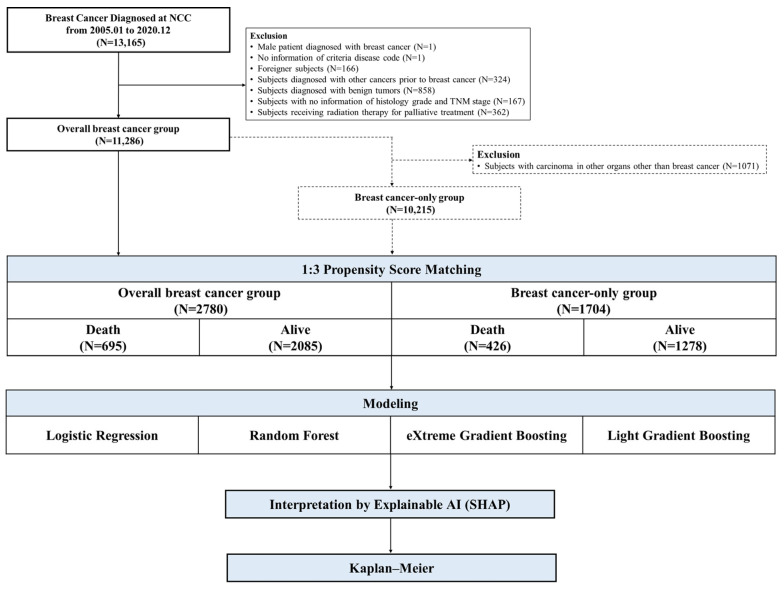
: Breast cancer is the most common cancer in women worldwide, requiring strategic efforts to reduce its mortality. This study aimed to develop a predictive classification model for breast cancer mortality using real-world data, including various clinical features. : A total of 11,286 patients with breast cancer from the National Cancer Center were included in this study. The mortality rate of the total sample was approximately 6.2%. Propensity score matching was used to reduce bias. Several machine learning models, including extreme gradient boosting, were applied to 31 clinical features. To enhance model interpretability, we used the SHapley Additive exPlanations method. ML analyses were also performed on the samples, excluding patients who developed other cancers after breast cancer. : Among the ML models, the XGB model exhibited the highest discriminatory power, with an area under the curve of 0.8722 and a specificity of 0.9472. Key predictors of the mortality classification model included occurrence in other organs, age at diagnosis, N stage, T stage, curative radiation treatment, and Ki-67(%). Even after excluding patients who developed other cancers after breast cancer, the XGB model remained the best-performing, with an AUC of 0.8518 and a specificity of 0.9766. Additionally, the top predictors from SHAP were similar to the results for the overall sample. : Our models provided excellent predictions of breast cancer mortality using real-world data from South Korea. Explainable artificial intelligence, such as SHAP, validated the clinical applicability and interpretability of these models.

摘要

乳腺癌是全球女性中最常见的癌症,需要采取战略措施降低其死亡率。本研究旨在利用包括各种临床特征在内的真实世界数据,开发一种用于预测乳腺癌死亡率的分类模型。

本研究纳入了国家癌症中心的11286例乳腺癌患者。总样本的死亡率约为6.2%。采用倾向得分匹配法减少偏差。将包括极端梯度提升在内的几种机器学习模型应用于31项临床特征。为了提高模型的可解释性,我们使用了SHapley加性解释方法。还对样本进行了机器学习分析,排除了乳腺癌后发生其他癌症的患者。

在机器学习模型中,XGB模型表现出最高的区分能力,曲线下面积为0.8722,特异性为0.9472。死亡率分类模型的关键预测因素包括其他器官的发生情况、诊断时的年龄、N分期、T分期、根治性放射治疗和Ki-67(%)。即使排除了乳腺癌后发生其他癌症的患者,XGB模型仍然是表现最佳的,曲线下面积为0.8518,特异性为0.9766。此外,SHAP的顶级预测因素与总体样本的结果相似。

我们的模型利用韩国的真实世界数据对乳腺癌死亡率进行了出色的预测。诸如SHAP之类的可解释人工智能验证了这些模型的临床适用性和可解释性。
https://cdn.ncbi.nlm.nih.gov/pmc/blobs/f3f0/11592669/a87ee57d4b30/cancers-16-03799-g004.jpg
https://cdn.ncbi.nlm.nih.gov/pmc/blobs/f3f0/11592669/6b98510b9cb1/cancers-16-03799-g001.jpg
https://cdn.ncbi.nlm.nih.gov/pmc/blobs/f3f0/11592669/e417bdf08667/cancers-16-03799-g002.jpg
https://cdn.ncbi.nlm.nih.gov/pmc/blobs/f3f0/11592669/e0ea4f28ad78/cancers-16-03799-g003.jpg
https://cdn.ncbi.nlm.nih.gov/pmc/blobs/f3f0/11592669/a87ee57d4b30/cancers-16-03799-g004.jpg
https://cdn.ncbi.nlm.nih.gov/pmc/blobs/f3f0/11592669/6b98510b9cb1/cancers-16-03799-g001.jpg
https://cdn.ncbi.nlm.nih.gov/pmc/blobs/f3f0/11592669/e417bdf08667/cancers-16-03799-g002.jpg
https://cdn.ncbi.nlm.nih.gov/pmc/blobs/f3f0/11592669/e0ea4f28ad78/cancers-16-03799-g003.jpg
https://cdn.ncbi.nlm.nih.gov/pmc/blobs/f3f0/11592669/a87ee57d4b30/cancers-16-03799-g004.jpg

相似文献

1
Mortality Prediction Modeling for Patients with Breast Cancer Based on Explainable Machine Learning.基于可解释机器学习的乳腺癌患者死亡率预测模型
Cancers (Basel). 2024 Nov 12;16(22):3799. doi: 10.3390/cancers16223799.
2
Cancer Metastasis Prediction and Genomic Biomarker Identification through Machine Learning and eXplainable Artificial Intelligence in Breast Cancer Research.通过机器学习和可解释人工智能在乳腺癌研究中进行癌症转移预测和基因组生物标志物识别。
Diagnostics (Basel). 2023 Oct 26;13(21):3314. doi: 10.3390/diagnostics13213314.
3
Proposed Comprehensive Methodology Integrated with Explainable Artificial Intelligence for Prediction of Possible Biomarkers in Metabolomics Panel of Plasma Samples for Breast Cancer Detection.结合可解释人工智能的拟议综合方法,用于预测血浆样本代谢组学面板中乳腺癌检测的潜在生物标志物。
Medicina (Kaunas). 2025 Mar 25;61(4):581. doi: 10.3390/medicina61040581.
4
Explainable machine learning model for prediction of 28-day all-cause mortality in immunocompromised patients in the intensive care unit: a retrospective cohort study based on MIMIC-IV database.用于预测重症监护病房免疫功能低下患者28天全因死亡率的可解释机器学习模型:一项基于MIMIC-IV数据库的回顾性队列研究
Eur J Med Res. 2025 May 3;30(1):358. doi: 10.1186/s40001-025-02622-3.
5
Constructing a predictive model for early-onset sepsis in neonatal intensive care unit newborns based on SHapley Additive exPlanations explainable machine learning.基于SHapley加性解释可解释机器学习构建新生儿重症监护病房新生儿早发性败血症的预测模型。
Transl Pediatr. 2024 Nov 30;13(11):1933-1946. doi: 10.21037/tp-24-278. Epub 2024 Nov 26.
6
Predicting dry matter intake in cattle at scale using gradient boosting regression techniques and Gaussian process boosting regression with Shapley additive explanation explainable artificial intelligence, MLflow, and its containerization.使用梯度提升回归技术以及带有夏普利值加法解释的高斯过程提升回归、可解释人工智能、MLflow及其容器化来大规模预测牛的干物质摄入量。
J Anim Sci. 2025 Jan 4;103. doi: 10.1093/jas/skaf041.
7
Development and Validation of an Explainable Machine Learning Model for Predicting Myocardial Injury After Noncardiac Surgery in Two Centers in China: Retrospective Study.中国两个中心用于预测非心脏手术后心肌损伤的可解释机器学习模型的开发与验证:一项回顾性研究
JMIR Aging. 2024 Jul 26;7:e54872. doi: 10.2196/54872.
8
Impact of Tumor Location on Predicting Early-Stage Breast Cancer Patient Survivability Using Explainable Machine Learning Models.肿瘤位置对使用可解释机器学习模型预测早期乳腺癌患者生存率的影响
JCO Clin Cancer Inform. 2025 Mar;9:e2400178. doi: 10.1200/CCI-24-00178. Epub 2025 Mar 31.
9
Explainable Artificial Intelligence in Quantifying Breast Cancer Factors: Saudi Arabia Context.沙特阿拉伯背景下用于量化乳腺癌因素的可解释人工智能
Healthcare (Basel). 2024 May 15;12(10):1025. doi: 10.3390/healthcare12101025.
10
Data-driven survival modeling for breast cancer prognostics: A comparative study with machine learning and traditional survival modeling methods.用于乳腺癌预后的数据驱动生存建模:与机器学习和传统生存建模方法的比较研究。
PLoS One. 2025 Apr 22;20(4):e0318167. doi: 10.1371/journal.pone.0318167. eCollection 2025.

引用本文的文献

1
Predicting in-hospital mortality in patients with alcoholic cirrhosis complicated by severe acute kidney injury: development and validation of an explainable machine learning model.预测酒精性肝硬化合并严重急性肾损伤患者的院内死亡率:一种可解释机器学习模型的开发与验证
Front Med (Lausanne). 2025 May 8;12:1570928. doi: 10.3389/fmed.2025.1570928. eCollection 2025.
2
Explainable machine learning to compare the overall survival status between patients receiving mastectomy and breast conserving surgeries.可解释的机器学习用于比较接受乳房切除术和保乳手术患者的总生存状况。
Sci Rep. 2025 Mar 28;15(1):10700. doi: 10.1038/s41598-025-91064-2.