Liu Chang, Zhang Kai, Yang Xiaodong, Meng Bingbing, Lou Jingsheng, Liu Yanhong, Cao Jiangbei, Liu Kexuan, Mi Weidong, Li Hao
Department of Anesthesiology, The First Medical Center, Chinese People's Liberation Army General Hospital, 28th Fuxing Road, Haidian District, Beijing, 100853, China, 86 15010665099.
Medical School of Chinese People's Liberation Army General Hospital, Beijing, China.
JMIR Aging. 2024 Jul 26;7:e54872. doi: 10.2196/54872.
Myocardial injury after noncardiac surgery (MINS) is an easily overlooked complication but closely related to postoperative cardiovascular adverse outcomes; therefore, the early diagnosis and prediction are particularly important.
We aimed to develop and validate an explainable machine learning (ML) model for predicting MINS among older patients undergoing noncardiac surgery.
The retrospective cohort study included older patients who had noncardiac surgery from 1 northern center and 1 southern center in China. The data sets from center 1 were divided into a training set and an internal validation set. The data set from center 2 was used as an external validation set. Before modeling, the least absolute shrinkage and selection operator and recursive feature elimination methods were used to reduce dimensions of data and select key features from all variables. Prediction models were developed based on the extracted features using several ML algorithms, including category boosting, random forest, logistic regression, naïve Bayes, light gradient boosting machine, extreme gradient boosting, support vector machine, and decision tree. Prediction performance was assessed by the area under the receiver operating characteristic (AUROC) curve as the main evaluation metric to select the best algorithms. The model performance was verified by internal and external validation data sets with the best algorithm and compared to the Revised Cardiac Risk Index. The Shapley Additive Explanations (SHAP) method was applied to calculate values for each feature, representing the contribution to the predicted risk of complication, and generate personalized explanations.
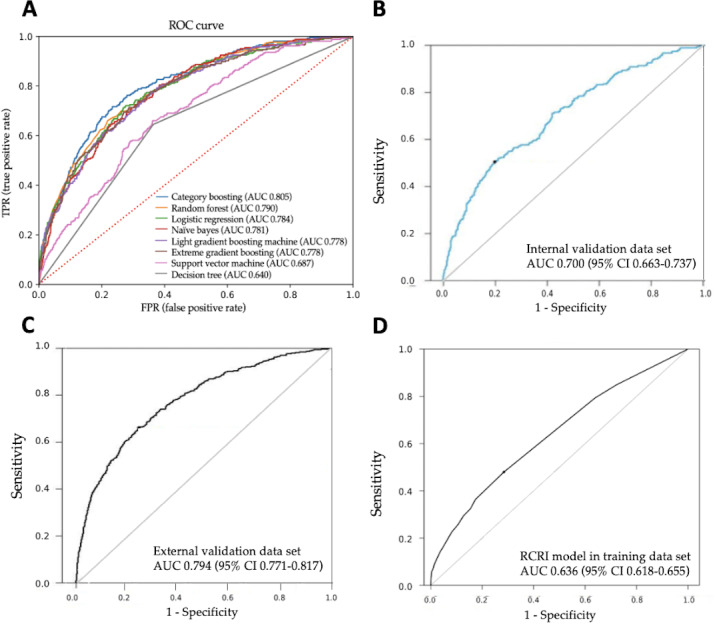
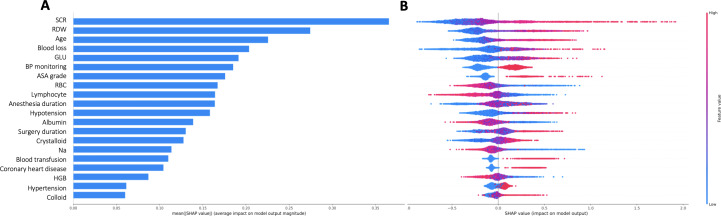
A total of 19,463 eligible patients were included; among those, 12,464 patients in center 1 were included as the training set; 4754 patients in center 1 were included as the internal validation set; and 2245 in center 2 were included as the external validation set. The best-performing model for prediction was the CatBoost algorithm, achieving the highest AUROC of 0.805 (95% CI 0.778-0.831) in the training set, validating with an AUROC of 0.780 in the internal validation set and 0.70 in external validation set. Additionally, CatBoost demonstrated superior performance compared to the Revised Cardiac Risk Index (AUROC 0.636; P<.001). The SHAP values indicated the ranking of the level of importance of each variable, with preoperative serum creatinine concentration, red blood cell distribution width, and age accounting for the top three. The results from the SHAP method can predict events with positive values or nonevents with negative values, providing an explicit explanation of individualized risk predictions.
The ML models can provide a personalized and fairly accurate risk prediction of MINS, and the explainable perspective can help identify potentially modifiable sources of risk at the patient level.
非心脏手术后心肌损伤(MINS)是一种容易被忽视的并发症,但与术后心血管不良结局密切相关;因此,早期诊断和预测尤为重要。
我们旨在开发并验证一种可解释的机器学习(ML)模型,用于预测接受非心脏手术的老年患者发生MINS的情况。
这项回顾性队列研究纳入了来自中国北方1个中心和南方1个中心接受非心脏手术的老年患者。中心1的数据集被分为训练集和内部验证集。中心2的数据集用作外部验证集。在建模之前,使用最小绝对收缩和选择算子以及递归特征消除方法来降低数据维度并从所有变量中选择关键特征。基于提取的特征,使用几种ML算法开发预测模型,包括类别提升、随机森林、逻辑回归、朴素贝叶斯、轻梯度提升机、极端梯度提升、支持向量机和决策树。以受试者操作特征曲线下面积(AUROC)作为主要评估指标来评估预测性能,以选择最佳算法。使用最佳算法通过内部和外部验证数据集验证模型性能,并与修订后的心脏风险指数进行比较。应用Shapley加性解释(SHAP)方法计算每个特征的值,代表对并发症预测风险的贡献,并生成个性化解释。
共纳入19463例符合条件的患者;其中,中心1的12464例患者作为训练集;中心1的4754例患者作为内部验证集;中心2的2245例患者作为外部验证集。预测性能最佳的模型是CatBoost算法,在训练集中达到最高AUROC为0.805(95%CI 0.778-0.831),在内部验证集中AUROC为0.780,在外部验证集中为0.70。此外,与修订后的心脏风险指数相比,CatBoost表现出更好的性能(AUROC 0.636;P<0.001)。SHAP值表明了每个变量重要性水平的排名,术前血清肌酐浓度、红细胞分布宽度和年龄位列前三。SHAP方法的结果可以预测阳性事件或阴性非事件,为个性化风险预测提供明确解释。
ML模型可以为MINS提供个性化且相当准确的风险预测,并且可解释的视角有助于在患者层面识别潜在可改变的风险来源。