Aabouch Farah, Annemer Saoussan, Satrani Badr, Ettaleb Ismail, Kara Mohammed, Ghanmi Mohamed, Shahat Abdelaaty Abdelaziz, Choudhary Ravish, Farah Abdellah, Ouajdi Mohamed, Dahmani Jamila
Plant, Animal Productions and Agro-Industry Laboratory, Faculty of Science, Ibn-Tofail University, BP 133, Kenitra 14000, Morocco.
Laboratory of Microbiology and Chemistry of Aromatic and Medicinal Plants, Forest Research Center, BP 763, Agdal, Rabat 10050, Morocco.
Life (Basel). 2024 Nov 5;14(11):1424. doi: 10.3390/life14111424.
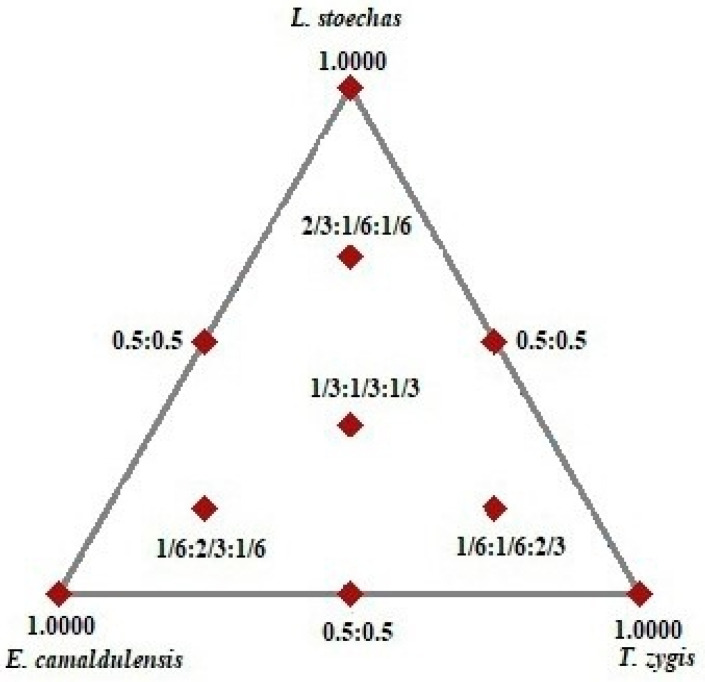
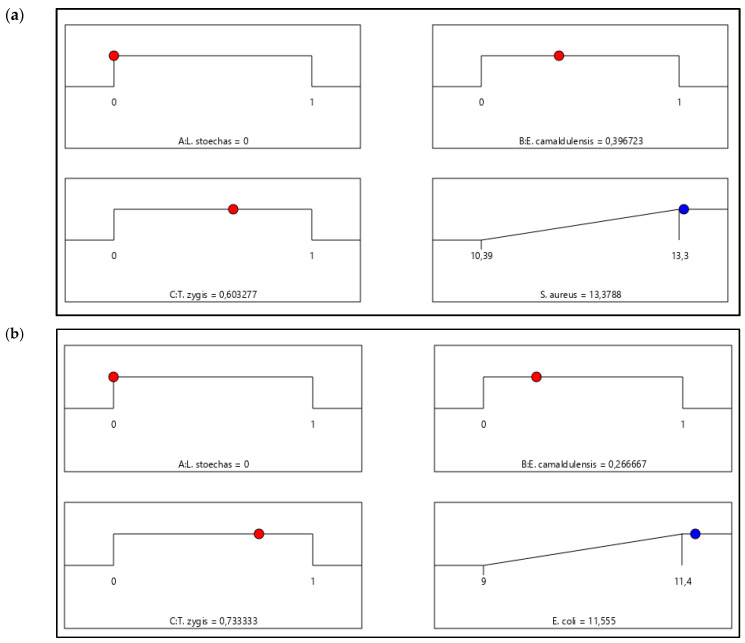
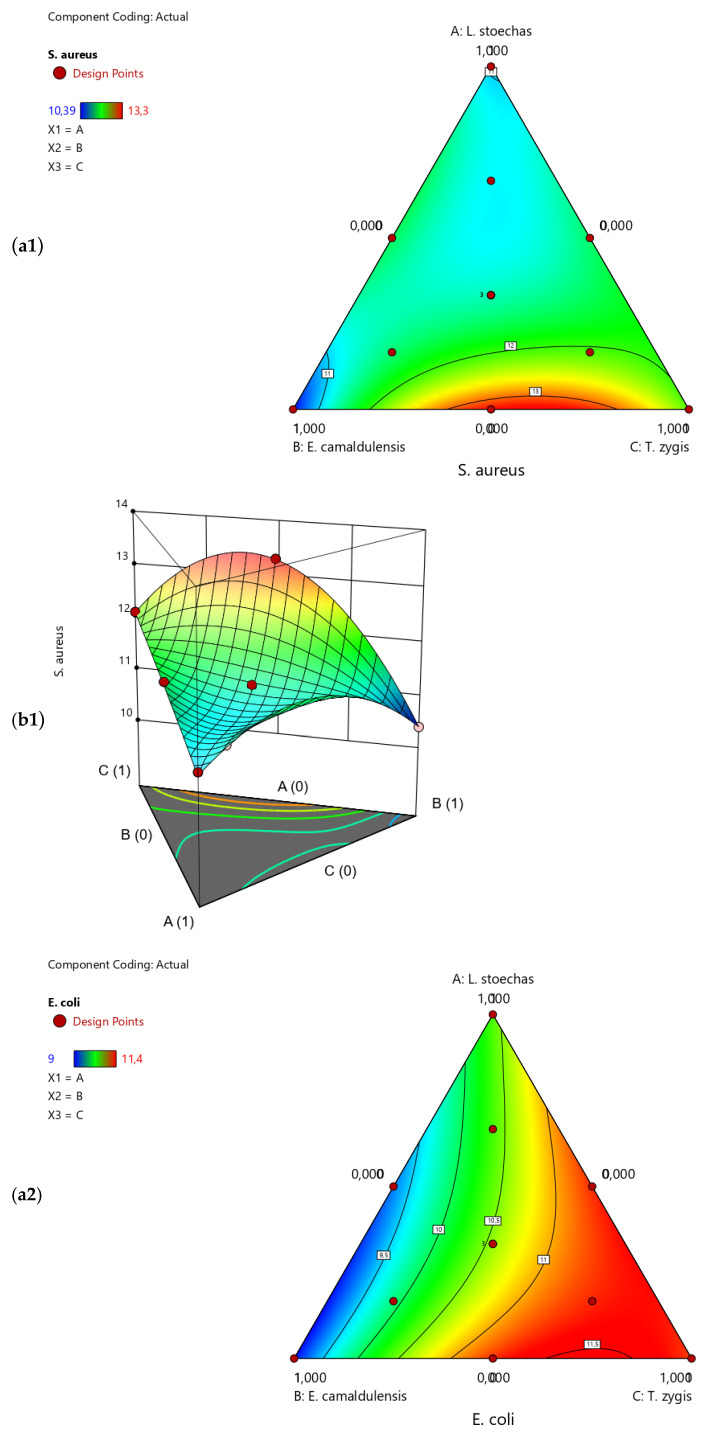
The use of combined essential oils (EOs) is a new technique that can improve their preservative effects while minimizing their sensory impact in foods. The aim of this study was to determine the chemical profile of three essential oils (EOs) extracted from L. (Ls), L. (Tz), and Dehnh (Ec) and to evaluate their synergistic antibacterial activity for optimal inhibition against , and using an augmented Simplex centroid mixing scheme. The essential oils were extracted by hydrodistillation and analyzed via gas chromatography-mass spectrometry. Anti-bacterial potency was evaluated by disk diffusion. Chemical analysis revealed the main compounds in (Ls) essential oil: camphor (36.15%), followed by fenchone (16.57%) and Z-8-hydroxy linalool (8.28%). The (Tz) essential oil is dominated by δ-terpineol (27.64%), δ-3-carene (15.7%), and thymol (14.17%). In contrast, the (Ec) essential oil contains mainly 1,8-cineole (43.61%), γ-terpinene (11.71%), and α-terpineol (10.58%). The optimal mixture is the binary association of 40% EO and 60% EO, which provides an effective inhibition diameter (ID) of 13.37 mm to inhibit . Furthermore, the formulation of 27% and 73% EOs of and , respectively, corresponds to the mixture required to achieve the optimum inhibition diameter (ID = 11.55 mm) against . In addition, the mixture of 29% EO of and 71% EO of is the optimum mixture to inhibit , with an inhibition diameter of 12.31 mm. These findings highlight the potency of antibacterial formulations of these essential oils and suggest that they might be used as substitutes for conventional drugs to prevent the development of bacteria responsible for serious infections and food spoilage.