Hanze Martin, Piper Andrew, Hamedi Mahiar Max
Department of Fibre and Polymer Technology, School of Engineering Sciences in Chemistry, Biotechnology and Health, KTH Royal Institute of Technology, Teknikringen 56-58, SE-100 44, Stockholm, Sweden.
Institut Català de Nanociència i Nanotecnologia (ICN2), CSIC and The Barcelona Institute of Science and Technology (BIST), Campus UAB, Bellaterra, 08193 Barcelona, Spain.
Lab Chip. 2024 Dec 17;25(1):28-40. doi: 10.1039/d4lc00697f.
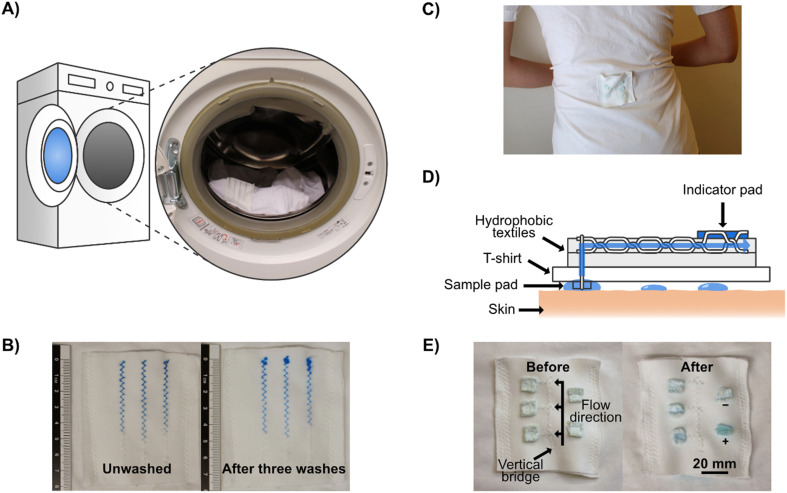
Thread-based microfluidics, which rely on capillary forces in threads for liquid flow, are a promising alternative to conventional microfluidics, as they can be easily integrated into wearable textile-based biosensors. We present here advanced textile-based microfluidic devices fabricated by machine stitching, using only commercially available textiles. We stitch a polyester "Coolmax®" yarn with enhanced wicking abilities into both hydrophobic fabric and hydrophobically treated stretchable fabric, that serve as non-wicking substrates. In doing so we construct textile microfluidics capable of performing a wide variety of functions, including mixing and separation in 2D and 3D configurations. Furthermore, we integrate a stitched microfluidic device into a wearable T-shirt and show that this device can collect, transport, and detect sweat from the wearer's skin. These can also be machine-washed, making them inherently reusable. Finally, we integrate electrochemical sensors into the textile-based microfluidic devices using stitched gold-coated yarns to detect analytes in the microfluidic yarns. Our stitched textile-based microfluidic devices hold promise for wearable diagnostic applications. This novel, bottom-up fabrication using machine stitching is scalable, reproducible, low-cost, and compatible with the existing textile manufacturing industry.
基于线的微流体技术依靠线中的毛细作用力来实现液体流动,是传统微流体技术的一种有前景的替代方案,因为它们可以轻松集成到基于可穿戴纺织品的生物传感器中。我们在此展示了通过机器缝合制造的先进的基于纺织品的微流体装置,仅使用市售纺织品。我们将具有增强吸液能力的聚酯“Coolmax®”纱线缝入疏水性织物和经过疏水处理的可拉伸织物中,这两种织物用作非吸液基材。通过这样做,我们构建了能够执行多种功能的纺织微流体装置,包括二维和三维配置中的混合和分离。此外,我们将缝合的微流体装置集成到一件可穿戴T恤中,并表明该装置可以收集、传输和检测来自穿着者皮肤的汗液。这些装置还可以机洗,使其具有内在的可重复使用性。最后,我们使用缝合的镀金纱线将电化学传感器集成到基于纺织品的微流体装置中,以检测微流体纱线中的分析物。我们的缝合式基于纺织品的微流体装置在可穿戴诊断应用方面具有前景。这种使用机器缝合的新颖的自下而上制造方法具有可扩展性、可重复性、低成本,并且与现有的纺织制造业兼容。