Kakizaki Masatoshi, Hashimoto Rina, Nagata Noriyo, Yamamoto Takuya, Okura Takashi, Katoh Hiroshi, Kitai Yuki, Akahori Yukiko, Shirato Kazuya, Ryo Akihide, Takayama Kazuo, Takeda Makoto
Department of Virology III, National Institute of Infectious Diseases, Tokyo, Japan.
Center for iPS Cell Research and Application (CiRA), Kyoto University, Kyoto, Japan.
J Virol. 2025 Jan 31;99(1):e0185324. doi: 10.1128/jvi.01853-24. Epub 2024 Nov 27.
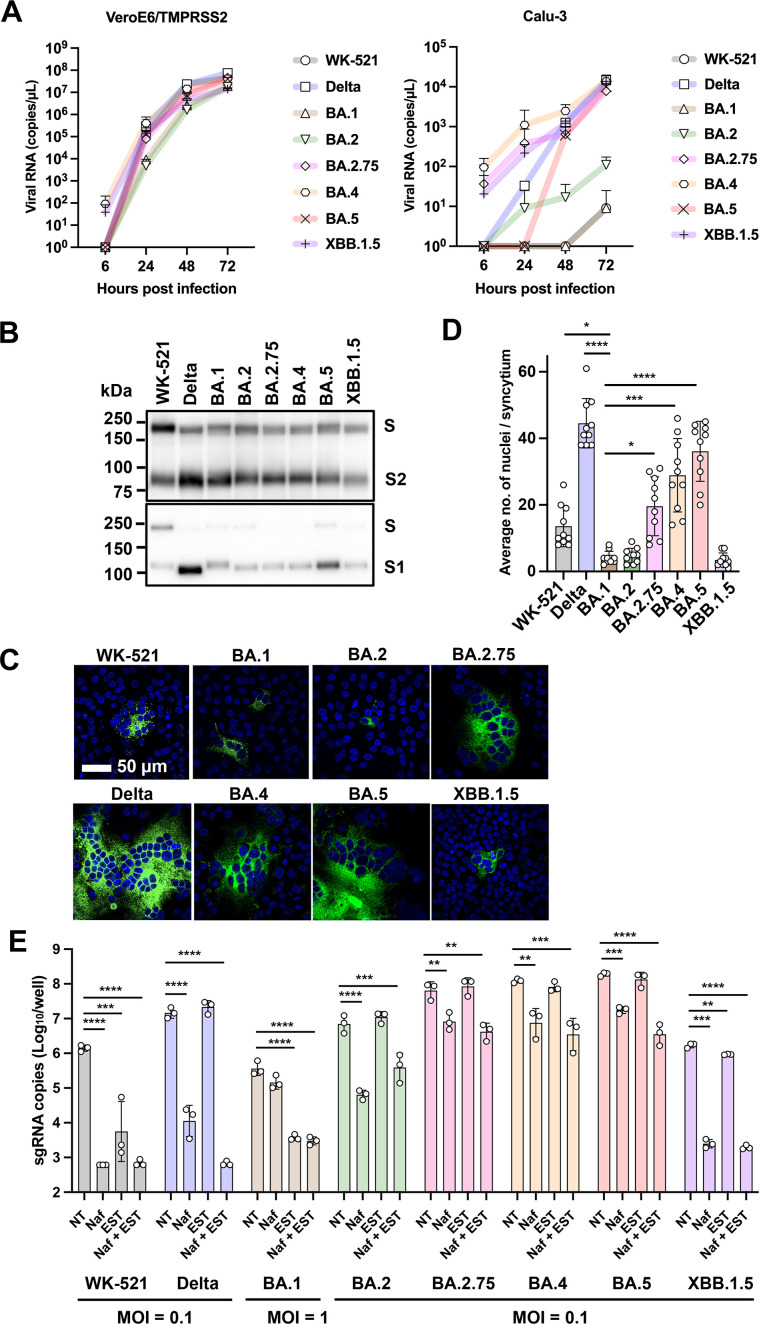
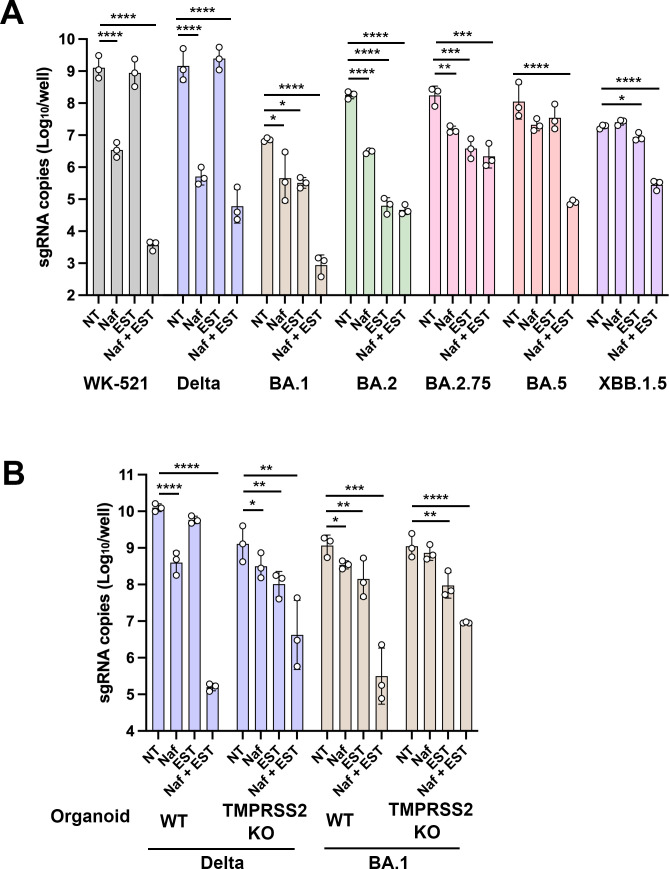
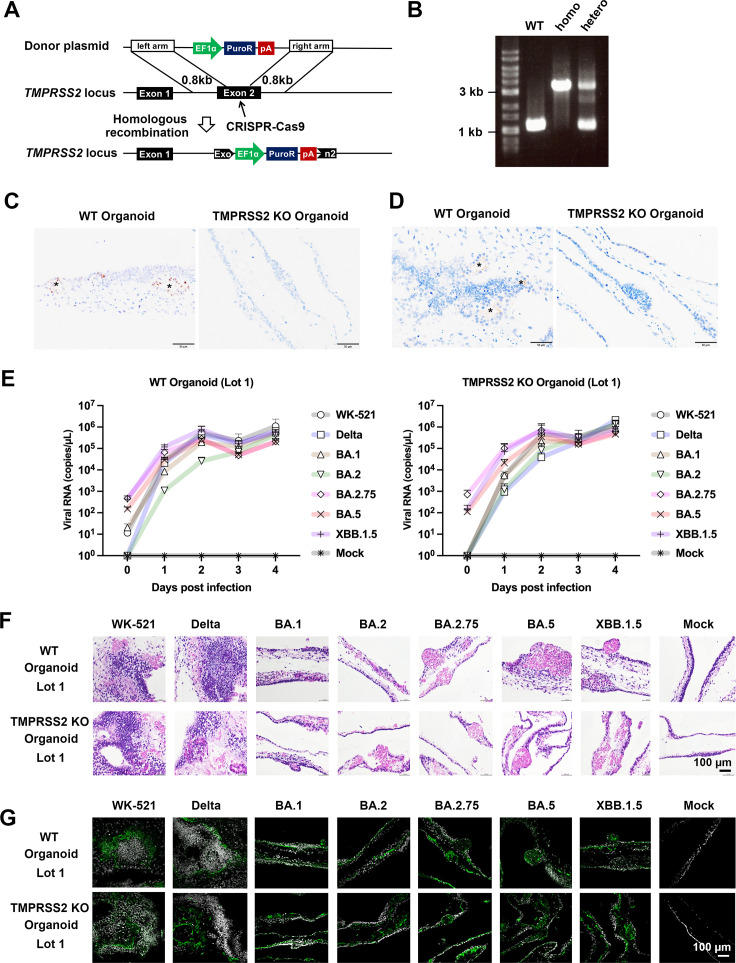
A critical aspect of the mechanism of severe acute respiratory syndrome coronavirus 2 (SARS-CoV-2) infection is the protease-mediated activation of the viral spike (S) protein. The type II transmembrane serine protease TMPRSS2 is crucial for SARS-CoV-2 infection in lung epithelial Calu-3 cells and murine airways. However, the importance of TMPRSS2 needs to be re-examined because the ability to utilize TMPRSS2 is significantly reduced in the Omicron variants that spread globally. For this purpose, replication profiles of SARS-CoV-2 were analyzed in human respiratory organoids. All tested viruses, including Omicron variants, replicated efficiently in these organoids. Notably, all SARS-CoV-2 strains retained replication ability in TMPRSS2-gene knockout (KO) respiratory organoids, suggesting that TMPRSS2 is not essential for SARS-CoV-2 infection in human respiratory tissues. However, TMPRSS2-gene knockout significantly reduces the inhibitory effect of nafamostat, indicating the advantage of TMPRSS2-utilizing ability for the SARS-CoV-2 infection in these organoids. Interestingly, Omicron variants regained the TMPRSS2-utilizing ability in recent subvariants. The basal infectivity would be supported mainly by cathepsins because the cathepsin inhibitor, EST, showed a significant inhibitory effect on infection with any SARS-CoV-2 strains, mainly when used with nafamostat. A supplementary contribution of other serine proteases was also suggested because the infection of the Delta variant was still inhibited partially by nafamostat in TMPRSS2 KO organoids. Thus, various proteases, including TMPRSS2, other serine proteases, and cathepsins, co-operatively contribute to SARS-CoV-2 infection significantly in the respiratory organoids. Thus, SARS-CoV-2 infection in the human respiratory tissues would be more complex than observed in cell lines or mice.
We explored how the severe acute respiratory syndrome coronavirus 2 (SARS-CoV-2) virus infects human respiratory organoids, which are a cultured cell model made to mimic the physiological conditions of the human airways. We focused on understanding the role of different proteases of host cells in activating the virus spike proteins. Specifically, we looked at TMPRSS2, a transmembrane serine protease, and cathepsin L, a lysosomal enzyme, which helps the virus enter cells by cutting the viral spike protein. We discovered that while TMPRSS2 is crucial for the virus in certain cells and animal models, other proteases, including cathepsins and various serine proteases, also play significant roles in the SARS-CoV-2 infection of human respiratory organoids. We suggest that SARS-CoV-2 uses a more complex mechanism involving multiple proteases to infect human airways, differing from what we see in conventional cell lines or animal models. This complexity might help explain how different variants can spread and infect people effectively.
严重急性呼吸综合征冠状病毒2(SARS-CoV-2)感染机制的一个关键方面是蛋白酶介导的病毒刺突(S)蛋白激活。II型跨膜丝氨酸蛋白酶TMPRSS2对肺上皮Calu-3细胞和小鼠气道中的SARS-CoV-2感染至关重要。然而,TMPRSS2的重要性需要重新审视,因为在全球传播的奥密克戎变体中利用TMPRSS2的能力显著降低。为此,在人类呼吸类器官中分析了SARS-CoV-2的复制情况。所有测试的病毒,包括奥密克戎变体,在这些类器官中均能有效复制。值得注意的是,所有SARS-CoV-2毒株在TMPRSS2基因敲除(KO)的呼吸类器官中仍保留复制能力,这表明TMPRSS2对人类呼吸组织中的SARS-CoV-2感染并非必不可少。然而,TMPRSS2基因敲除显著降低了那法莫司他的抑制作用,这表明在这些类器官中利用TMPRSS2的能力对SARS-CoV-2感染具有优势。有趣的是,奥密克戎变体在最近的亚变体中恢复了利用TMPRSS2的能力。基础感染性可能主要由组织蛋白酶支持,因为组织蛋白酶抑制剂EST对任何SARS-CoV-2毒株的感染均显示出显著的抑制作用,主要是在与那法莫司他联合使用时。还提示了其他丝氨酸蛋白酶的辅助作用,因为在TMPRSS2 KO类器官中,那法莫司他仍能部分抑制德尔塔变体的感染。因此,包括TMPRSS2、其他丝氨酸蛋白酶和组织蛋白酶在内的各种蛋白酶在呼吸类器官中对SARS-CoV-2感染起着显著的协同作用。因此,人类呼吸组织中的SARS-CoV-2感染可能比在细胞系或小鼠中观察到的更为复杂。
我们探究了严重急性呼吸综合征冠状病毒2(SARS-CoV-2)如何感染人类呼吸类器官,这是一种用于模拟人类气道生理条件的培养细胞模型。我们专注于了解宿主细胞不同蛋白酶在激活病毒刺突蛋白中的作用。具体而言,我们研究了跨膜丝氨酸蛋白酶TMPRSS2和溶酶体酶组织蛋白酶L,后者通过切割病毒刺突蛋白帮助病毒进入细胞。我们发现,虽然TMPRSS2在某些细胞和动物模型中对病毒至关重要,但其他蛋白酶,包括组织蛋白酶和各种丝氨酸蛋白酶,在SARS-CoV-2感染人类呼吸类器官中也发挥着重要作用。我们认为,SARS-CoV-2利用一种涉及多种蛋白酶的更复杂机制来感染人类气道,这与我们在传统细胞系或动物模型中看到的情况不同。这种复杂性可能有助于解释不同变体如何有效传播和感染人类。