• 文献检索
  • 文档翻译
  • 深度研究
  • 学术资讯
  • Suppr Zotero 插件Zotero 插件
  • 邀请有礼
  • 套餐&价格
  • 历史记录
应用&插件
Suppr Zotero 插件Zotero 插件浏览器插件Mac 客户端Windows 客户端微信小程序
定价
高级版会员购买积分包购买API积分包
服务
文献检索文档翻译深度研究API 文档MCP 服务
关于我们
关于 Suppr公司介绍联系我们用户协议隐私条款
关注我们

Suppr 超能文献

核心技术专利:CN118964589B侵权必究
粤ICP备2023148730 号-1Suppr @ 2026

文献检索

告别复杂PubMed语法,用中文像聊天一样搜索,搜遍4000万医学文献。AI智能推荐,让科研检索更轻松。

立即免费搜索

文件翻译

保留排版,准确专业,支持PDF/Word/PPT等文件格式,支持 12+语言互译。

免费翻译文档

深度研究

AI帮你快速写综述,25分钟生成高质量综述,智能提取关键信息,辅助科研写作。

立即免费体验

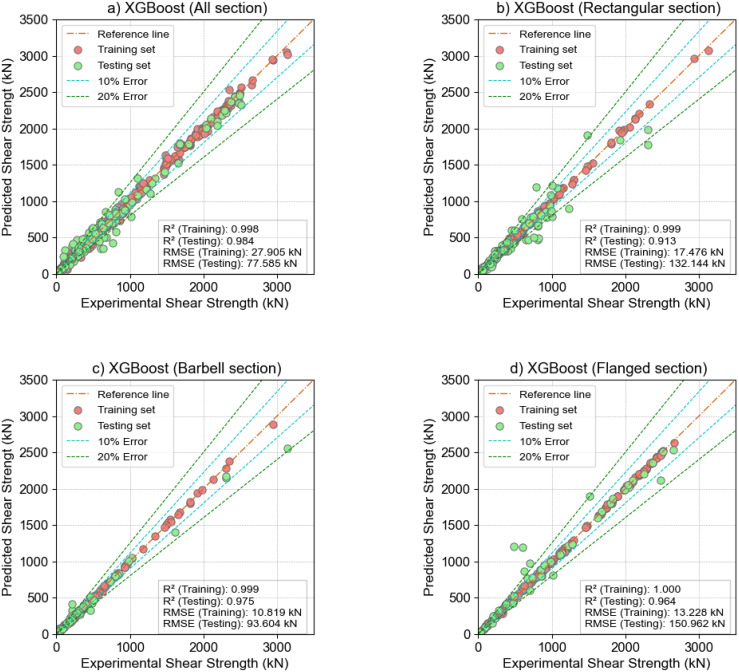
该研究使用 XGBoost 模型探索了不同截面形状的钢筋混凝土墙剪切强度的预测能力。

The research explores the predictive capacity of the shear strength of reinforced concrete walls with different cross-sectional shapes using the XGBoost model.

机构信息

University of Transport Technology, Hanoi, Vietnam.

出版信息

PLoS One. 2024 Nov 27;19(11):e0312531. doi: 10.1371/journal.pone.0312531. eCollection 2024.

DOI:10.1371/journal.pone.0312531
PMID:39602412
原文链接:https://pmc.ncbi.nlm.nih.gov/articles/PMC11602087/
Abstract

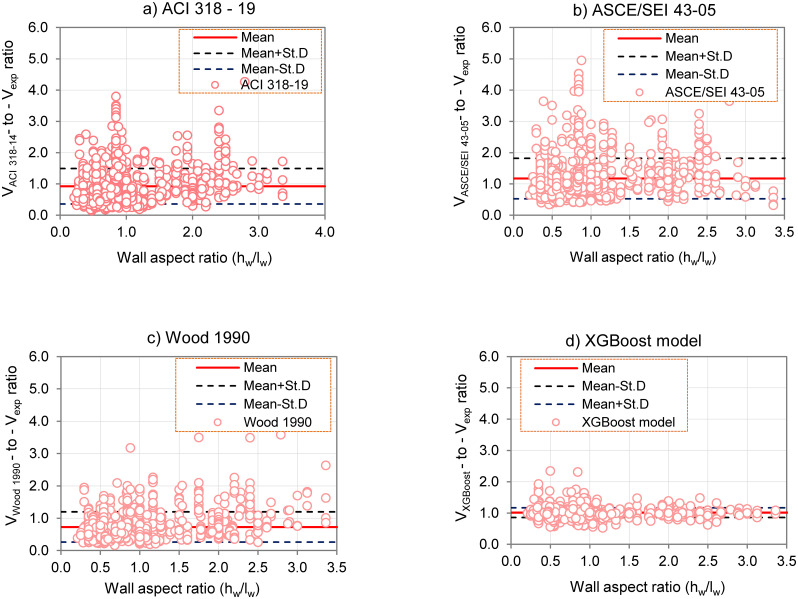
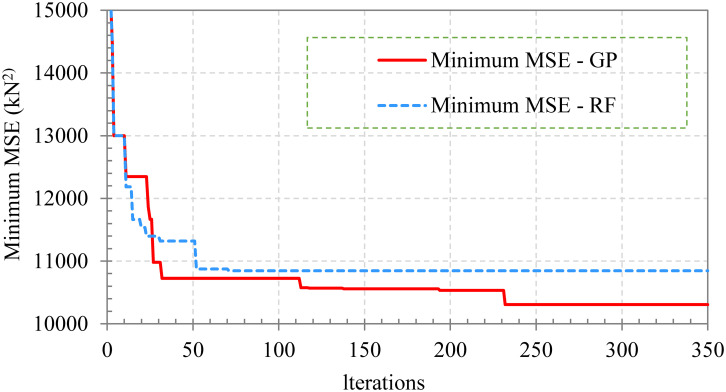
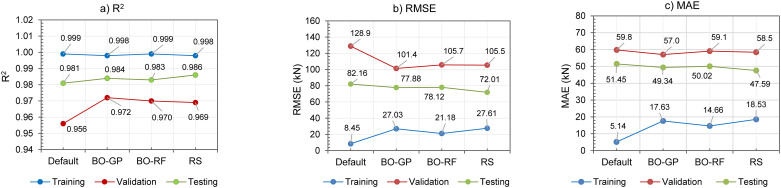
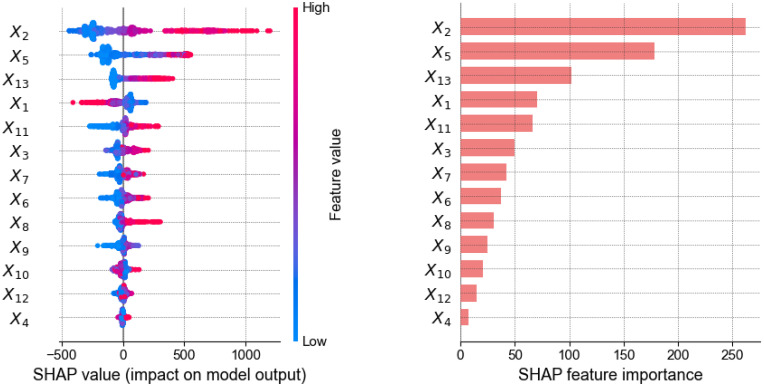
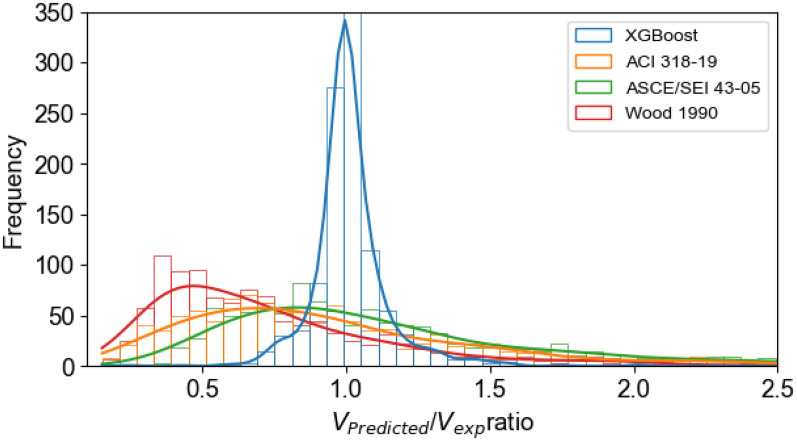
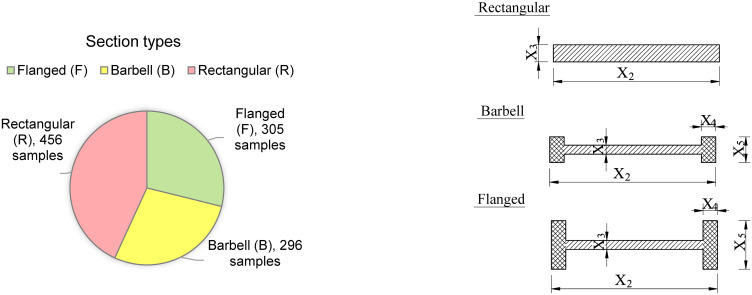
Structurally, the lateral load-bearing capacity mainly depends on reinforced concrete (RC) walls. Determination of flexural strength and shear strength is mandatory when designing reinforced concrete walls. Typically, these strengths are determined through theoretical formulas and verified experimentally. However, theoretical formulas often have large errors and testing is costly and time-consuming. Therefore, this study exploits machine learning techniques, specifically the hybrid XGBoost model combined with optimization algorithms, to predict the shear strength of RC walls based on model training from available experimental results. The study used the largest database of RC walls to date, consisting of 1057 samples with various cross-sectional shapes. Bayesian optimization (BO) algorithms, including BO-Gaussian Process, BO-Random Forest, and Random Search methods, were used to refine the XGBoost model architecture. The results show that Gaussian Process emerged as the most efficient solution compared to other optimization algorithms, providing the lowest Mean Square Error and achieving a prediction R2 of 0.998 for the training set, 0.972 for the validation set and 0.984 for the test set, while BO-Random Forest and Random Search performed as well on the training and test sets as Gaussian Process but significantly worse on the validation set, specifically R2 on the validation set of BO-Random Forest and Random Search were 0.970 and 0.969 respectively over the entire dataset including all cross-sectional shapes of the RC wall. SHAP (Shapley Additive Explanations) technique was used to clarify the predictive ability of the model and the importance of input variables. Furthermore, the performance of the model was validated through comparative analysis with benchmark models and current standards. Notably, the coefficient of variation (COV %) of the XGBoost model is 13.27%, while traditional models often have COV % exceeding 50%.

摘要

从结构上看,侧向承载能力主要取决于钢筋混凝土(RC)墙。在设计钢筋混凝土墙时,必须确定抗弯强度和抗剪强度。通常,这些强度是通过理论公式确定的,并通过实验验证。然而,理论公式往往存在较大误差,且测试成本高、耗时。因此,本研究利用机器学习技术,特别是结合优化算法的混合 XGBoost 模型,根据现有实验结果进行模型训练,预测 RC 墙的抗剪强度。该研究使用了迄今为止最大的 RC 墙数据库,其中包含 1057 个具有各种横截面形状的样本。贝叶斯优化(BO)算法,包括 BO-高斯过程、BO-随机森林和随机搜索方法,用于改进 XGBoost 模型架构。结果表明,与其他优化算法相比,高斯过程是最有效的解决方案,它提供了最低的均方误差,并在训练集上实现了 0.998 的预测 R2、在验证集上实现了 0.972 的预测 R2、在测试集上实现了 0.984 的预测 R2,而 BO-随机森林和随机搜索在训练集和测试集上的表现与高斯过程一样好,但在验证集上的表现明显更差,具体来说,BO-随机森林和随机搜索在验证集上的 R2 分别为 0.970 和 0.969,而整个数据集包括 RC 墙的所有横截面形状。SHAP(Shapley Additive Explanations)技术用于阐明模型的预测能力和输入变量的重要性。此外,还通过与基准模型和现行标准的对比分析来验证模型的性能。值得注意的是,XGBoost 模型的变异系数(COV%)为 13.27%,而传统模型的 COV%通常超过 50%。
https://cdn.ncbi.nlm.nih.gov/pmc/blobs/02f7/11602087/2b9126db3994/pone.0312531.g008.jpg
https://cdn.ncbi.nlm.nih.gov/pmc/blobs/02f7/11602087/dd0c6f18e234/pone.0312531.g001.jpg
https://cdn.ncbi.nlm.nih.gov/pmc/blobs/02f7/11602087/daee1b537409/pone.0312531.g002.jpg
https://cdn.ncbi.nlm.nih.gov/pmc/blobs/02f7/11602087/39fa63e3282a/pone.0312531.g003.jpg
https://cdn.ncbi.nlm.nih.gov/pmc/blobs/02f7/11602087/f65454a6f9c1/pone.0312531.g004.jpg
https://cdn.ncbi.nlm.nih.gov/pmc/blobs/02f7/11602087/c03f6f9d1d56/pone.0312531.g005.jpg
https://cdn.ncbi.nlm.nih.gov/pmc/blobs/02f7/11602087/489cde8ed5b3/pone.0312531.g006.jpg
https://cdn.ncbi.nlm.nih.gov/pmc/blobs/02f7/11602087/dde43b99ef4c/pone.0312531.g007.jpg
https://cdn.ncbi.nlm.nih.gov/pmc/blobs/02f7/11602087/2b9126db3994/pone.0312531.g008.jpg
https://cdn.ncbi.nlm.nih.gov/pmc/blobs/02f7/11602087/dd0c6f18e234/pone.0312531.g001.jpg
https://cdn.ncbi.nlm.nih.gov/pmc/blobs/02f7/11602087/daee1b537409/pone.0312531.g002.jpg
https://cdn.ncbi.nlm.nih.gov/pmc/blobs/02f7/11602087/39fa63e3282a/pone.0312531.g003.jpg
https://cdn.ncbi.nlm.nih.gov/pmc/blobs/02f7/11602087/f65454a6f9c1/pone.0312531.g004.jpg
https://cdn.ncbi.nlm.nih.gov/pmc/blobs/02f7/11602087/c03f6f9d1d56/pone.0312531.g005.jpg
https://cdn.ncbi.nlm.nih.gov/pmc/blobs/02f7/11602087/489cde8ed5b3/pone.0312531.g006.jpg
https://cdn.ncbi.nlm.nih.gov/pmc/blobs/02f7/11602087/dde43b99ef4c/pone.0312531.g007.jpg
https://cdn.ncbi.nlm.nih.gov/pmc/blobs/02f7/11602087/2b9126db3994/pone.0312531.g008.jpg

相似文献

1
The research explores the predictive capacity of the shear strength of reinforced concrete walls with different cross-sectional shapes using the XGBoost model.该研究使用 XGBoost 模型探索了不同截面形状的钢筋混凝土墙剪切强度的预测能力。
PLoS One. 2024 Nov 27;19(11):e0312531. doi: 10.1371/journal.pone.0312531. eCollection 2024.
2
Machine Learning-Based Prediction Models for Punching Shear Strength of Fiber-Reinforced Polymer Reinforced Concrete Slabs Using a Gradient-Boosted Regression Tree.基于梯度提升回归树的纤维增强聚合物增强混凝土板冲切剪切强度的机器学习预测模型
Materials (Basel). 2024 Aug 9;17(16):3964. doi: 10.3390/ma17163964.
3
Hybrid BO-XGBoost and BO-RF Models for the Strength Prediction of Self-Compacting Mortars with Parametric Analysis.用于自密实砂浆强度预测的混合BO-XGBoost和BO-RF模型及参数分析
Materials (Basel). 2023 Jun 13;16(12):4366. doi: 10.3390/ma16124366.
4
Explainable prediction model for punching shear strength of FRP-RC slabs based on kernel density estimation and XGBoost.基于核密度估计和XGBoost的FRP-RC板冲切抗剪强度可解释预测模型
Sci Rep. 2024 Dec 30;14(1):31760. doi: 10.1038/s41598-024-82159-3.
5
The Application of Machine Learning Algorithms to Bond Strength between Steel Rebars and Concrete Using Bayesian Optimization.基于贝叶斯优化的机器学习算法在钢筋与混凝土粘结强度中的应用
Materials (Basel). 2024 Sep 21;17(18):4641. doi: 10.3390/ma17184641.
6
Optimized Machine Learning Model for Predicting Compressive Strength of Alkali-Activated Concrete Through Multi-Faceted Comparative Analysis.通过多方面比较分析预测碱激发混凝土抗压强度的优化机器学习模型
Materials (Basel). 2024 Oct 18;17(20):5086. doi: 10.3390/ma17205086.
7
Prediction and reliability analysis of shear strength of RC deep beams.钢筋混凝土深梁抗剪强度的预测与可靠性分析
Sci Rep. 2024 Jun 25;14(1):14590. doi: 10.1038/s41598-024-64386-w.
8
Optimal Dimensioning of Retaining Walls Using Explainable Ensemble Learning Algorithms.使用可解释集成学习算法对挡土墙进行优化尺寸设计
Materials (Basel). 2022 Jul 18;15(14):4993. doi: 10.3390/ma15144993.
9
Predicting axial load capacity in elliptical fiber reinforced polymer concrete steel double skin columns using machine learning.利用机器学习预测椭圆形纤维增强聚合物混凝土钢双壁柱的轴向承载能力。
Sci Rep. 2025 Apr 15;15(1):12899. doi: 10.1038/s41598-025-97258-y.
10
Interpretable Predictive Modelling of Basalt Fiber Reinforced Concrete Splitting Tensile Strength Using Ensemble Machine Learning Methods and SHAP Approach.基于集成机器学习方法和SHAP方法的玄武岩纤维增强混凝土劈裂抗拉强度可解释预测建模
Materials (Basel). 2023 Jun 25;16(13):4578. doi: 10.3390/ma16134578.