Division of Reproductive Health, National Center for Chronic Disease Prevention and Health Promotion, CDC.
MMWR Surveill Summ. 2024 Nov 28;73(7):1-28. doi: 10.15585/mmwr.ss7307a1.
PROBLEM/CONDITION: CDC conducts abortion surveillance to document the number and characteristics of women obtaining legal induced abortions and the number of abortion-related deaths in the United States.
Each year, CDC requests abortion data from the central health agencies for the 50 states, the District of Columbia, and New York City. For 2022, a total of 48 reporting areas voluntarily provided aggregate abortion data to CDC. Of these, 47 reporting areas provided data each year during 2013-2022. Census and natality data were used to calculate abortion rates (number of abortions per 1,000 women aged 15-44 years) and ratios (number of abortions per 1,000 live births), respectively. Abortion-related deaths from 2021 were assessed as part of CDC's Pregnancy Mortality Surveillance System (PMSS).
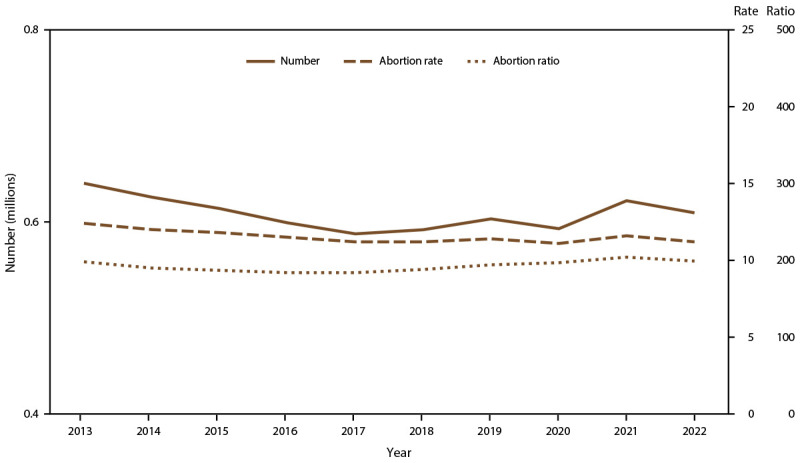
For 2022, a total of 613,383 abortions were reported to CDC from 48 reporting areas. Among 47 reporting areas with data each year during 2013-2022, in 2022, a total of 609,360 abortions were reported, the abortion rate was 11.2 abortions per 1,000 women aged 15-44 years, and the abortion ratio was 199 abortions per 1,000 live births. From 2021 to 2022, the total number of abortions decreased 2% (from 622,108 total abortions), the abortion rate decreased 3% (from 11.6 abortions per 1,000 women aged 15-44 years), and the abortion ratio decreased 2% (from 204 abortions per 1,000 live births). From 2013 to 2022, the total number of reported abortions decreased 5% (from 640,154), the abortion rate decreased 10% (from 12.4 abortions per 1,000 women aged 15-44 years), and the abortion ratio increased 1% (from 198 abortions per 1,000 live births).In 2022, women in their 20s accounted for more than half of abortions (56.5%). Women aged 20-24 and 25-29 years accounted for the highest percentages of abortions (28.3% and 28.2%, respectively) and had the highest abortion rates (18.1 and 18.7 abortions per 1,000 women aged 20-24 and 25-29 years, respectively). By contrast, adolescents aged <15 years and women aged ≥40 years accounted for the lowest percentages of abortions (0.2% and 3.6%, respectively) and had the lowest abortion rates (0.4 and 2.5 abortions per 1,000 women aged <15 and ≥40 years, respectively). However, abortion ratios were highest among adolescents (aged ≤19 years) and lowest among women aged 30-39 years.From 2021 to 2022, abortion rates decreased among women aged ≥20 years and did not change among adolescents (aged ≤19 years). Abortion rates decreased from 2013 to 2022 among all age groups, except women aged 30-34 years for whom it increased. The decrease in the abortion rate from 2013 to 2022 was highest among adolescents compared with other age groups. From 2021 to 2022, abortion ratios increased for adolescents and decreased among women aged ≥20 years. From 2013 to 2022, abortion ratios increased among adolescents and women aged 20-34 years and decreased among women aged ≥35 years.In 2022, the majority (78.6%) of abortions were performed at ≤9 weeks' gestation, and nearly all (92.8%) were performed at ≤13 weeks' gestation. During 2013-2022, the percentage of abortions performed at >13 weeks' gestation remained low (≤8.7%). In 2022, the highest percentage of abortions were performed by early medication abortion at ≤9 weeks' gestation (53.3%), followed by surgical abortion at ≤13 weeks' gestation (35.5%), surgical abortion at >13 weeks' gestation (6.9%), and medication abortion at >9 weeks' gestation (4.3%); all other methods were uncommon (<0.1%). Among those that were eligible (≤9 weeks' gestation), 70.2% of abortions were early medication abortions. In 2021, the most recent year for which PMSS data were reviewed for pregnancy-related deaths, five women died as a result of complications from legal induced abortions.
Among the 47 areas that reported data continuously during 2013-2022, overall decreases were observed over this time in the number and rate of reported abortions and an increase was observed in the abortion ratio; in addition, from 2021 to 2022, decreases of 2%-3% were observed across all measures.
Abortion surveillance can be used to help evaluate programs aimed at promoting equitable access to patient-centered quality contraceptive services in the United States to reduce unintended pregnancies.
问题/情况:疾病预防控制中心进行堕胎监测,以记录在美国获得合法人工流产的妇女人数和特征,以及与堕胎相关的死亡人数。
2022 年。
每年,疾病预防控制中心都会向美国 50 个州、哥伦比亚特区和纽约市的中央卫生机构请求堕胎数据。2022 年,共有 48 个报告地区自愿向疾病预防控制中心提供了综合堕胎数据。在这些报告地区中,有 47 个报告地区在 2013-2022 年期间每年都提供数据。人口普查和出生率数据分别用于计算堕胎率(每 1000 名 15-44 岁妇女中的堕胎数)和比率(每 1000 例活产中的堕胎数)。2021 年与堕胎相关的死亡情况作为疾病预防控制中心妊娠死亡率监测系统(PMSS)的一部分进行了评估。
2022 年,疾病预防控制中心从 48 个报告地区收到了 613383 例堕胎报告。在 2013-2022 年期间每年都有数据报告的 47 个报告地区中,2022 年报告了 609360 例堕胎,堕胎率为每 1000 名 15-44 岁妇女 11.2 例,堕胎比率为每 1000 例活产 199 例。从 2021 年到 2022 年,堕胎总数下降了 2%(从 622108 例),堕胎率下降了 3%(从每 1000 名 15-44 岁妇女 11.6 例),堕胎比率下降了 2%(从每 1000 例活产 204 例)。从 2013 年到 2022 年,报告的堕胎总数下降了 5%(从 640154 例),堕胎率下降了 10%(从每 1000 名 15-44 岁妇女 12.4 例),堕胎比率上升了 1%(从每 1000 例活产 198 例)。2022 年,20 多岁的妇女占堕胎总数的一半以上(56.5%)。20-24 岁和 25-29 岁的妇女分别占堕胎人数的最高比例(分别为 28.3%和 28.2%),堕胎率最高(分别为每 1000 名 20-24 岁和 25-29 岁妇女 18.1 和 18.7 例)。相比之下,年龄<15 岁的青少年和年龄≥40 岁的妇女占堕胎人数的比例最低(分别为 0.2%和 3.6%),堕胎率最低(分别为每 1000 名年龄<15 岁和≥40 岁妇女 0.4 和 2.5 例)。然而,堕胎比率在青少年(≤19 岁)中最高,在 30-39 岁的妇女中最低。从 2021 年到 2022 年,≥20 岁的妇女的堕胎率下降,而青少年(≤19 岁)的堕胎率没有变化。除了 30-34 岁的妇女堕胎率增加外,所有年龄段的堕胎率从 2013 年到 2022 年都有所下降。从 2013 年到 2022 年,青少年的堕胎率下降幅度最大。从 2021 年到 2022 年,青少年和≥20 岁的妇女的堕胎比率增加,而≥35 岁的妇女的堕胎比率下降。2022 年,大多数(78.6%)堕胎发生在≤9 周的妊娠,几乎所有(92.8%)堕胎发生在≤13 周的妊娠。在 2013-2022 年期间,妊娠>13 周的堕胎比例仍然较低(≤8.7%)。2022 年,≤9 周的早期药物流产的堕胎比例最高(53.3%),其次是≤13 周的手术流产(35.5%)、妊娠>13 周的手术流产(6.9%)和>9 周的药物流产(4.3%);其他所有方法都不常见(<0.1%)。在符合条件的(≤9 周)中,70.2%的堕胎是早期药物流产。在 2021 年,PMSS 审查的与妊娠相关的死亡的最近一年,有 5 名妇女因合法人工流产引起的并发症而死亡。
在 2013-2022 年期间连续报告数据的 47 个地区中,在此期间,报告的堕胎总数和比率均有所下降,而堕胎比率有所上升;此外,从 2021 年到 2022 年,所有指标均下降了 2%-3%。
堕胎监测可用于帮助评估旨在促进在美国获得以患者为中心的优质避孕服务的公平机会的项目,以减少意外怀孕。