He Daniel, Guler Sabina A, Shannon Casey P, Ryerson Christopher J, Tebbutt Scott J
Department of Medicine, University of British Columbia, Vancouver, BC, Canada.
Centre for Heart Lung Innovation, St Paul's Hospital, Vancouver, BC, Canada.
Eur Respir J. 2025 Jun 5;65(6). doi: 10.1183/13993003.01070-2024. Print 2025 Jun.
Gene expression (transcriptomics) studies have revealed potential mechanisms of interstitial lung disease, yet sample sizes of studies are often limited and between-subtype comparisons are scarce. The aim of this study was to identify and validate consensus transcriptomic signatures of interstitial lung disease subtypes.
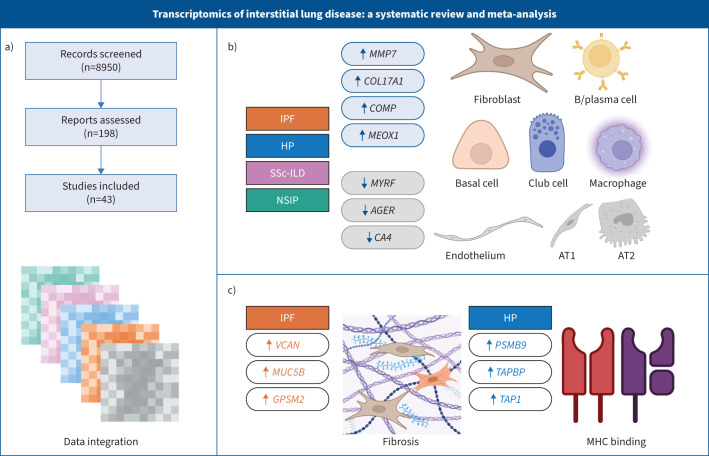
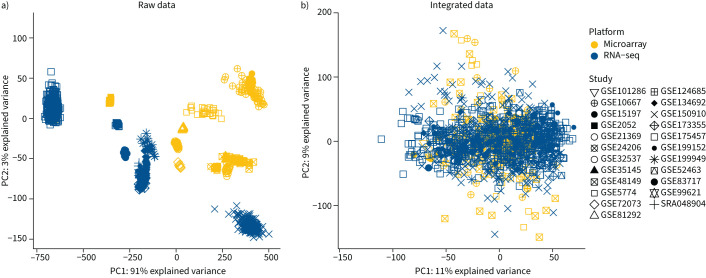
We performed a systematic review and meta-analysis of fibrotic interstitial lung disease transcriptomics studies using an individual participant data approach. We included studies examining bulk transcriptomics of human adult interstitial lung disease samples and excluded those focusing on individual cell populations. Patient-level data and expression matrices were extracted from 43 studies and integrated using a multivariable integrative algorithm to develop interstitial lung disease classification models.
Using 1459 samples from 24 studies, we identified transcriptomic signatures for idiopathic pulmonary fibrosis, hypersensitivity pneumonitis, idiopathic nonspecific interstitial pneumonia and systemic sclerosis-associated interstitial lung disease against control samples, which were validated on 308 samples from eight studies (idiopathic pulmonary fibrosis area under receiver operating curve (AUC) 0.99, 95% CI 0.99-1.00; hypersensitivity pneumonitis AUC 0.91, 95% CI 0.84-0.99; nonspecific interstitial pneumonia AUC 0.94, 95% CI 0.88-0.99; systemic sclerosis-associated interstitial lung disease AUC 0.98, 95% CI 0.93-1.00). Significantly, meta-analysis allowed us to identify, for the first time, robust lung transcriptomics signatures to discriminate idiopathic pulmonary fibrosis (AUC 0.71, 95% CI 0.63-0.79) and hypersensitivity pneumonitis (AUC 0.76, 95% CI 0.63-0.89) from other fibrotic interstitial lung disease, and unsupervised learning algorithms identified putative molecular endotypes of interstitial lung disease associated with decreased forced vital capacity and diffusing capacity of the lungs for carbon monoxide % predicted. Transcriptomics signatures were reflective of both cell-specific and disease-specific changes in gene expression.
We present the first systematic review and largest meta-analysis of fibrotic interstitial lung disease transcriptomics to date, identifying reproducible transcriptomic signatures with clinical relevance.
基因表达(转录组学)研究揭示了间质性肺疾病的潜在机制,但研究样本量往往有限,且亚型间比较较少。本研究旨在识别并验证间质性肺疾病亚型的共识转录组特征。
我们采用个体参与者数据方法对纤维化间质性肺疾病转录组学研究进行了系统评价和荟萃分析。我们纳入了检测成人间质性肺疾病样本整体转录组学的研究,并排除了专注于单个细胞群体的研究。从43项研究中提取患者水平数据和表达矩阵,并使用多变量整合算法进行整合,以建立间质性肺疾病分类模型。
利用来自24项研究的1459个样本,我们识别出了特发性肺纤维化、过敏性肺炎、特发性非特异性间质性肺炎和系统性硬化症相关间质性肺疾病相对于对照样本的转录组特征,并在来自8项研究的308个样本上进行了验证(特发性肺纤维化受试者工作特征曲线下面积(AUC)为0.99,95%CI为0.99 - 1.00;过敏性肺炎AUC为0.9l,95%CI为0.84 - 0.99;非特异性间质性肺炎AUC为0.94,95%CI为0.88 - 0.99;系统性硬化症相关间质性肺疾病AUC为0.98,95%CI为0.93 - 1.00)。重要的是,荟萃分析使我们首次能够识别出强大的肺转录组特征,以区分特发性肺纤维化(AUC为0.71,95%CI为0.63 - 0.79)和过敏性肺炎(AUC为0.76,95%CI为0.63 - 0.89)与其他纤维化间质性肺疾病,并且无监督学习算法识别出了与预测的用力肺活量和肺一氧化碳弥散量降低相关的间质性肺疾病假定分子内型。转录组特征反映了基因表达中细胞特异性和疾病特异性的变化。
我们展示了迄今为止首次对纤维化间质性肺疾病转录组学进行的系统评价和最大规模的荟萃分析,识别出了具有临床相关性的可重复转录组特征。