Heyraud Agathe, Tallia Francesca, Chen Steven, Liu Jingwen, Chen Jishizhan, Turner Joel, Jell Gavin, Lee Peter D, Jones Julian R
Department of Materials, Imperial College London London UK
Faculty of Engineering Science, Department of Mechanical Engineering, University College London UK.
RSC Adv. 2024 Nov 27;14(51):37846-37858. doi: 10.1039/d3ra07946e. eCollection 2024 Nov 25.
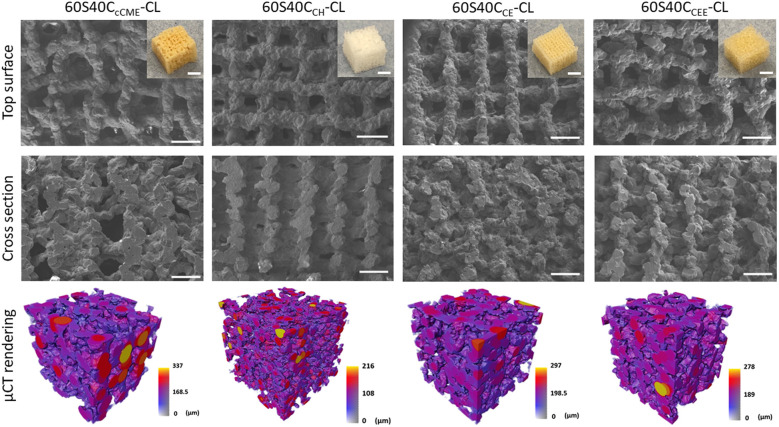
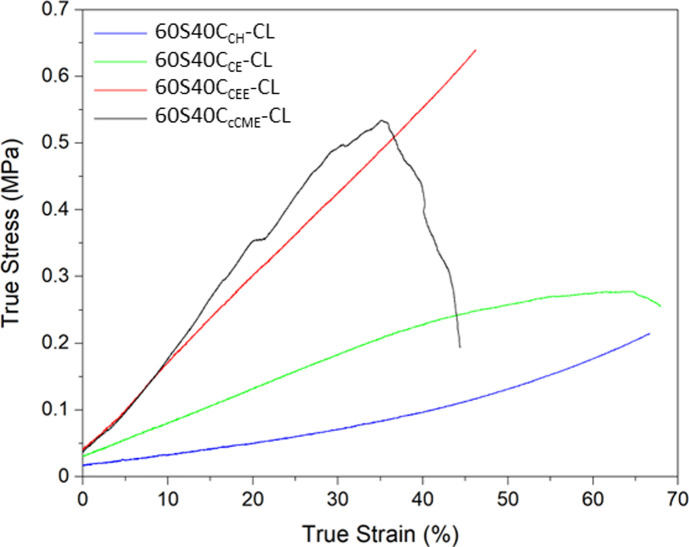
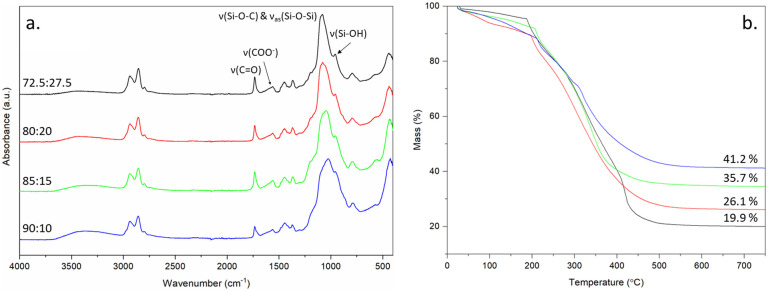
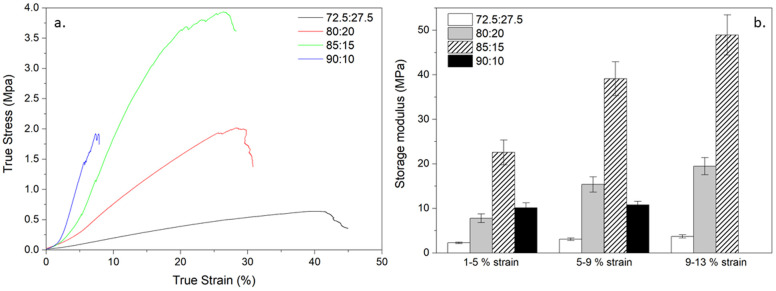
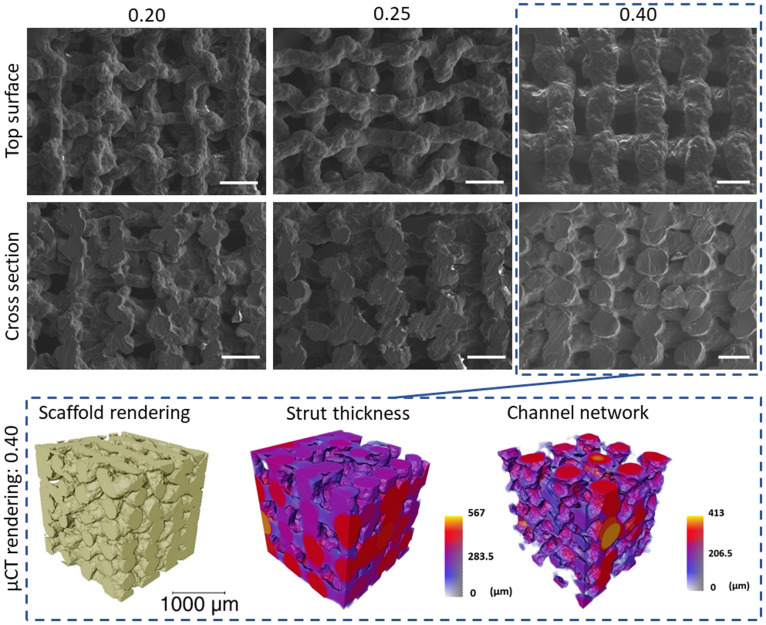
Inorganic/organic hybrid biomaterials have been developed to obtain synergy of the inorganic and organic co-networks for implant and 3D printed scaffold applications, providing combinations of bioactivity, toughness and controlled biodegradation. SiO-CaO/PTHF/PCL-diCOOH sol-gel hybrids previously showed potential for osteogenesis due to the addition of calcium to the silicate network of the hybrid, using calcium methoxyethoxide (CME) as the calcium source. Here, we investigate other calcium sources to improve mechanical properties and printability of the hybrid inks. The aim was to produce porous scaffolds with mechanical properties similar to trabecular bone. The original Ca-free hybrid composition SiO/PTHF/PCL-diCOOH was highly elastic and the addition of Ca increased strength while introducing bioactivity, with hydroxyapatite formation in simulated body fluid (SBF), and no negative effects on the metabolic activity of human bone marrow stromal cells (hBMSCs). However, when the hybrid was 3D printed by Direct Ink Writing, the mechanical properties were insufficient for a load sharing bone scaffold. Alternative calcium sources were investigated here, using concentrated CME (cCME), calcium hydroxide (CH), calcium ethoxide (CE), and calcium ethoxyethoxide (CEE). CEE improved the overall printability and final structure of the hybrid scaffold obtained and apatite formed on its surface in SBF. This hybrid reached the highest stress at failure (0.55 ± 0.08 MPa) and toughness modulus (0.13 ± 0.03 MPa), with a corresponding strain of >50%. With this calcium source and the optimal 70 : 30 TEOS : CEE molar ratio, scaffold properties were optimised by increasing the strut size whilst maintaining the interconnected channel size >400 μm and increasing the inorganic : organic ratio. Using a TEOS : PCL-diCOOH ratio of 85 : 15 wt%, giving a final inorganic content of 35.7 wt%, showed the optimal mechanical properties with a stress at failure of 3.1 ± 0.54 MPa for strain of 26%, and a toughness modulus of 0.58 ± 0.06 MPa, whilst keeping an open porosity >38%. Compressive strength was within the lower range of trabecular bone (2-12 MPa), and there was no observed cytotoxic effect on hBMSCs, indicating potential for use of this hybrid for bone regeneration.
无机/有机杂化生物材料已被开发出来,以实现无机和有机共网络在植入物和3D打印支架应用中的协同作用,提供生物活性、韧性和可控生物降解性的组合。先前,SiO-CaO/PTHF/PCL-二羧酸溶胶-凝胶杂化物由于使用甲氧基乙醇钙(CME)作为钙源,向杂化物的硅酸盐网络中添加了钙,显示出成骨潜力。在此,我们研究其他钙源以改善杂化墨水的机械性能和可打印性。目的是生产具有与松质骨相似机械性能的多孔支架。原始的无钙杂化组合物SiO/PTHF/PCL-二羧酸具有高弹性,添加钙增加了强度,同时引入了生物活性,在模拟体液(SBF)中形成了羟基磷灰石,并且对人骨髓基质细胞(hBMSCs)的代谢活性没有负面影响。然而,当通过直接墨水书写对杂化物进行3D打印时,其机械性能不足以作为负载分担骨支架。这里研究了替代钙源,使用浓缩CME(cCME)、氢氧化钙(CH)、乙醇钙(CE)和乙氧基乙醇钙(CEE)。CEE改善了所得杂化支架的整体可打印性和最终结构,并且在其表面的SBF中形成了磷灰石。这种杂化物在破坏时达到最高应力(0.55±0.08MPa)和韧性模量(0.13±0.03MPa),相应应变>50%。使用这种钙源和最佳的70∶30 TEOS∶CEE摩尔比,通过增加支柱尺寸同时保持互连通道尺寸>400μm并增加无机∶有机比来优化支架性能。使用85∶15 wt%的TEOS∶PCL-二羧酸比例,最终无机含量为35.7 wt%,显示出最佳机械性能,对于26%的应变,破坏应力为3.1±0.54MPa,韧性模量为0.58±0.06MPa,同时保持开放孔隙率>38%。抗压强度在松质骨的较低范围内(2-12MPa),并且未观察到对hBMSCs的细胞毒性作用,表明这种杂化物具有用于骨再生的潜力。