Universidade de São Paulo. Faculdade de Saúde Pública. Núcleo de Pesquisas Epidemiológicas em Nutrição e Saúde. São Paulo, SP, Brasil.
Universidade Federal de Ciências da Saúde de Porto Alegre. Departamento de Nutrição. Porto Alegre, RS, Brasil.
Rev Saude Publica. 2024 Nov 25;58:47. doi: 10.11606/s1518-8787.2024058006470. eCollection 2024.
To describe two low-burden diet quality scores and evaluate their performance in reflecting the dietary share of the least and most processed foods defined within the Nova food system classification.
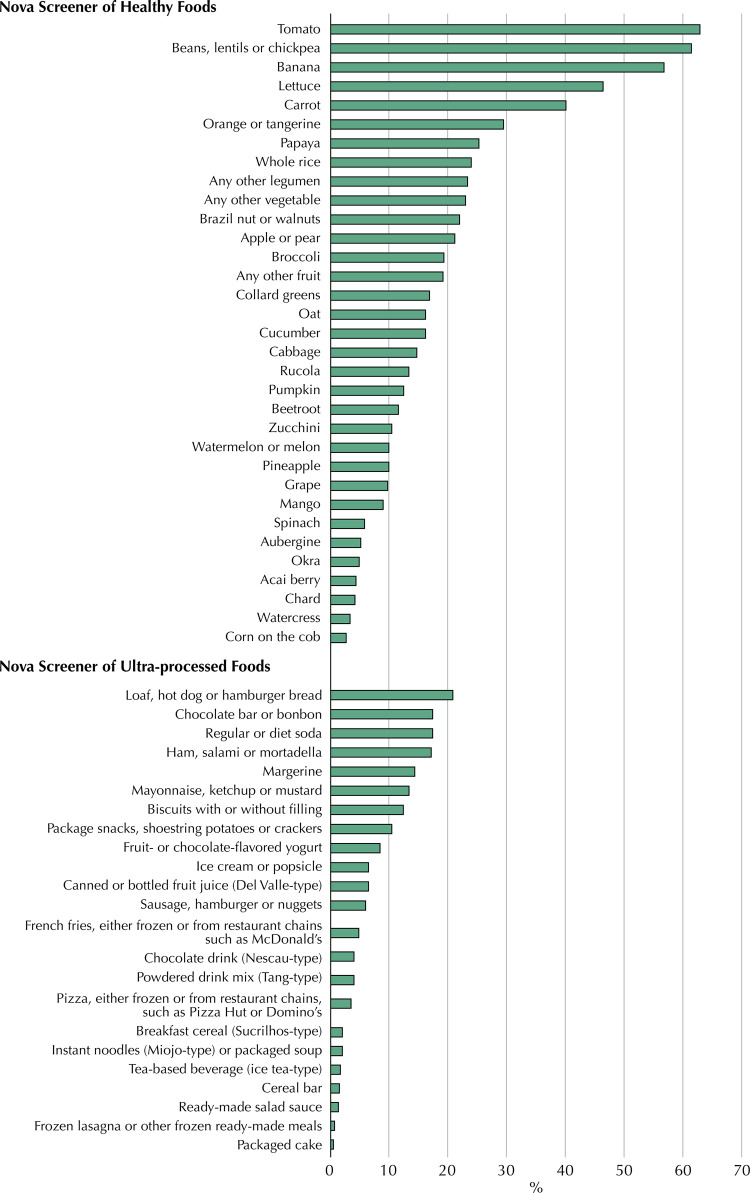
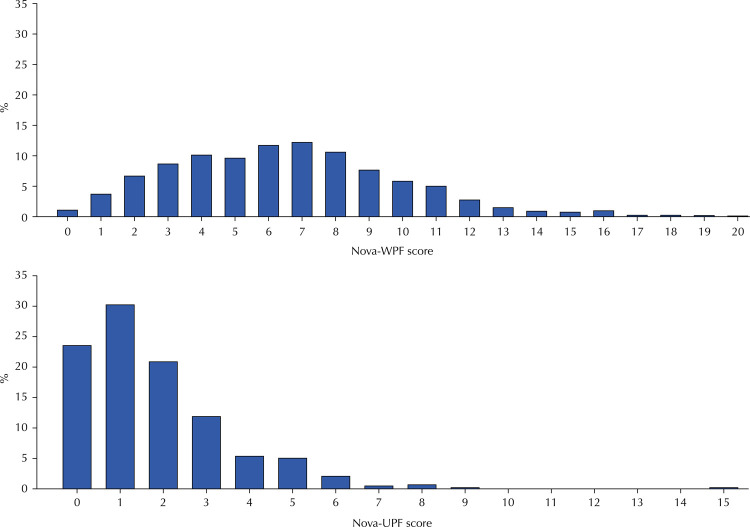
This cross-sectional study included data from the NutriNet-Brasil cohort. Participants answered the Nova24hScreener, a 3-minute self-administered questionnaire measuring the consumption of a set of foods on the day before. Food items included in this tool belong to two main groups of the Nova classification: unprocessed or minimally processed whole plant foods (WPF, 33 items) and ultra-processed foods (UPF, 23 items). Two scores were obtained by summing the number of items checked: the Nova-WPF and the Nova-UPF. We compared the scores, respectively, with the dietary intake (% of total energy) of all unprocessed or minimally processed whole plant foods and all ultra-processed foods obtained from a full self-administered web-based 24-hour recall performed on the same day.
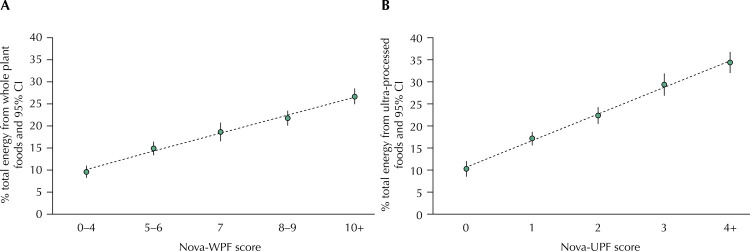
The approximate quintiles of each score had a direct and linear relationship with the corresponding % of energy intake (p-value for linear trend < 0.001). We found a substantial agreement between the intervals of each score and the corresponding % of energy intake (Nova-WPF score: Prevalence-Adjusted and Bias-Adjusted Kappa (PABAK) 0.72, 95%CI 0.64-0.81; Nova-UPF score: PABAK 0.79, 95%CI 0.69-0.88).
These two scores performed well against the dietary share of unprocessed or minimally processed whole plant foods and ultra-processed foods in Brazil and can be used to evaluate and monitor diet quality.
描述两种低负担的饮食质量评分,并评估它们在反映基于 Nova 食品系统分类定义的最少和最多加工食品的饮食份额方面的表现。
这是一项横断面研究,纳入了 NutriNet-Brasil 队列的数据。参与者回答了 Nova24hScreener,这是一种 3 分钟的自我管理问卷,用于测量前一天的一组食物的摄入量。该工具中包含的食物项目属于 Nova 分类的两个主要组:未加工或最低限度加工的植物性食物(WPF,33 种)和超加工食品(UPF,23 种)。通过将检查的项目数量相加,获得了两个评分:Nova-WPF 和 Nova-UPF。我们分别将这些评分与同日进行的完全基于网络的 24 小时回顾性调查中获得的所有未加工或最低限度加工的植物性食物和所有超加工食品的饮食摄入量(总能量的%)进行比较。
每个评分的近似五分位数与相应的能量摄入%呈直接和线性关系(线性趋势的 p 值<0.001)。我们发现每个评分的间隔与相应的能量摄入%之间存在实质性一致性(Nova-WPF 评分:调整后流行率和偏差调整后的 Kappa(PABAK)0.72,95%CI 0.64-0.81;Nova-UPF 评分:PABAK 0.79,95%CI 0.69-0.88)。
这两个评分在巴西对未加工或最低限度加工的植物性食物和超加工食品的饮食份额表现良好,可用于评估和监测饮食质量。