Faculty of Natural and Agricultural Sciences, Centre for Environmental Management, University of the Free State, PO Box 339, Bloemfontein, 9300, South Africa.
Centre for Mineral Biogeochemistry, University of the Free State, Bloemfontein, South Africa.
Environ Geochem Health. 2024 Nov 28;47(1):3. doi: 10.1007/s10653-024-02293-9.
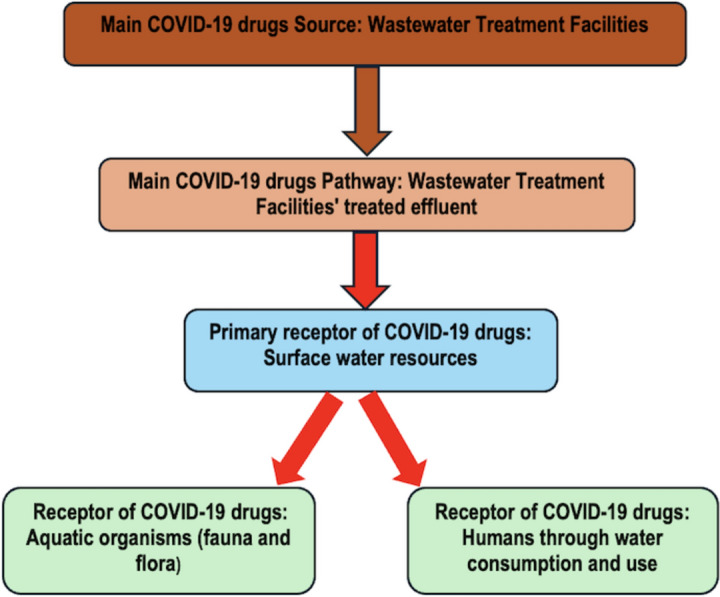
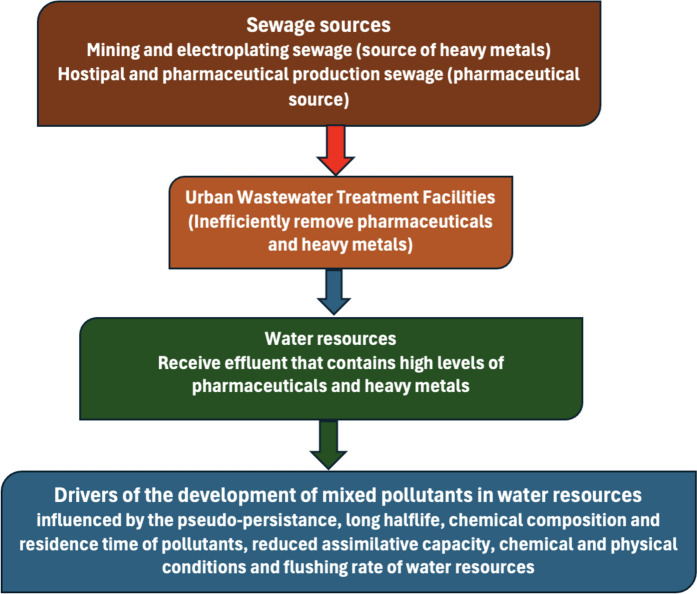
The outbreak of the coronavirus disease 2019 (Covid-19) led to the high consumption of antibiotics such as azithromycin as well as corticosteroids such as prednisone, prednisolone, and dexamethasone used to treat the disease. Seemingly, the concentrations of these four Covid-19 drugs increased in wastewater effluents and surface water resources. This is due to the failure of traditional wastewater treatment facilities (WWTFs) to eliminate pharmaceuticals from wastewater. Therefore, the objective of the current research was to review the present state of literature on the occurrence of four Covid-19 drugs in water resources, the associated risks and toxicity, their fate, as well as the emergence of combined pollutants of Covid-19 drugs and heavy metals. From late 2019 to date, azithromycin was observed at concentrations of 935 ng/L, prednisone at 433 ng/L, prednisolone at 0.66 ng/L, and dexamethasone at 360 ng/L, respectively, in surface water resources. These concentrations had increased substantially in water resources and were all attributed to pollution by wastewater effluents and the rise in Covid-?19 infections. This phenomenon was also exacerbated by the observation of the pseudo-persistence of Covid-19 drugs, long half-life periods, as well as the excretion of Covid-19 drugs from the human body with about 30?90% of the parent drug. Nonetheless, the aquatic and human health toxicity and risks of Covid-19 drugs in water resources are unknown as the concentrations are deemed too low; thus, neglecting the possible long-term effects. Also, the accumulation of Covid-19 drugs in water resources presents the possible development of combined pollutants of Covid-19 drugs and heavy metals that are yet to be investigated. The risks and toxicity of the combined pollutants, including the fate of the Covid-19 drugs in water resources remains a research gap that undoubtably needs to be investigated.
2019 年冠状病毒病(COVID-19)的爆发导致阿奇霉素和泼尼松、泼尼松龙、地塞米松等用于治疗该疾病的皮质类固醇等抗生素的高消耗。显然,这四种 COVID-19 药物的浓度在废水和地表水资源中增加。这是由于传统废水处理设施(WWTF)未能从废水中消除药物。因此,当前研究的目的是审查有关 COVID-19 药物在水资源中出现的文献现状、相关风险和毒性、它们的命运以及 COVID-19 药物和重金属联合污染物的出现。自 2019 年底以来,在地表水资源中分别观察到阿奇霉素的浓度为 935ng/L、泼尼松的浓度为 433ng/L、泼尼松龙的浓度为 0.66ng/L、地塞米松的浓度为 360ng/L。这些浓度在水资源中大幅增加,均归因于废水排放和 COVID-19 感染的增加造成的污染。这种现象也因 COVID-19 药物的假持久性、半衰期长以及 COVID-19 药物从人体排泄约 30%-90%的母体药物而加剧。尽管如此,由于浓度被认为太低,COVID-19 药物在水资源中的水生和人类健康毒性和风险尚不清楚,从而忽略了可能的长期影响。此外,COVID-19 药物在水资源中的积累可能会产生 COVID-19 药物和重金属的联合污染物,这有待进一步研究。联合污染物的风险和毒性,包括 COVID-19 药物在水资源中的命运,仍然是一个研究空白,无疑需要进行调查。